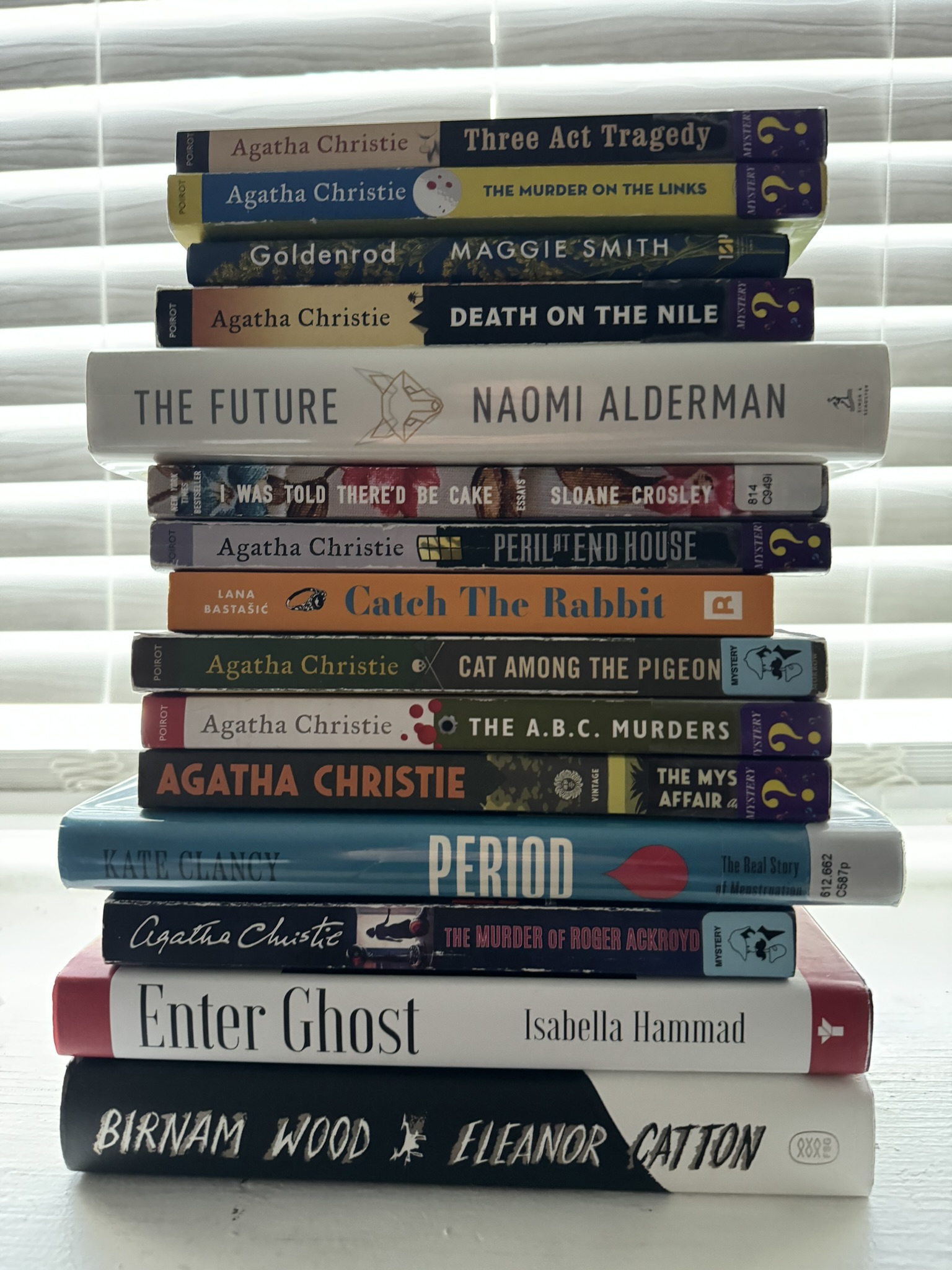
I’ve always been a reader, although my reading has tended to be done in spurts. Read a bunch in a condensed period of time and then read nothing for awhile. The last couple of years I’ve been more consistent, reaching the point where now I always seem to have a book, if not multiple, in progress.
After a race to hit an arbitrary target number by the end of 2023, a pursuit bolstered by getting COVID over the holidays, my reading muscles are in peak condition. Still, the number of books I finished in January 2024 surprises me. Colder weather and the tail end of COVID recovery helped me reach fifteen books read during the month, and only one of them, a small book of poetry, might look like number-padding.
Unlike my moviegoing, which is influenced a lot by the commercial and repertory release calendars, there’s not much intentionality involved with determining what I read when. But that ‘s what can be fun. I wander and end up somewhere I couldn’t have anticipated. A comment in one book may inspire one of my next choices. Last year a mention of a Jack London novel in a Whit Stillman monograph led me to Martin Eden. I read Agatha Christie’s By the Pricking of My Thumbs and Ray Bradbury’s Something Wicked This Way Comes back-to-back because having the titles in that order on my list amused me. A topic or a title in a podcast, news article, or social media post might spark my interest. I may just randomly find something at the library or decide that it’s time I give my attention to a book that’s been on my shelf for years.
Of January’s reads, only the first two were “planned,” by which I mean they were novels I hadn’t found time for in 2023 and decided it was their turn. I didn’t intend for all the books I read last month to be written by women, but after the first few, I thought why not? I also didn’t plan to go on such an Agatha Christie kick, but I did and don’t see that pattern abating. (It doesn’t hurt that I can read her mysteries exceptionally quickly.) I don’t expect that I’ll continue reading at a pace of a book about every two days, in part because there are some long and more complicated books I want to tackle.
Anyway, this is all a preamble to me jotting down brief thoughts about what I’ve read. I’m not interested in writing down extensive impressions about everything, but I figured I might be motivated to crank out a sentence or two for each book. If you think these insights lack depth, I agree! (It would help if I had tweeted something after finishing each. I’ll try to do better next time.) I’ve also posted my 2022 reading list and 2023 reading list if they are of interest. If not, at least I know I have them in another place for my own reference.
January 2004 Reading List

Birnam Wood (Eleanor Catton, 2023)
An American tech billionaire building a doomsday bunker in New Zealand and a leftist ecological collective become unlikely partners in a highly entertaining thriller and satire. Internal group politics are sharply observed, especially in examining what happens when pure ideology rubs against personal needs, desires, and practicalities. Catton’s facility with language elevates this above nuts-and-bolts genre fiction while remaining a gripping page-turner.

Enter Ghost (Isabella Hammad, 2023)
Hammad’s The Parisian or Al-Barisi was one of the best books I read in 2023, and her follow-up may be even better. I was deeply moved by the crescendo to the novel’s final words. An actress visits her sister in Haifa and becomes involved in a production of Hamlet to be staged in the West Bank, leading her to reexamine what it has meant for those who remained after 1948 and those who left. The defiance and hope that arise in the book might seem naive, particularly while reading this as the news of human atrocities in Gaza surface every day, but without them, how could one continue to press on?

The Murder of Roger Ackroyd (Agatha Christie, 1926) - includes “A Letter to My Publisher” (1936) and “Creating Poirot” (1938)
I enjoyed reading Agatha Christie books as a kid–very fashionable, right?–and had this interest rekindled at the 2019 Toronto International Film Festival upon seeing Rian Johnson’s Knives Out and the Johnson-introduced screening of The Last of Sheila. This is widely considered one of her best, a sentiment I agree with.

Period: The Real Story of Menstruation (Kate Clancy, 2023)
I was expecting more anthropology and less science than what this turns out to contain, which is not a criticism of the book that was written but rather a note of my expectations. The history and anthropology about women’s health made for more compelling reading, especially in light of today’s political environment.. Of course the science matters and is not a separate thing from how the subject is treated in the public arena. Some of it just seemed a bit over my head.

The Mysterious Affair at Styles (Agatha Christie, 1920)
Christie’s first published novel, which also introduces the detective Hercule Poirot, displays an Arthur Conan Doyle influence, particularly Poirot’s Hastings as a Watson-like narrator. This is a solid start to what became an unbelievably successful career for the author. I’m not reading the Poirot books in order, which doesn’t seem necessary and is too much trouble when borrowing from the library, but even as I bounce around, it’s interesting to note how her style adapts and how she references earlier books in later ones but not at the expense of spoiling the outcomes.

The A.B.C. Murders (Agatha Christie, 1936)
If all of the serial killer films, TV shows, and books don’t owe a debt to this, I would be shocked. This mystery features good dramatic momentum and, as usual, a resolution that I didn’t see coming. For what it’s worth, I don’t read Christie’s mysteries to try to crack the cases, although maybe after I’ve read enough of them I’ll detect a pattern. Or not.

Cat Among the Pigeons (Agatha Christie, 1959)
Rex Reed griped about being forty-five minutes into The Tree of Life with no sign of Brad Pitt, so I want to joke about no Poirot on the scene until relatively late into Cat Among the Pigeons. Murder and intrigue at a boarding school for girls make for a solid mystery.

Catch the Rabbit (Uhvati zeca) (Lana Bastašić, 2018) - (Translated from Serbian-Croatian by the author)
I’m sure some of the shadings here are lost on me. Sorry, I’m not up to speed on all the intricacies involved with the break-up of Yugoslavia and the post-war fallout. Knowing that may make for a richer read, but without that footing I was impressed with how Bastašić examines a friendship that fell out, the narratives that both women constructed about their relationship, and how these carried stories clash during a reunion road trip many years later.

Peril at End House (Agatha Christie, 1932)
If you approach these mysteries solely as tests to be solved, this one will likely disappoint because I don’t think it’s likely you can figure it out before the reveal. The setting and cast of characters feels a bit small, but Christie includes enough twists and turns to keep things moving along nicely.

I Was Told There’d Be Cake (Sloane Crosley, 2008)
As a lifelong Midwesterner, I suppose it is inevitable that I felt a certain amount of animus building toward a collection of comedic essays about life as a privileged (or seemingly privileged) twentysomething in New York City. To Crosley’s credit, I think she uses self-deprecation in these stories (and the title) to signal awareness, and not in an overcompensating way, of whatever advantages she’s had. (Bonus observation: I’ve also read Crosley’s two novels and would put The Clasp at the top.)

The Future (Naomi Alderman, 2023)
This zeitgeist-y book shares some overlapping elements with Birnam Wood–namely tech billionaire schemes–but its near-future setting veers more into the science fiction realm with thinly veiled riffs on contemporary figures and companies. Elizabeth Hand called it “immensely readable if frustrating” in a Washington Post review that tidily sums up my experience with The Future. To me there seems to be a big thematic contradiction in what the book calls for and how it is achieved. I’ll also note that this is the first time I recall seeing the book equivalent of a film putting a scene in the middle of the end credits. On top of that there’s also a page with an e-mail address that you can write to and get a small piece of information that fills in an important unaddressed gap in the book.

Death on the Nile (Agatha Christie, 1937)
I thought the Kenneth Branagh film adaptation was dull when seeing it in the theater, but maybe I need to give it another chance because the book is quite good. Then again, Branagh changes and cuts some characters while still retaining the resolution of the whodunit component. Notably, the book does not feature any backstory about Poirot’s mustaches, something I assume was invented for the screen.

Goldenrod (Maggie Smith, 2021)
I don’t have much experience reading poetry, but I enjoyed the Columbus-based poet’s collection, which often touches on political frustrations, the challenges of parenthood, and a failing marriage.

The Murder on the Links (Agatha Christie, 1923) - includes “Agatha Christie on Poirot’s Favorite Cases” (1938)
Less to do with golf than the title might lead you to expect. (The victim’s body is found on a golf course.) It’s probably worth reading this one early on, if simply to better understand a detail about Hastings’ life that is mentioned in other books.

Three Act Tragedy (Agatha Christie, 1934)
Two unexpected deaths at dinner parties lead to a third get-together being thrown in an attempt to catch the killer. I’ve been impressed with how Christie plays with form. She’s not rewriting virtually the same thing every time. The plot and/or economy of characters may be on the thin side for this concept, though, even as I enjoyed seeing the author do something different.
In-progress
The Arabian Nights: Tales of 1001 Nights: Volume 1 - translation by Malcolm C. Lyons (2008)
I was looking through the Penguin Classics list to spur ideas of what to read and decided this looked interesting. Which it better be because at 982 pages, it is a commitment. Not to mention that there are two additional volumes of approximately equal length if one is to polish off all of these tales. So far, so good. I have been surprised by how risqué some of these tales are.
The One Year Bible: New Living Translation (2004)
I’ve tried this project before and come up far short, but as I’m reading more right now, the time seems right to try again. This book breaks up the Bible into daily readings from the Old Testament, New Testament, Psalms, and Proverbs. Ideally I’d read a little every day, per the text’s organization, but in reality I will read a few (or more) days at a time depending on if I get behind. This month delivered a neat bit of synchronicity in reading the story of Lot, which also plays a thematic role in The Future.


