This is another post filed under "and other ephemera", so consider yourself warned if you're looking for a lot of movie-related content. I haven't been to a theater since November 18, which might as well be considered a fast considering it's easily the longest movie-free stretch I've had all year. (If one wants to get all technical, which my brothers would surely insist upon doing, I have seen snatches of the DVDs playing on the team bus, although I've ignored most of those choices except for getting pulled into NAPOLEON DYNAMITE occasionally.)
Yesterday was a long day on the road from Memphis to Lexington. The experience must be akin to being on tour. When I arrive home, I'll have spent seven consecutive nights in seven different cities that span five states.
I've been surprised that all five hotels have provided free high-speed internet connections. Except for the one in Memphis, all of them have been wireless too. I suppose it's a necessity these days if you want to attract customers.
I don't travel a lot, but one thing I've noticed from these stays is that the size of the rooms are inversely proportional to the size of the cities. For instance, my room in Memphis was, at best, half the size of my room in Sulphur Springs, Texas. Biggest city, smallest accommodations. It makes sense, but I'd never given it any thought.
It's always nice to meet people you "know" but have never actually met--people you converse with in discussion groups but might not recognize if they were sitting next to you--and I had the good fortune to do that on Monday. Noel Murray and Donna Bowman are Arkansas-based critics. Both write for the Nashville Scene, and Noel's work can also be found in The Onion's AV Club. They were gracious enough to take me to dinner at a local Mexican place, a nice change of pace from a travel diet mostly consisting of fast food and continental breakfasts. The time we had was too short--I needed to get to Hendrix College to do the radio broadcast of Otterbein's basketball game--but it was my pleasure getting to meet them.
The last game is tonight at Transylvania University. If you must know, I probably won't be able to resist making at least one vampire joke. All this time away has probably been a good purging of all the cinema I've absorbed during 2005, making room for the onslaught that December brings. This year I'm receiving a fair number of "for your consideration" screeners, which are on top of the regular crop of theatrical moviegoing, so a break is good for hunkering down to make it through awards season.
(Addendum: My Otterbein basketball three-game recap is now online, for those so inclined.)
Wednesday, November 30, 2005


Monday, November 28, 2005
Arkansas blogging
Surprise, I'm not dead, although my virtual disappearance from this space might have led some to think so. I've been on the road for a little more than a week and only now have gathered the time to make some much-needed updates here.
I flew into Dallas-Fort Worth early in the morning on November 20 and was there with family until the day after Thanksgiving. Then I drove to Georgetown, Texas to handle sports information duties and broadcast two basketball games. Being so close to Austin--about 30 miles north--I had to venture into the city on my one night there.
Actually, a more apt description is around the city. The highway system in Texas can be confusing, what with roads seemingly having two or three names yet displaying little signage. My AAA directions didn't quite make the cut when it came to getting me everywhere I needed to be, but I'm not too proud to stop and ask at gas stations if I think I'm lost. (I was off course a couple times. Good job Austin-area gas station attendants knowing how to get me back on track.)
My destination was a Kelly Willis concert at One World Theatre. The unique venue is styled like a Tuscan villa and tucked into the hills of west Austin. The performance area is on the top floor. It's a terrific, intimate space to see live music. Kelly was playing two concerts, an impressive feat considering that she is in the latter stages of pregnancy. I caught the "late" (9:30 p.m.) concert, which will be her last performance until she gives birth. (That sentence sounds kind of strange, but I can't think of any other way to put it, unintended humor notwithstanding.)
I've seen her play live many times but never in her hometown. The concert wasn't significantly different, although the local audience, more accustomed to seeing her, seemed more respectful--in other words, not yelling out requests--than midwestern and eastern concertgoers who may get to see her every two years. The one bonus in seeing Kelly play in Austin is that her husband, Bruce Robison, came out and did a mini-set with her and the band. The country couple have regularly done holiday shows--not this year for obvious reasons--and stirred up a little of the seasonal spirit with a few wintry, Christmastime songs, including a playful "Baby, It's Cold Outside". (As Kelly remarked afterwards, the song works better if you don't think about her being pregnant.)
A One World Theatre usher offered up easier directions to get me back to my hotel, although she qualified such a route as "the long way". Was it ever. I stopped at a 7-11 on Highway 620 about two blocks before the I-35 ramp because I thought I must have missed something. In retrospect, it's a good thing I checked because I didn't see any signs indicating freeway entrance ramps.
After the game on Saturday night, I hopped on the bus with the team and rode to an overnight stay in Sulphur Springs, Texas. We arrived around 2:00 a.m. and had to stand outside while the front desk clerk verified that we were who we claimed to be. I'm assuming it's a necessary safety measure, albeit an irritating one for guests trying to check in. As I've found in my travels, you pay less in the boondocks and get nicer rooms. I had a suite, which was unnecessary since I'd be sleeping for six or seven hours and then leaving. I'm exaggerating when I call it the loneliest hotel room in the world, but considering the hinterland location and the closed restaurant next to the inn (apparently the former location of the adjacent new restaurant), it seemed like the sort of place one might go if running from the law but end up getting shot. Like I said, I'm exaggerating. It would have had to be much, much dingier--this place wasn't dingy at all--and smaller, so indulge my fantasy. Blame it on seeing too many movies.
The trip then led me to Conway, Arkansas, where I sit writing this in the lobby of a Super 8 while the team has practice. I found one of the NFL telecasts to catch up on the day's action and was treated to regular interruptions for updates about the tornado warnings for the area. With my exquisite view of the highway and the foreboding sky, I could see that the weathermen weren't fooling around. It rained cats and dogs. A twister touched down somewhere in these parts, although not especially close to where I am.
I have a raft of reviews to post when I get the chance, and since I know an empty day awaits me in Lexington, they'll probably get here sooner than later. I'll also have some photos to illustrate this entry when I return home.
I flew into Dallas-Fort Worth early in the morning on November 20 and was there with family until the day after Thanksgiving. Then I drove to Georgetown, Texas to handle sports information duties and broadcast two basketball games. Being so close to Austin--about 30 miles north--I had to venture into the city on my one night there.
Actually, a more apt description is around the city. The highway system in Texas can be confusing, what with roads seemingly having two or three names yet displaying little signage. My AAA directions didn't quite make the cut when it came to getting me everywhere I needed to be, but I'm not too proud to stop and ask at gas stations if I think I'm lost. (I was off course a couple times. Good job Austin-area gas station attendants knowing how to get me back on track.)
My destination was a Kelly Willis concert at One World Theatre. The unique venue is styled like a Tuscan villa and tucked into the hills of west Austin. The performance area is on the top floor. It's a terrific, intimate space to see live music. Kelly was playing two concerts, an impressive feat considering that she is in the latter stages of pregnancy. I caught the "late" (9:30 p.m.) concert, which will be her last performance until she gives birth. (That sentence sounds kind of strange, but I can't think of any other way to put it, unintended humor notwithstanding.)
I've seen her play live many times but never in her hometown. The concert wasn't significantly different, although the local audience, more accustomed to seeing her, seemed more respectful--in other words, not yelling out requests--than midwestern and eastern concertgoers who may get to see her every two years. The one bonus in seeing Kelly play in Austin is that her husband, Bruce Robison, came out and did a mini-set with her and the band. The country couple have regularly done holiday shows--not this year for obvious reasons--and stirred up a little of the seasonal spirit with a few wintry, Christmastime songs, including a playful "Baby, It's Cold Outside". (As Kelly remarked afterwards, the song works better if you don't think about her being pregnant.)
A One World Theatre usher offered up easier directions to get me back to my hotel, although she qualified such a route as "the long way". Was it ever. I stopped at a 7-11 on Highway 620 about two blocks before the I-35 ramp because I thought I must have missed something. In retrospect, it's a good thing I checked because I didn't see any signs indicating freeway entrance ramps.
After the game on Saturday night, I hopped on the bus with the team and rode to an overnight stay in Sulphur Springs, Texas. We arrived around 2:00 a.m. and had to stand outside while the front desk clerk verified that we were who we claimed to be. I'm assuming it's a necessary safety measure, albeit an irritating one for guests trying to check in. As I've found in my travels, you pay less in the boondocks and get nicer rooms. I had a suite, which was unnecessary since I'd be sleeping for six or seven hours and then leaving. I'm exaggerating when I call it the loneliest hotel room in the world, but considering the hinterland location and the closed restaurant next to the inn (apparently the former location of the adjacent new restaurant), it seemed like the sort of place one might go if running from the law but end up getting shot. Like I said, I'm exaggerating. It would have had to be much, much dingier--this place wasn't dingy at all--and smaller, so indulge my fantasy. Blame it on seeing too many movies.
The trip then led me to Conway, Arkansas, where I sit writing this in the lobby of a Super 8 while the team has practice. I found one of the NFL telecasts to catch up on the day's action and was treated to regular interruptions for updates about the tornado warnings for the area. With my exquisite view of the highway and the foreboding sky, I could see that the weathermen weren't fooling around. It rained cats and dogs. A twister touched down somewhere in these parts, although not especially close to where I am.
I have a raft of reviews to post when I get the chance, and since I know an empty day awaits me in Lexington, they'll probably get here sooner than later. I'll also have some photos to illustrate this entry when I return home.
Sunday, November 06, 2005
Kelly Willis in concert at The Ark

Kelly Willis at The Ark in Ann Arbor, MI (Mark Pfeiffer/November 3, 2005)
More comments to come, but for now here are some photos and the setlist...
1. If I Left You
2. Find Another Fool
3. Get Real
4. Wrapped
5. Take Me Down
6. Getting To Me
7. Heaven's Just a Sin Away
8. Easy
9. Heaven Bound
10. Not Forgotten You
11. What Did You Think
12. Take It All Out On You
13. What World Are You Living In
14. River of Love
15. What I Deserve
16. Fading Fast
17. Got a Feeling For Ya
18. I'll Try Again
19. Whatever Way the Wind Blows
Encore:
20. Reason To Believe

Kelly Willis and band

Kelly Willis

Kelly Willis during the encore
Wednesday, October 26, 2005
An Evening with Steve Buscemi
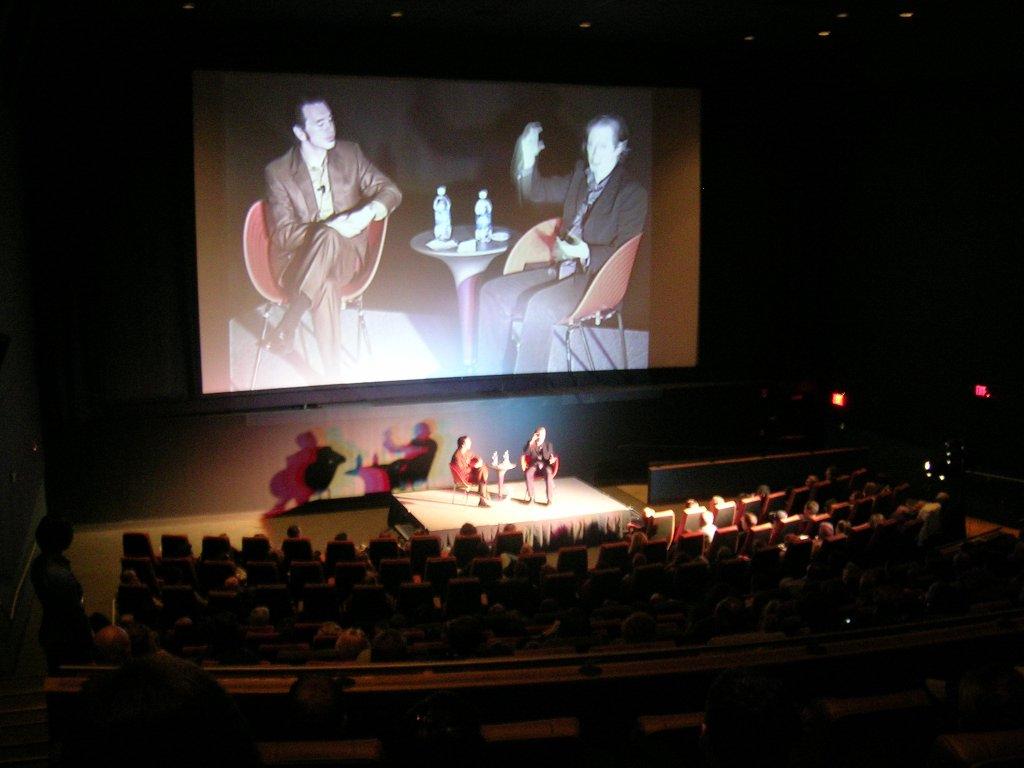
A view from the top of the post-LONESOME JIM Q&A with Steve Buscemi (Mark Pfeiffer/October 26, 2005)
The Drexel Gateway Theater opened its doors to VIPs and the paying public for the first time tonight. (Proceeds from the event will go to ABATE--American Bikers Aimed Toward Education--and their Firefighters for Kids 18th Annual Toy Run.) The attraction was a screening of LONESOME JIM, the third feature film directed by Steve Buscemi. The noted character actor was also in attendance, a visit aided by the fact that Buscemi's wife hails from Hilliard.
Casey Affleck plays the weary and depressed title character, an aspiring writer in his late twenties who returns to his parents' Indiana home after his time in Manhattan produced nothing more than walking dogs for a living. Buscemi's direction proves him adept at capturing the details of rural midwestern life and finding a dry sense of humor amid the dissatisfaction and disappointment dragging Jim down. LONESOME JIM has a surprisingly light touch despite the heavier emotional tone. Although the film is full of sadness and despair, it still holds out hope that people are decent and all will turn out well in the end. It's a good film and worth looking for when it is released next spring.
The moderator asked a couple questions to kick off the post-film Q&A, but audience members had ample opportunities to ask Buscemi what their hearts desired. He humored the inevitable (and impolite) "why did you do that" question--there's one in every crowd--when asked if he regretted making CON AIR. Buscemi explained that he had fun, got to work with other interesting actors, and could help fund smaller, more personal projects with the payday he gets from appearing in bigger movies. It's worth remembering that very few actors are raking in $20 million a picture, so it's understandable why Buscemi or any other performer below the title would make some films less artistically minded than the indies that garner acclaim but pay squat. If being in CON AIR lets him direct small films he feels passionately about, where's the harm in it?

The new Drexel Gateway Theater (Mark Pfeiffer/October 26, 2005)
My first impression of the new Drexel Gateway is very positive. The seats are very comfortable, and there's plenty of leg room in the aisles. The auditoriums are plusher than I expected. This should be an excellent place to see movies. Parking around the Ohio State campus can be problematic, but a garage directly behind the theater is convenient and cheaper than anywhere else in the area unless you can snag a spot along the street somewhere in the neighborhood and are willing to hoof it.
A History of Violence
A HISTORY OF VIOLENCE (David Cronenberg, 2005)
Millbrook, Indiana is the picture of idyllic small town America that exists in Norman Rockwell paintings and TV sitcoms of the 1950s. In A HISTORY OF VIOLENCE, trouble enters this peaceful burg when two criminal outsiders slink into a diner and try to rob it. Tom Stall (Viggo Mortensen), the soft-spoken diner owner, saves the day when he kills the bad guys in defense of his employees and customers.
Naturally the incident attracts a lot of attention from local media, but it also catches the eye of Philadelphia crime boss Richie Cusack (William Hurt). He believes that Tom is his long-lost brother Joey, a thug renowned for his brutality. Richie sends a crew to Millbrook to confirm that Tom is Joey and, if so, to bring him back to Pennsylvania.
Like a dormant virus, the propensity for violence is hidden until the proper conditions are realized in David Cronenberg’s film. When brought to the surface, the violence is unleashed in rapid bursts of fury. To illustrate the immediacy with which violent impulses are summoned, Cronenberg switches from the film’s restrained pace to quick cuts during the bloodshed.
A HISTORY OF VIOLENCE posits that such aggressive behavior lurks within everyone but remains masked most of the time. Cronenberg has the characters engage in role-playing in their everyday lives. They behave according to the norms and hierarchy in society, giving the director the chance to explore the purpose artifice and façade serve in personal and community relationships.
Like FAR FROM HEAVEN, A HISTORY OF VIOLENCE takes nostalgic ideas of the so-called good old days and exposes the truth of human behavior that such rosy views obscure.
Grade: B+
Millbrook, Indiana is the picture of idyllic small town America that exists in Norman Rockwell paintings and TV sitcoms of the 1950s. In A HISTORY OF VIOLENCE, trouble enters this peaceful burg when two criminal outsiders slink into a diner and try to rob it. Tom Stall (Viggo Mortensen), the soft-spoken diner owner, saves the day when he kills the bad guys in defense of his employees and customers.
Naturally the incident attracts a lot of attention from local media, but it also catches the eye of Philadelphia crime boss Richie Cusack (William Hurt). He believes that Tom is his long-lost brother Joey, a thug renowned for his brutality. Richie sends a crew to Millbrook to confirm that Tom is Joey and, if so, to bring him back to Pennsylvania.
Like a dormant virus, the propensity for violence is hidden until the proper conditions are realized in David Cronenberg’s film. When brought to the surface, the violence is unleashed in rapid bursts of fury. To illustrate the immediacy with which violent impulses are summoned, Cronenberg switches from the film’s restrained pace to quick cuts during the bloodshed.
A HISTORY OF VIOLENCE posits that such aggressive behavior lurks within everyone but remains masked most of the time. Cronenberg has the characters engage in role-playing in their everyday lives. They behave according to the norms and hierarchy in society, giving the director the chance to explore the purpose artifice and façade serve in personal and community relationships.
Like FAR FROM HEAVEN, A HISTORY OF VIOLENCE takes nostalgic ideas of the so-called good old days and exposes the truth of human behavior that such rosy views obscure.
Grade: B+
An Unfinished Life
AN UNFINISHED LIFE (Lasse Hallström, 2005)
Single mother Jean Gilkyson (Jennifer Lopez)runs from an abusive boyfriend in AN UNFINISHED LIFE. With nowhere else to turn, she goes to the Wyoming home of her father-in-law Einar (Robert Redford). He still holds Jean responsible for the accidental death of his son—her husband—that happened more than a decade ago. Their relationship has been so frayed that Einar never knew he had a granddaughter. Also living with Einar is Mitch, a ranch hand played by Morgan Freeman. Mitch was mauled by a bear, and out of friendship and guilt, Einar cares for him. AN UNFINISHED LIFE brings these wounded individuals together with the anticipation of healing.
AN UNFINISHED LIFE is an affecting demonstration of the enormous impact forgiveness can have on oneself and others. Director Lasse Hallström’s Oscar-bait films, such as THE CIDER HOUSE RULES and CHOCOLAT, tend to have sentiment thickly applied, but AN UNFINISHED LIFE’S story of redemption is told with restraint. The film is old-fashioned in the best sense of the word. The characters’ emotional scars are old and deep, and the film grants time for changes to occur gradually. Aside from the abusive boyfriend, who pops up briefly, AN UNFINISHED LIFE is a film without a villain. The forces harming the characters’ lives are internal, not some external figure. Once they come to this realization, their lives are transformed. Jean learns to stand up for herself. Einar lets go of his anger and self-pity.
None of this is especially surprising, but it gains power through the cast’s uniformly solid performances. Lopez again shows that she’s a capable actress when she’s not being a diva. Redford lends great poignancy to the softening of his grizzled farmer’s bitterness. One more time Freeman is the film’s voice of reason, providing a steadying influence in stormy conditions. As Jean’s daughter Griff, Becca Gardner holds her own with these veterans.
Grade: B
Single mother Jean Gilkyson (Jennifer Lopez)runs from an abusive boyfriend in AN UNFINISHED LIFE. With nowhere else to turn, she goes to the Wyoming home of her father-in-law Einar (Robert Redford). He still holds Jean responsible for the accidental death of his son—her husband—that happened more than a decade ago. Their relationship has been so frayed that Einar never knew he had a granddaughter. Also living with Einar is Mitch, a ranch hand played by Morgan Freeman. Mitch was mauled by a bear, and out of friendship and guilt, Einar cares for him. AN UNFINISHED LIFE brings these wounded individuals together with the anticipation of healing.
AN UNFINISHED LIFE is an affecting demonstration of the enormous impact forgiveness can have on oneself and others. Director Lasse Hallström’s Oscar-bait films, such as THE CIDER HOUSE RULES and CHOCOLAT, tend to have sentiment thickly applied, but AN UNFINISHED LIFE’S story of redemption is told with restraint. The film is old-fashioned in the best sense of the word. The characters’ emotional scars are old and deep, and the film grants time for changes to occur gradually. Aside from the abusive boyfriend, who pops up briefly, AN UNFINISHED LIFE is a film without a villain. The forces harming the characters’ lives are internal, not some external figure. Once they come to this realization, their lives are transformed. Jean learns to stand up for herself. Einar lets go of his anger and self-pity.
None of this is especially surprising, but it gains power through the cast’s uniformly solid performances. Lopez again shows that she’s a capable actress when she’s not being a diva. Redford lends great poignancy to the softening of his grizzled farmer’s bitterness. One more time Freeman is the film’s voice of reason, providing a steadying influence in stormy conditions. As Jean’s daughter Griff, Becca Gardner holds her own with these veterans.
Grade: B
Proof
PROOF (John Madden, 2005)
In PROOF long-suffering daughter Catherine (Gwyneth Paltrow) cares for her brilliant, mentally ill father Robert (Anthony Hopkins). Catherine’s dad was a mathematical genius, but his final years have been marked with insanity that left him unable to work. PROOF begins the night before Robert’s funeral, a time that causes Catherine to wonder about her own mental health and if her father’s affliction runs in the family.
Math can confirm many things, but it can’t prove that love exists or how much of it there is. Such is the dilemma in PROOF, an emotionally charged film that throbs like an open wound. Catherine cannot prove the most important things in her life, and it is ripping her apart. Paltrow’s inward performance is of a piece with her stunning work as Sylvia Plath in the biopic SYLVIA. Again she’s an intelligent, depressed woman, but what makes her performance as Catherine different is the physicality of it. She often doesn’t look at others in conversation and wraps her arms around herself, making tangible how wrapped up she is in her own mind. In PROOF Paltrow and her SHAKESPEARE IN LOVE director John Madden reteam for a dynamite actor’s showcase and depiction of the ravages of mental illness on the individual and the family.
(Review first aired in a modified version on the October 11, 2005 NOW PLAYING)
In PROOF long-suffering daughter Catherine (Gwyneth Paltrow) cares for her brilliant, mentally ill father Robert (Anthony Hopkins). Catherine’s dad was a mathematical genius, but his final years have been marked with insanity that left him unable to work. PROOF begins the night before Robert’s funeral, a time that causes Catherine to wonder about her own mental health and if her father’s affliction runs in the family.
Math can confirm many things, but it can’t prove that love exists or how much of it there is. Such is the dilemma in PROOF, an emotionally charged film that throbs like an open wound. Catherine cannot prove the most important things in her life, and it is ripping her apart. Paltrow’s inward performance is of a piece with her stunning work as Sylvia Plath in the biopic SYLVIA. Again she’s an intelligent, depressed woman, but what makes her performance as Catherine different is the physicality of it. She often doesn’t look at others in conversation and wraps her arms around herself, making tangible how wrapped up she is in her own mind. In PROOF Paltrow and her SHAKESPEARE IN LOVE director John Madden reteam for a dynamite actor’s showcase and depiction of the ravages of mental illness on the individual and the family.
(Review first aired in a modified version on the October 11, 2005 NOW PLAYING)
Oliver Twist
OLIVER TWIST (Roman Polanski, 2005)
Roman Polanski helms the latest cinematic adaptation of Charles Dickens’ OLIVER TWIST. Barney Clark stars as Oliver, an orphan who falls in with a group of boys who pick pockets on the London streets for their master. Ben Kingsley is Fagin, the devilish rogue who shows the boys kindness in exchange for their thieving.
With its handsome art direction and cinematography, Polanski’s OLIVER TWIST represents a triumph of formal design. It’s an impeccable production on a visual level and undeniably a well-made film, but the narrative often lacks the spark to bring it to life. The social commentary lingering from the source material grants Polanski some well-deserved potshots at those who believe Oliver should be grateful for even their most meager charity. Yet this airless adaptation chokes on its lack of freshness. A more interesting and relevant take on OLIVER TWIST might be to move it to the Brazilian slums in the explosive CITY OF GOD. OLIVER TWIST gradually improves, building to a climax in which Oliver pardons his oppressor, a scene that contains real power. Unfortunately, too much of the film lacks the same resonance.
Grade: C+
(Review first aired on the October 11, 2005 NOW PLAYING)
Roman Polanski helms the latest cinematic adaptation of Charles Dickens’ OLIVER TWIST. Barney Clark stars as Oliver, an orphan who falls in with a group of boys who pick pockets on the London streets for their master. Ben Kingsley is Fagin, the devilish rogue who shows the boys kindness in exchange for their thieving.
With its handsome art direction and cinematography, Polanski’s OLIVER TWIST represents a triumph of formal design. It’s an impeccable production on a visual level and undeniably a well-made film, but the narrative often lacks the spark to bring it to life. The social commentary lingering from the source material grants Polanski some well-deserved potshots at those who believe Oliver should be grateful for even their most meager charity. Yet this airless adaptation chokes on its lack of freshness. A more interesting and relevant take on OLIVER TWIST might be to move it to the Brazilian slums in the explosive CITY OF GOD. OLIVER TWIST gradually improves, building to a climax in which Oliver pardons his oppressor, a scene that contains real power. Unfortunately, too much of the film lacks the same resonance.
Grade: C+
(Review first aired on the October 11, 2005 NOW PLAYING)
In Her Shoes
IN HER SHOES (Curtis Hanson, 2005)
Toni Collette’s Rose has a loving but exasperating relationship with her party girl sister Maggie(Cameron Diaz) in IN HER SHOES. Aside from a shared fondness for footwear, the two couldn’t be more different. Rose is the practical one who works hard at the office and struggles to get and keep a man in her life. Maggie can barely hold down any job, choosing instead to exploit her genetic superiority to snag well-heeled men to support her. Eventually Rose has enough of Maggie’s freeloading and throws her out, leaving her to turn to a grandmother (Shirley MacLaine) neither of them know at all.
IN HER SHOES director Curtis Hanson again demonstrates his uncommon touch for storytelling with more of a literary approach. Working from Susannah Grant’s adaptation of Jennifer Weiner’s chick-lit novel, Hanson’s loose direction lets the film meander, to soak up the tone, while still hitting the pivotal yet familiar developments in the plot.
Diaz and Collette are playing types, but they are given room to embody the characters, frequently with surprising results. Diaz’s Maggie proves to be more than just a good-time girl, although discovering her deeper dimensions requires moving into a retirement community. Maggie could have easily been just an object of scorn and ridicule, but Diaz finds the complexity that makes her character relatable. Likewise, Collette doesn’t characterize Rose as a martyr or someone who has all the answers.
IN HER SHOES may not look much different than other female relationship films, but when faced with the choice to follow convention or not, it usually goes the other way. It’s practically a given that such a film will end with a wedding, but it’s a rarity, one found here, that such a scene will feel fresh. A funny, generous film with strong performances, IN HER SHOES redeems the often derogatory "chick flick" label.
Grade: B
Toni Collette’s Rose has a loving but exasperating relationship with her party girl sister Maggie(Cameron Diaz) in IN HER SHOES. Aside from a shared fondness for footwear, the two couldn’t be more different. Rose is the practical one who works hard at the office and struggles to get and keep a man in her life. Maggie can barely hold down any job, choosing instead to exploit her genetic superiority to snag well-heeled men to support her. Eventually Rose has enough of Maggie’s freeloading and throws her out, leaving her to turn to a grandmother (Shirley MacLaine) neither of them know at all.
IN HER SHOES director Curtis Hanson again demonstrates his uncommon touch for storytelling with more of a literary approach. Working from Susannah Grant’s adaptation of Jennifer Weiner’s chick-lit novel, Hanson’s loose direction lets the film meander, to soak up the tone, while still hitting the pivotal yet familiar developments in the plot.
Diaz and Collette are playing types, but they are given room to embody the characters, frequently with surprising results. Diaz’s Maggie proves to be more than just a good-time girl, although discovering her deeper dimensions requires moving into a retirement community. Maggie could have easily been just an object of scorn and ridicule, but Diaz finds the complexity that makes her character relatable. Likewise, Collette doesn’t characterize Rose as a martyr or someone who has all the answers.
IN HER SHOES may not look much different than other female relationship films, but when faced with the choice to follow convention or not, it usually goes the other way. It’s practically a given that such a film will end with a wedding, but it’s a rarity, one found here, that such a scene will feel fresh. A funny, generous film with strong performances, IN HER SHOES redeems the often derogatory "chick flick" label.
Grade: B
Doom
DOOM (Andrzej Bartkowiak, 2005)
The Rock leads a tactical fighting unit to a research base on Mars in DOOM. The station is locked down until the squad can locate and eliminate whatever is wreaking havoc. These elite fighters are loaded with weapons capable of dealing with whatever alien predators they may encounter. The compound even has a few extra-lethal guns stashed away for the cleverest to find.
DOOM originated as a first person shooter video game, but what makes such games fun to play does not translate into compelling viewing. The characters are merely slight variations of one another, with Rosamund Pike’s blonde scientist in the mix in to provide relief from all of the raging testosterone. Although the film spends an inordinate amount of time attempting to develop them, the results are the most boring cut scenes a gamer could watch. The Rock is wasted, employed more for his physical stature than his comedic abilities. A film this humorless is in bad need of the charisma he has demonstrated time and again, whether as a lead in THE RUNDOWN or as a supporting player in the dud BE COOL.
Considering that DOOM and other first person shooter games thrive on constant ammunition firing, there’s surprisingly little action for much of the film’s running time. Director Andrzej Bartkowiak, responsible for helming two of Jet Li’s worst American films, repeats scene after scene of the squad creeping around dark, dank corridors that lead only to brief engagements in combat. The action finally gets ratcheted up in the end, which includes the one noteworthy sequence: the game’s first person point of view with the gun bobbing in the lower center of the frame. Gamers would be better off playing DOOM or sitting in front of a blank screen than wasting time with this incredibly dull ALIENS rip-off.
Grade: F
The Rock leads a tactical fighting unit to a research base on Mars in DOOM. The station is locked down until the squad can locate and eliminate whatever is wreaking havoc. These elite fighters are loaded with weapons capable of dealing with whatever alien predators they may encounter. The compound even has a few extra-lethal guns stashed away for the cleverest to find.
DOOM originated as a first person shooter video game, but what makes such games fun to play does not translate into compelling viewing. The characters are merely slight variations of one another, with Rosamund Pike’s blonde scientist in the mix in to provide relief from all of the raging testosterone. Although the film spends an inordinate amount of time attempting to develop them, the results are the most boring cut scenes a gamer could watch. The Rock is wasted, employed more for his physical stature than his comedic abilities. A film this humorless is in bad need of the charisma he has demonstrated time and again, whether as a lead in THE RUNDOWN or as a supporting player in the dud BE COOL.
Considering that DOOM and other first person shooter games thrive on constant ammunition firing, there’s surprisingly little action for much of the film’s running time. Director Andrzej Bartkowiak, responsible for helming two of Jet Li’s worst American films, repeats scene after scene of the squad creeping around dark, dank corridors that lead only to brief engagements in combat. The action finally gets ratcheted up in the end, which includes the one noteworthy sequence: the game’s first person point of view with the gun bobbing in the lower center of the frame. Gamers would be better off playing DOOM or sitting in front of a blank screen than wasting time with this incredibly dull ALIENS rip-off.
Grade: F
Saturday, October 22, 2005
A Keane Conversation with Lodge Kerrigan
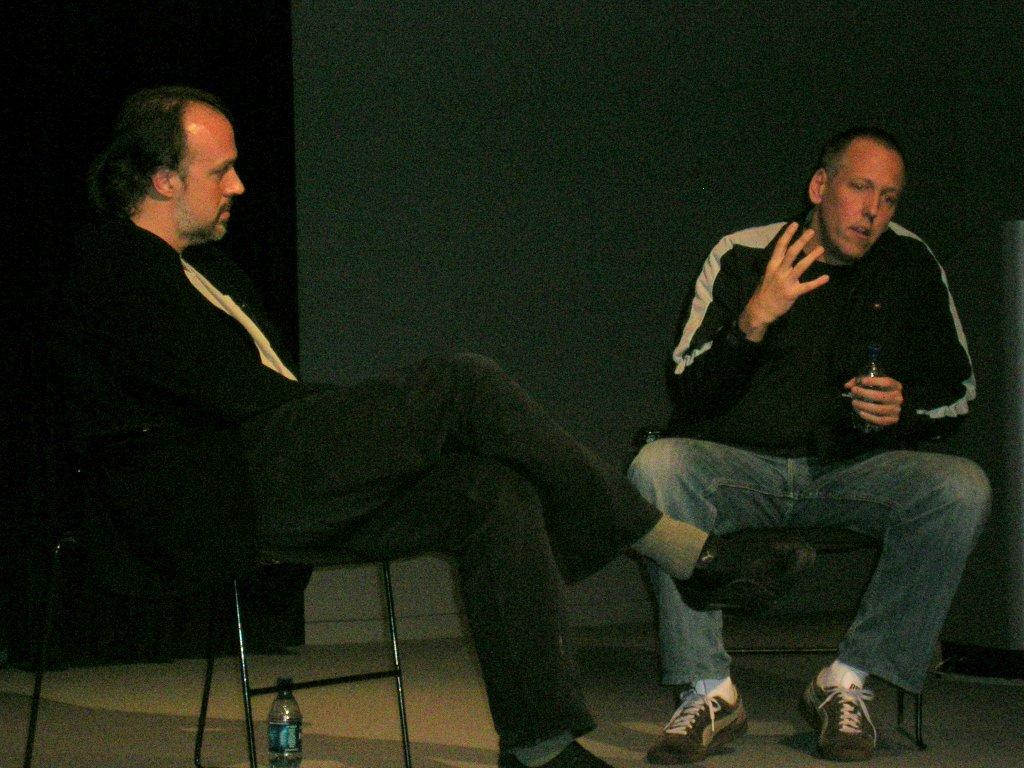
Film critic Kent Jones and director Lodge Kerrigan discuss KEANE at the Wexner Center (Mark Pfeiffer/October 21, 2005)

Lodge Kerrigan
In addition to introducing (and reintroducing) central Ohio cineastes to the best the film world has to offer, the Wexner Center also possesses an enviable record of bringing in the people who make the films. Capping their latest visiting filmmaker program was the area premiere of KEANE followed by Kent Jones' post-film discussion with director Lodge Kerrigan. (His other features, CLEAN, SHAVEN and CLAIRE DOLAN, screened last Friday. Unfortunately I was unable to attend.)
While I wouldn't rank KEANE among the year's best films, Kerrigan's rigorous and empathetic examination of a mentally ill man, intensely played by Damian Lewis, is recommended viewing.
Wednesday, October 19, 2005
The Lull
Allow me to make my periodic post apologizing for the lull generated by my lack of posting of late. The reasons aren't anything exotic: no avian flu or blockbuster deal with web portal. Rather, it's a combination of being exceptionally busy and desiring to tinker with reviews I've already written for television. The busy part has interfered with the plan to lengthen what I've already delivered on NOW PLAYING.
I'll get around to posting a few reviews soon, hopefully beginning after returning from the Antonoio Banderas ZORRO sequel that has taken an unusually long amount of time to get to the screen. (Maybe it isn't so unusual. This year has turned up follow-up films arriving several years after their forebears [DEUCE BIGALOW: EUROPEAN GIGOLO, MISS CONGENIALITY 2].) Then again, I'm going to have the latest episode of LOST waiting on the DVR when I get home.
This time might as well be as good a time as any for an unscientific study. If you're a regular reader of this blog--and I hope you are--please feel free to let me know you're out there, what brought you here in the first place, what keeps you coming back, and from where you're reading (city, country, etc.--not "in front of the computer"). The comments section is probably the best place, but if you'd prefer to e-mail me, that's fine too. I have a general idea of the readership from looking at the site traffic reports, but I know they're imperfect.
I'll get around to posting a few reviews soon, hopefully beginning after returning from the Antonoio Banderas ZORRO sequel that has taken an unusually long amount of time to get to the screen. (Maybe it isn't so unusual. This year has turned up follow-up films arriving several years after their forebears [DEUCE BIGALOW: EUROPEAN GIGOLO, MISS CONGENIALITY 2].) Then again, I'm going to have the latest episode of LOST waiting on the DVR when I get home.
This time might as well be as good a time as any for an unscientific study. If you're a regular reader of this blog--and I hope you are--please feel free to let me know you're out there, what brought you here in the first place, what keeps you coming back, and from where you're reading (city, country, etc.--not "in front of the computer"). The comments section is probably the best place, but if you'd prefer to e-mail me, that's fine too. I have a general idea of the readership from looking at the site traffic reports, but I know they're imperfect.
Saturday, October 01, 2005
Trailer Tricks
For an object lesson in how editing and music in trailers can make enormous differences in setting expectations, take a look at the clever mock trailers for THE SHINING and WEST SIDE STORY.
THE SHINING has been transformed into a heartwarming domestic comedy while WEST SIDE STORY becomes a horror film. The former is a brilliant piece of work. If I didn't know any better, I wouldn't suspect that it completely perverts what the film is actually like. The rejiggered WEST SIDE STORY trailer is pretty good too, although it "cheats" in adding some well-placed special effects to enhance the illusion.
(Credit to Rob Blackwelder for posting these links on the Online Film Critics Society forum)
Addendum: I found another one linked on the P.S. 260 blog. It applies the horror film template to TITANIC. Not bad but not as inspired as the other two.
THE SHINING has been transformed into a heartwarming domestic comedy while WEST SIDE STORY becomes a horror film. The former is a brilliant piece of work. If I didn't know any better, I wouldn't suspect that it completely perverts what the film is actually like. The rejiggered WEST SIDE STORY trailer is pretty good too, although it "cheats" in adding some well-placed special effects to enhance the illusion.
(Credit to Rob Blackwelder for posting these links on the Online Film Critics Society forum)
Addendum: I found another one linked on the P.S. 260 blog. It applies the horror film template to TITANIC. Not bad but not as inspired as the other two.
Wednesday, September 28, 2005
On Offensive Film Depictions
(Spoiler warning: Although I'm trying to keep this entry vague, there's really no way to comment without revealing key information about FLIGHTPLAN.)
Is it possible to make a film without offending any special interest group?
From today's Los Angeles Times:
I think audiences are capable of distinguishing between fiction and reality, so flight attendants shouldn't worry that air travellers will now suspect them of being terrorists. If you're not a "rude, unhelpful, and uncaring" worker, then such a depiction in FLIGHTPLAN probably isn't going to trigger a sea change in passenger attitudes.
Look, I understand that how people are portrayed in films can affect attitudes and matters to those reflected on screen; however, if you take every complaint like this to its logical, offense-free end, then any less-than-perfect behavior, not to mention villains, must be banished from cinematic depictions. The flight attendants would have a point if there were rampant examples of films showing them to be terrorists. It's hard to make a case that having one flight attendant in one film characterized in such a way causes undue harm.
I can only wonder what the nation's restaurant workers will have to say about WAITING, a toxic "comedy" that paints them in the most unfavorable light possible.
Overall, though, everyone needs to cool down about perceived slights and digs in movies. The most innocuous things are getting overpoliticized. Luckily JUST LIKE HEAVEN wasn't released in the midst of that outrageous Terri Schiavo situation. I'm unaware of any group hijacking the Reese Witherspoon romantic comedy to promote their agenda--a silly tactic since the film is one big flight of fantasy--but in these increasingly hostile and polarized political times, it wouldn't surprise me if an organization did. Conservatives and liberals need to accept that sometimes a cigar is just a cigar and not a call for the dismantling of corporate America or the expression of individual choice.
Is it possible to make a film without offending any special interest group?
From today's Los Angeles Times:
Three flight attendant groups are calling for a boycott of "Flightplan," which debuted at No. 1 last weekend, claiming that the depictions of a flight attendant and air marshal are outrageous and disrespectful.Also:
According to a statement, the groups were also troubled by the depiction of the non-villianous flight attendants, who were "rude, unhelpful and uncaring."So I suppose the Arab passengers should have been the bad guys, right?
Early in the film, flight attendants are seen rolling their eyes over a family with boisterous children, with one telling another something like: "It's OK to hate the passengers."
I think audiences are capable of distinguishing between fiction and reality, so flight attendants shouldn't worry that air travellers will now suspect them of being terrorists. If you're not a "rude, unhelpful, and uncaring" worker, then such a depiction in FLIGHTPLAN probably isn't going to trigger a sea change in passenger attitudes.
Look, I understand that how people are portrayed in films can affect attitudes and matters to those reflected on screen; however, if you take every complaint like this to its logical, offense-free end, then any less-than-perfect behavior, not to mention villains, must be banished from cinematic depictions. The flight attendants would have a point if there were rampant examples of films showing them to be terrorists. It's hard to make a case that having one flight attendant in one film characterized in such a way causes undue harm.
I can only wonder what the nation's restaurant workers will have to say about WAITING, a toxic "comedy" that paints them in the most unfavorable light possible.
Overall, though, everyone needs to cool down about perceived slights and digs in movies. The most innocuous things are getting overpoliticized. Luckily JUST LIKE HEAVEN wasn't released in the midst of that outrageous Terri Schiavo situation. I'm unaware of any group hijacking the Reese Witherspoon romantic comedy to promote their agenda--a silly tactic since the film is one big flight of fantasy--but in these increasingly hostile and polarized political times, it wouldn't surprise me if an organization did. Conservatives and liberals need to accept that sometimes a cigar is just a cigar and not a call for the dismantling of corporate America or the expression of individual choice.
Tuesday, September 27, 2005
Junebug
JUNEBUG (Phil Morrison, 2005)
A cosmopolitan art dealer meets her husband’s family for the first time in JUNEBUG. Embeth Davidtz plays Madeleine, a gallery owner specializing in outsider art. She and new husband George (Alessandro Nivola) travel from Chicago to North Carolina in hopes of securing a deal with an artist whose work incorporates Civil War imagery and phalluses. George hasn’t seen his family for three years, but since the artist lives nearby, he and Madeleine take a side trip to spend time with his folks. Although eager to ingratiate herself to her in-laws, Madeleine finds resistance from George’s resentful mother and hostile brother. On the other hand, George’s pregnant sister-in-law Ashley (Amy Adams) cottons to her immediately.
JUNEBUG does a wonderful job of capturing the regional flavor and finding humor in the people and place without holding the southern characters up for ridicule or scorn. Director Phil Morrison shows respect for simple, quiet lives of close-knit families and church carry-in dinners while also examining the wariness such insularity breeds toward outsiders.
JUNEBUG is seen through Madeleine’s eyes, a natural choice considering her unfamiliarity with this way of life despite her interest in the area’s folk art. Davidtz handles this tricky role quite well, making Madeleine neither the target of vilification nor the model of perfection.
There’s a niggling sense, though, that George should be JUNEBUG’S focus. At times he seems to be eminently comfortable in his old stomping grounds—he sings a hymn for the congregants at the church social, showing a part of himself that Madeleine has likely never witnessed—but he has not seen his family for a long time and spends much of the film avoiding them. It then comes as a big surprise when he takes his wife to task for not placing family above work when Ashley goes into labor at the same time Madeleine faces a crisis in finalizing a deal with the local artist. When they leave for Chicago, George expresses relief at getting away from his family. JUNEBUG would be a more successful film if George weren’t a cipher. As it stands, his contradictions contribute to the film’s mixed message.
What’s abundantly clear is that Adams steals the film as the irrepressible Ashley. She brings warmth and hilarity to a quirky character who never has less than everyone’s best interests at heart.
JUNEBUG has a good feel for its environment and gets many details right, but the major inconsistency (or glaring lack of understanding) regarding George throws the rest out of balance.
Grade: C
A cosmopolitan art dealer meets her husband’s family for the first time in JUNEBUG. Embeth Davidtz plays Madeleine, a gallery owner specializing in outsider art. She and new husband George (Alessandro Nivola) travel from Chicago to North Carolina in hopes of securing a deal with an artist whose work incorporates Civil War imagery and phalluses. George hasn’t seen his family for three years, but since the artist lives nearby, he and Madeleine take a side trip to spend time with his folks. Although eager to ingratiate herself to her in-laws, Madeleine finds resistance from George’s resentful mother and hostile brother. On the other hand, George’s pregnant sister-in-law Ashley (Amy Adams) cottons to her immediately.
JUNEBUG does a wonderful job of capturing the regional flavor and finding humor in the people and place without holding the southern characters up for ridicule or scorn. Director Phil Morrison shows respect for simple, quiet lives of close-knit families and church carry-in dinners while also examining the wariness such insularity breeds toward outsiders.
JUNEBUG is seen through Madeleine’s eyes, a natural choice considering her unfamiliarity with this way of life despite her interest in the area’s folk art. Davidtz handles this tricky role quite well, making Madeleine neither the target of vilification nor the model of perfection.
There’s a niggling sense, though, that George should be JUNEBUG’S focus. At times he seems to be eminently comfortable in his old stomping grounds—he sings a hymn for the congregants at the church social, showing a part of himself that Madeleine has likely never witnessed—but he has not seen his family for a long time and spends much of the film avoiding them. It then comes as a big surprise when he takes his wife to task for not placing family above work when Ashley goes into labor at the same time Madeleine faces a crisis in finalizing a deal with the local artist. When they leave for Chicago, George expresses relief at getting away from his family. JUNEBUG would be a more successful film if George weren’t a cipher. As it stands, his contradictions contribute to the film’s mixed message.
What’s abundantly clear is that Adams steals the film as the irrepressible Ashley. She brings warmth and hilarity to a quirky character who never has less than everyone’s best interests at heart.
JUNEBUG has a good feel for its environment and gets many details right, but the major inconsistency (or glaring lack of understanding) regarding George throws the rest out of balance.
Grade: C
Tim Burton's Corpse Bride
TIM BURTON’S CORPSE BRIDE (Tim Burton and Mike Johnson, 2005)
A groom practicing his vows unwittingly weds the dead in TIM BURTON’S CORPSE BRIDE. For the stop-motion animated film Johnny Depp provides the voice of Victor, a nervous husband-to-be who places a ring on what turns out to be the skeletal finger of a murdered woman. The corpse bride (Helena Bonham Carter) is sweet, but there’s the little matter of their very wrong engagement being contrary to the natural order.
CORPSE BRIDE’S protagonists are kindred spirits with the sensitive, pale, black-clad heroes who populate Burton’s body of work. He and co-director Mike Johnson have made the first film perfect for parents who were teenage goths and their angst-ridden children. After all, in CORPSE BRIDE the after life is where color is found. The world of the living is draped in black, white, and the bluish gray of a dead body. The ghastly elegant visual style and macabre humor are indebted to Edward Gorey’s illustrations.
For all its death fixations, CORPSE BRIDE is a film alive with inventiveness and devil-may-care attitude. Certainly it’s darker than the Burton-produced stop-motion classic THE NIGHTMARE BEFORE CHRISTMAS, enough that it may mortify unsuspecting moms and dads, yet the creepiness should elicit gleeful shudders from children rather than bad dreams.
It’s all in good fun, something in evidence with jokes including a maggot that sounds like Peter Lorre, a secondhand shop that gives new meaning to such a place, and a gag with a skeleton whose reaction to a shocking revelation is a literal jaw-dropper. There’s also a funny, inadvertent warning of the perils of wedding a lass so thin that her ribcage is actually visible. (The corpse bride has select spots where what’s underneath her rotted flesh is exposed.)
CORPSE BRIDE continues a perfect marriage between Burton’s creativity and a technique rarely used for feature films.
Grade: B
A groom practicing his vows unwittingly weds the dead in TIM BURTON’S CORPSE BRIDE. For the stop-motion animated film Johnny Depp provides the voice of Victor, a nervous husband-to-be who places a ring on what turns out to be the skeletal finger of a murdered woman. The corpse bride (Helena Bonham Carter) is sweet, but there’s the little matter of their very wrong engagement being contrary to the natural order.
CORPSE BRIDE’S protagonists are kindred spirits with the sensitive, pale, black-clad heroes who populate Burton’s body of work. He and co-director Mike Johnson have made the first film perfect for parents who were teenage goths and their angst-ridden children. After all, in CORPSE BRIDE the after life is where color is found. The world of the living is draped in black, white, and the bluish gray of a dead body. The ghastly elegant visual style and macabre humor are indebted to Edward Gorey’s illustrations.
For all its death fixations, CORPSE BRIDE is a film alive with inventiveness and devil-may-care attitude. Certainly it’s darker than the Burton-produced stop-motion classic THE NIGHTMARE BEFORE CHRISTMAS, enough that it may mortify unsuspecting moms and dads, yet the creepiness should elicit gleeful shudders from children rather than bad dreams.
It’s all in good fun, something in evidence with jokes including a maggot that sounds like Peter Lorre, a secondhand shop that gives new meaning to such a place, and a gag with a skeleton whose reaction to a shocking revelation is a literal jaw-dropper. There’s also a funny, inadvertent warning of the perils of wedding a lass so thin that her ribcage is actually visible. (The corpse bride has select spots where what’s underneath her rotted flesh is exposed.)
CORPSE BRIDE continues a perfect marriage between Burton’s creativity and a technique rarely used for feature films.
Grade: B
Just Like Heaven
JUST LIKE HEAVEN (Mark Waters, 2005)
Reese Witherspoon and Mark Ruffalo form a cosmic connection in JUST LIKE HEAVEN. As Elizabeth Masterson, Witherspoon plays a hardworking doctor who can’t find time for anything else, least of all a relationship. On the way to her sister’s house, Elizabeth’s car meets with a semi truck, an accident that leaves her in a coma. Ruffalo’s David Abbott is still deep in mourning for his deceased wife when he sublets Elizabeth’s apartment. Somehow Elizabeth’s soul separates from her body and continues to inhabit her residence, which convinces David that he may have finally cracked.
JUST LIKE HEAVEN’S time-tested and timeworn formula may not require much brain exertion, but it provides celestial stars for the thinking man and woman in the forms of Witherspoon and Ruffalo. Witherspoon projects intelligence even when playing the ditziest of characters. Here she’s quite funny coping with the collision of Elizabeth’s professional practicality and utter befuddlement in personal matters. Seeing her blithe spirit revive the rumpled, brooding David is a primary source of the film’s charms. Ruffalo pulls several laughs reacting to someone no one else can see, particularly when Witherspoon talks him through an emergency surgery. Witherspoon and Ruffalo underplay the broad comedy and their characters’ attraction, which is why their chemistry ultimately proves to be so satisfying.
In addition to the boundless appeal of its stars, JUST LIKE HEAVEN brings in a scene-stealing supporting character and a director with sharp comic timing. Jon Heder follows up his breakthrough NAPOLEON DYNAMITE role with a funny turn as an occult bookstore employee who can commune with spirits. On the heels of the FREAKY FRIDAY remake and MEAN GIRLS, director Mark Waters shows his ability to deliver good mainstream comedies, a talent less common than you might think.
Grade: B
Reese Witherspoon and Mark Ruffalo form a cosmic connection in JUST LIKE HEAVEN. As Elizabeth Masterson, Witherspoon plays a hardworking doctor who can’t find time for anything else, least of all a relationship. On the way to her sister’s house, Elizabeth’s car meets with a semi truck, an accident that leaves her in a coma. Ruffalo’s David Abbott is still deep in mourning for his deceased wife when he sublets Elizabeth’s apartment. Somehow Elizabeth’s soul separates from her body and continues to inhabit her residence, which convinces David that he may have finally cracked.
JUST LIKE HEAVEN’S time-tested and timeworn formula may not require much brain exertion, but it provides celestial stars for the thinking man and woman in the forms of Witherspoon and Ruffalo. Witherspoon projects intelligence even when playing the ditziest of characters. Here she’s quite funny coping with the collision of Elizabeth’s professional practicality and utter befuddlement in personal matters. Seeing her blithe spirit revive the rumpled, brooding David is a primary source of the film’s charms. Ruffalo pulls several laughs reacting to someone no one else can see, particularly when Witherspoon talks him through an emergency surgery. Witherspoon and Ruffalo underplay the broad comedy and their characters’ attraction, which is why their chemistry ultimately proves to be so satisfying.
In addition to the boundless appeal of its stars, JUST LIKE HEAVEN brings in a scene-stealing supporting character and a director with sharp comic timing. Jon Heder follows up his breakthrough NAPOLEON DYNAMITE role with a funny turn as an occult bookstore employee who can commune with spirits. On the heels of the FREAKY FRIDAY remake and MEAN GIRLS, director Mark Waters shows his ability to deliver good mainstream comedies, a talent less common than you might think.
Grade: B
Thursday, September 22, 2005
Upcoming radio appearance
They can't keep me off Columbus radio. They can only hope to contain me...or something like that.
I join John DeSando for this week's It's Movie Time on 90.5 WCBE. (I'm filling in for the vacationing Clay Lowe.) We discuss JUST LIKE HEAVEN and TIM BURTON'S CORPSE BRIDE. The show airs at 3:01 p.m. and 8:01 p.m. on Friday, September 23. Out-of-towners or those not near radios can hear it live via streaming audio. Remember to account for time differences if you're not in the eastern time zone.
I think it turned out well, so make sure to catch it.
I join John DeSando for this week's It's Movie Time on 90.5 WCBE. (I'm filling in for the vacationing Clay Lowe.) We discuss JUST LIKE HEAVEN and TIM BURTON'S CORPSE BRIDE. The show airs at 3:01 p.m. and 8:01 p.m. on Friday, September 23. Out-of-towners or those not near radios can hear it live via streaming audio. Remember to account for time differences if you're not in the eastern time zone.
I think it turned out well, so make sure to catch it.
Wednesday, September 21, 2005
A Wexner Plug
For those in the Columbus area, I highly encourage you to visit the newly reopened and renovated Wexner Center film and video space this Thursday or Friday. Arnaud Desplechin's KINGS AND QUEEN, which currently sits atop my best films of 2005 list, returns. Circumstances are probably going to prevent me from seeing it again, but I'd go if I could. It's a head-spinning masterpiece that deserves to be seen on a big screen.
Kudos to the Wexner folks for improving their screening room. The new seats are much more comfortable than the old ones, and the clarity of the sound is noticeably better as well.
Kudos to the Wexner folks for improving their screening room. The new seats are much more comfortable than the old ones, and the clarity of the sound is noticeably better as well.
Monday, September 19, 2005
Trading Faces
Science fiction becomes science fact, sort of, with news of a Cleveland doctor's search for candidates to undergo the first face transplant. It's not quite FACE/OFF territory--Nicolas Cage couldn't swap his face for John Travolta's and look just like him--but it does seem the recipients might have to deal with issues of identity as in the John Woo film.
Here's the most shudder-inducing passage from the story:
Here's the most shudder-inducing passage from the story:
But her critics say the operation is way too risky for something that is not a matter of life or death, as organ transplants are. They paint the frighteningly surreal image of a worst-case scenario: a transplanted face being rejected and sloughing away, leaving the patient worse off than before
Subscribe to:
Posts (Atom)