DOMINO (Tony Scott, 2005)
The true story of a model turned bounty hunter gets told, sort of, in DOMINO. Keira Knightley stars as Domino Harvey, the daughter of THE MANCHURIAN CANDIDATE actor Laurence Harvey. Although raised in a life of luxury, Domino prefers the thrill of capturing bail jumpers and other miscreants.
Domino’s slender frame and photogenic looks belie her abilities to bust heads. Upon proving her mettle to Ed Mosbey, a rough and tumble bounty hunter played by Mickey Rourke, she joins his team and quickly rises in her chosen field.
In DOMINO director Tony Scott utilizes a collage technique that has style to burn. He scuttles using one shot when he can do it with five, ideally with lots of cranked up sound effects to complement the acid-washed images. DOMINO looks like what an Avid might vomit up after partially digesting the digitized footage. It’s flashy as hell, but the amphetamine-fueled method is compensating for a distinct lack of substance. The screenplay, penned by DONNIE DARKO director Richard Kelly, jazzes up what should be an absorbing story with postmodern revisionism. As best I can tell, the true part of DOMINO is that Laurence Harvey’s daughter became a bounty hunter, and the rest of the film is mostly fiction.
DOMINO is more about the storytellers than the subject. Scott and Kelly have altered the timeline of events by a decade or so, a move that more easily jibes with their superficial commentary on reality television and the nature of truth. The real Domino Harvey may have been an enigma, but that’s what makes her an interesting character for a film. Her cinematic representation does her no justice. Cast in the glamorous light of nihilism, Domino the character affects the posture of coolness and toughness, a pose that the real woman wouldn't need to fake.
Grade: D+
Friday, December 09, 2005


Wednesday, November 30, 2005
Kentucky blogging
This is another post filed under "and other ephemera", so consider yourself warned if you're looking for a lot of movie-related content. I haven't been to a theater since November 18, which might as well be considered a fast considering it's easily the longest movie-free stretch I've had all year. (If one wants to get all technical, which my brothers would surely insist upon doing, I have seen snatches of the DVDs playing on the team bus, although I've ignored most of those choices except for getting pulled into NAPOLEON DYNAMITE occasionally.)
Yesterday was a long day on the road from Memphis to Lexington. The experience must be akin to being on tour. When I arrive home, I'll have spent seven consecutive nights in seven different cities that span five states.
I've been surprised that all five hotels have provided free high-speed internet connections. Except for the one in Memphis, all of them have been wireless too. I suppose it's a necessity these days if you want to attract customers.
I don't travel a lot, but one thing I've noticed from these stays is that the size of the rooms are inversely proportional to the size of the cities. For instance, my room in Memphis was, at best, half the size of my room in Sulphur Springs, Texas. Biggest city, smallest accommodations. It makes sense, but I'd never given it any thought.
It's always nice to meet people you "know" but have never actually met--people you converse with in discussion groups but might not recognize if they were sitting next to you--and I had the good fortune to do that on Monday. Noel Murray and Donna Bowman are Arkansas-based critics. Both write for the Nashville Scene, and Noel's work can also be found in The Onion's AV Club. They were gracious enough to take me to dinner at a local Mexican place, a nice change of pace from a travel diet mostly consisting of fast food and continental breakfasts. The time we had was too short--I needed to get to Hendrix College to do the radio broadcast of Otterbein's basketball game--but it was my pleasure getting to meet them.
The last game is tonight at Transylvania University. If you must know, I probably won't be able to resist making at least one vampire joke. All this time away has probably been a good purging of all the cinema I've absorbed during 2005, making room for the onslaught that December brings. This year I'm receiving a fair number of "for your consideration" screeners, which are on top of the regular crop of theatrical moviegoing, so a break is good for hunkering down to make it through awards season.
(Addendum: My Otterbein basketball three-game recap is now online, for those so inclined.)
Monday, November 28, 2005
Arkansas blogging
Surprise, I'm not dead, although my virtual disappearance from this space might have led some to think so. I've been on the road for a little more than a week and only now have gathered the time to make some much-needed updates here.
I flew into Dallas-Fort Worth early in the morning on November 20 and was there with family until the day after Thanksgiving. Then I drove to Georgetown, Texas to handle sports information duties and broadcast two basketball games. Being so close to Austin--about 30 miles north--I had to venture into the city on my one night there.
Actually, a more apt description is around the city. The highway system in Texas can be confusing, what with roads seemingly having two or three names yet displaying little signage. My AAA directions didn't quite make the cut when it came to getting me everywhere I needed to be, but I'm not too proud to stop and ask at gas stations if I think I'm lost. (I was off course a couple times. Good job Austin-area gas station attendants knowing how to get me back on track.)
My destination was a Kelly Willis concert at One World Theatre. The unique venue is styled like a Tuscan villa and tucked into the hills of west Austin. The performance area is on the top floor. It's a terrific, intimate space to see live music. Kelly was playing two concerts, an impressive feat considering that she is in the latter stages of pregnancy. I caught the "late" (9:30 p.m.) concert, which will be her last performance until she gives birth. (That sentence sounds kind of strange, but I can't think of any other way to put it, unintended humor notwithstanding.)
I've seen her play live many times but never in her hometown. The concert wasn't significantly different, although the local audience, more accustomed to seeing her, seemed more respectful--in other words, not yelling out requests--than midwestern and eastern concertgoers who may get to see her every two years. The one bonus in seeing Kelly play in Austin is that her husband, Bruce Robison, came out and did a mini-set with her and the band. The country couple have regularly done holiday shows--not this year for obvious reasons--and stirred up a little of the seasonal spirit with a few wintry, Christmastime songs, including a playful "Baby, It's Cold Outside". (As Kelly remarked afterwards, the song works better if you don't think about her being pregnant.)
A One World Theatre usher offered up easier directions to get me back to my hotel, although she qualified such a route as "the long way". Was it ever. I stopped at a 7-11 on Highway 620 about two blocks before the I-35 ramp because I thought I must have missed something. In retrospect, it's a good thing I checked because I didn't see any signs indicating freeway entrance ramps.
After the game on Saturday night, I hopped on the bus with the team and rode to an overnight stay in Sulphur Springs, Texas. We arrived around 2:00 a.m. and had to stand outside while the front desk clerk verified that we were who we claimed to be. I'm assuming it's a necessary safety measure, albeit an irritating one for guests trying to check in. As I've found in my travels, you pay less in the boondocks and get nicer rooms. I had a suite, which was unnecessary since I'd be sleeping for six or seven hours and then leaving. I'm exaggerating when I call it the loneliest hotel room in the world, but considering the hinterland location and the closed restaurant next to the inn (apparently the former location of the adjacent new restaurant), it seemed like the sort of place one might go if running from the law but end up getting shot. Like I said, I'm exaggerating. It would have had to be much, much dingier--this place wasn't dingy at all--and smaller, so indulge my fantasy. Blame it on seeing too many movies.
The trip then led me to Conway, Arkansas, where I sit writing this in the lobby of a Super 8 while the team has practice. I found one of the NFL telecasts to catch up on the day's action and was treated to regular interruptions for updates about the tornado warnings for the area. With my exquisite view of the highway and the foreboding sky, I could see that the weathermen weren't fooling around. It rained cats and dogs. A twister touched down somewhere in these parts, although not especially close to where I am.
I have a raft of reviews to post when I get the chance, and since I know an empty day awaits me in Lexington, they'll probably get here sooner than later. I'll also have some photos to illustrate this entry when I return home.
Sunday, November 06, 2005
Kelly Willis in concert at The Ark

Kelly Willis at The Ark in Ann Arbor, MI (Mark Pfeiffer/November 3, 2005)
More comments to come, but for now here are some photos and the setlist...
1. If I Left You
2. Find Another Fool
3. Get Real
4. Wrapped
5. Take Me Down
6. Getting To Me
7. Heaven's Just a Sin Away
8. Easy
9. Heaven Bound
10. Not Forgotten You
11. What Did You Think
12. Take It All Out On You
13. What World Are You Living In
14. River of Love
15. What I Deserve
16. Fading Fast
17. Got a Feeling For Ya
18. I'll Try Again
19. Whatever Way the Wind Blows
Encore:
20. Reason To Believe

Kelly Willis and band

Kelly Willis

Kelly Willis during the encore
Wednesday, October 26, 2005
An Evening with Steve Buscemi
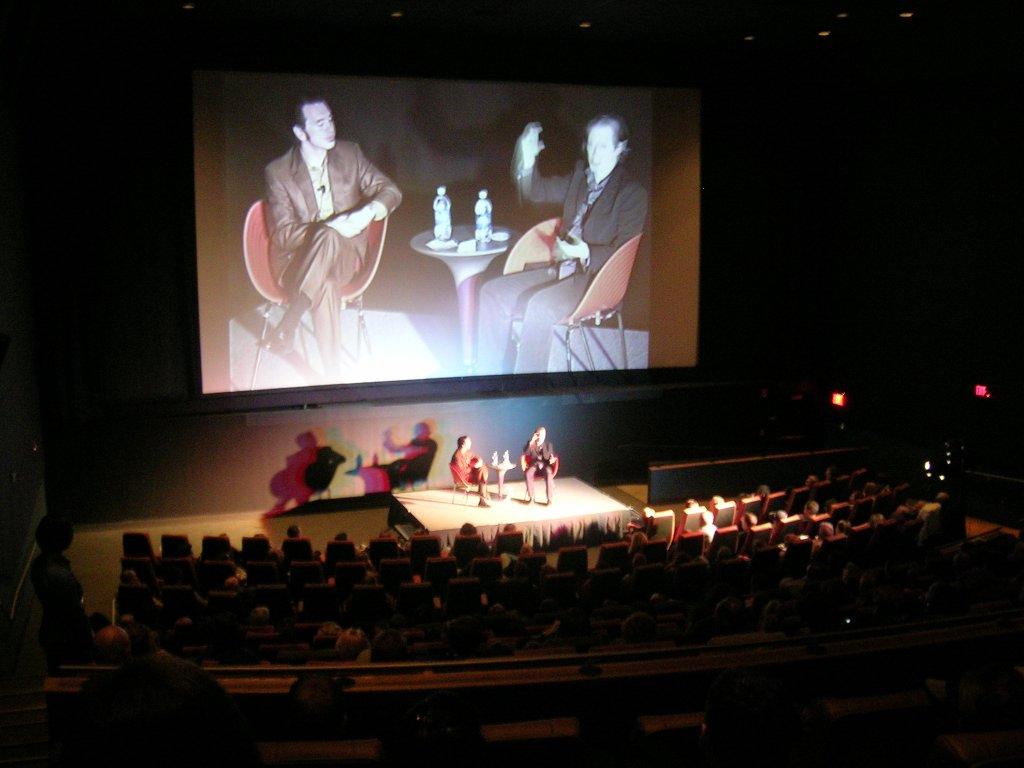
A view from the top of the post-LONESOME JIM Q&A with Steve Buscemi (Mark Pfeiffer/October 26, 2005)
The Drexel Gateway Theater opened its doors to VIPs and the paying public for the first time tonight. (Proceeds from the event will go to ABATE--American Bikers Aimed Toward Education--and their Firefighters for Kids 18th Annual Toy Run.) The attraction was a screening of LONESOME JIM, the third feature film directed by Steve Buscemi. The noted character actor was also in attendance, a visit aided by the fact that Buscemi's wife hails from Hilliard.
Casey Affleck plays the weary and depressed title character, an aspiring writer in his late twenties who returns to his parents' Indiana home after his time in Manhattan produced nothing more than walking dogs for a living. Buscemi's direction proves him adept at capturing the details of rural midwestern life and finding a dry sense of humor amid the dissatisfaction and disappointment dragging Jim down. LONESOME JIM has a surprisingly light touch despite the heavier emotional tone. Although the film is full of sadness and despair, it still holds out hope that people are decent and all will turn out well in the end. It's a good film and worth looking for when it is released next spring.
The moderator asked a couple questions to kick off the post-film Q&A, but audience members had ample opportunities to ask Buscemi what their hearts desired. He humored the inevitable (and impolite) "why did you do that" question--there's one in every crowd--when asked if he regretted making CON AIR. Buscemi explained that he had fun, got to work with other interesting actors, and could help fund smaller, more personal projects with the payday he gets from appearing in bigger movies. It's worth remembering that very few actors are raking in $20 million a picture, so it's understandable why Buscemi or any other performer below the title would make some films less artistically minded than the indies that garner acclaim but pay squat. If being in CON AIR lets him direct small films he feels passionately about, where's the harm in it?

The new Drexel Gateway Theater (Mark Pfeiffer/October 26, 2005)
My first impression of the new Drexel Gateway is very positive. The seats are very comfortable, and there's plenty of leg room in the aisles. The auditoriums are plusher than I expected. This should be an excellent place to see movies. Parking around the Ohio State campus can be problematic, but a garage directly behind the theater is convenient and cheaper than anywhere else in the area unless you can snag a spot along the street somewhere in the neighborhood and are willing to hoof it.
A History of Violence
A HISTORY OF VIOLENCE (David Cronenberg, 2005)
Millbrook, Indiana is the picture of idyllic small town America that exists in Norman Rockwell paintings and TV sitcoms of the 1950s. In A HISTORY OF VIOLENCE, trouble enters this peaceful burg when two criminal outsiders slink into a diner and try to rob it. Tom Stall (Viggo Mortensen), the soft-spoken diner owner, saves the day when he kills the bad guys in defense of his employees and customers.
Naturally the incident attracts a lot of attention from local media, but it also catches the eye of Philadelphia crime boss Richie Cusack (William Hurt). He believes that Tom is his long-lost brother Joey, a thug renowned for his brutality. Richie sends a crew to Millbrook to confirm that Tom is Joey and, if so, to bring him back to Pennsylvania.
Like a dormant virus, the propensity for violence is hidden until the proper conditions are realized in David Cronenberg’s film. When brought to the surface, the violence is unleashed in rapid bursts of fury. To illustrate the immediacy with which violent impulses are summoned, Cronenberg switches from the film’s restrained pace to quick cuts during the bloodshed.
A HISTORY OF VIOLENCE posits that such aggressive behavior lurks within everyone but remains masked most of the time. Cronenberg has the characters engage in role-playing in their everyday lives. They behave according to the norms and hierarchy in society, giving the director the chance to explore the purpose artifice and façade serve in personal and community relationships.
Like FAR FROM HEAVEN, A HISTORY OF VIOLENCE takes nostalgic ideas of the so-called good old days and exposes the truth of human behavior that such rosy views obscure.
Grade: B+
An Unfinished Life
AN UNFINISHED LIFE (Lasse Hallström, 2005)
Single mother Jean Gilkyson (Jennifer Lopez)runs from an abusive boyfriend in AN UNFINISHED LIFE. With nowhere else to turn, she goes to the Wyoming home of her father-in-law Einar (Robert Redford). He still holds Jean responsible for the accidental death of his son—her husband—that happened more than a decade ago. Their relationship has been so frayed that Einar never knew he had a granddaughter. Also living with Einar is Mitch, a ranch hand played by Morgan Freeman. Mitch was mauled by a bear, and out of friendship and guilt, Einar cares for him. AN UNFINISHED LIFE brings these wounded individuals together with the anticipation of healing.
AN UNFINISHED LIFE is an affecting demonstration of the enormous impact forgiveness can have on oneself and others. Director Lasse Hallström’s Oscar-bait films, such as THE CIDER HOUSE RULES and CHOCOLAT, tend to have sentiment thickly applied, but AN UNFINISHED LIFE’S story of redemption is told with restraint. The film is old-fashioned in the best sense of the word. The characters’ emotional scars are old and deep, and the film grants time for changes to occur gradually. Aside from the abusive boyfriend, who pops up briefly, AN UNFINISHED LIFE is a film without a villain. The forces harming the characters’ lives are internal, not some external figure. Once they come to this realization, their lives are transformed. Jean learns to stand up for herself. Einar lets go of his anger and self-pity.
None of this is especially surprising, but it gains power through the cast’s uniformly solid performances. Lopez again shows that she’s a capable actress when she’s not being a diva. Redford lends great poignancy to the softening of his grizzled farmer’s bitterness. One more time Freeman is the film’s voice of reason, providing a steadying influence in stormy conditions. As Jean’s daughter Griff, Becca Gardner holds her own with these veterans.
Grade: B
Proof
PROOF (John Madden, 2005)
In PROOF long-suffering daughter Catherine (Gwyneth Paltrow) cares for her brilliant, mentally ill father Robert (Anthony Hopkins). Catherine’s dad was a mathematical genius, but his final years have been marked with insanity that left him unable to work. PROOF begins the night before Robert’s funeral, a time that causes Catherine to wonder about her own mental health and if her father’s affliction runs in the family.
Math can confirm many things, but it can’t prove that love exists or how much of it there is. Such is the dilemma in PROOF, an emotionally charged film that throbs like an open wound. Catherine cannot prove the most important things in her life, and it is ripping her apart. Paltrow’s inward performance is of a piece with her stunning work as Sylvia Plath in the biopic SYLVIA. Again she’s an intelligent, depressed woman, but what makes her performance as Catherine different is the physicality of it. She often doesn’t look at others in conversation and wraps her arms around herself, making tangible how wrapped up she is in her own mind. In PROOF Paltrow and her SHAKESPEARE IN LOVE director John Madden reteam for a dynamite actor’s showcase and depiction of the ravages of mental illness on the individual and the family.
(Review first aired in a modified version on the October 11, 2005 NOW PLAYING)
Oliver Twist
OLIVER TWIST (Roman Polanski, 2005)
Roman Polanski helms the latest cinematic adaptation of Charles Dickens’ OLIVER TWIST. Barney Clark stars as Oliver, an orphan who falls in with a group of boys who pick pockets on the London streets for their master. Ben Kingsley is Fagin, the devilish rogue who shows the boys kindness in exchange for their thieving.
With its handsome art direction and cinematography, Polanski’s OLIVER TWIST represents a triumph of formal design. It’s an impeccable production on a visual level and undeniably a well-made film, but the narrative often lacks the spark to bring it to life. The social commentary lingering from the source material grants Polanski some well-deserved potshots at those who believe Oliver should be grateful for even their most meager charity. Yet this airless adaptation chokes on its lack of freshness. A more interesting and relevant take on OLIVER TWIST might be to move it to the Brazilian slums in the explosive CITY OF GOD. OLIVER TWIST gradually improves, building to a climax in which Oliver pardons his oppressor, a scene that contains real power. Unfortunately, too much of the film lacks the same resonance.
Grade: C+
(Review first aired on the October 11, 2005 NOW PLAYING)
In Her Shoes
IN HER SHOES (Curtis Hanson, 2005)
Toni Collette’s Rose has a loving but exasperating relationship with her party girl sister Maggie(Cameron Diaz) in IN HER SHOES. Aside from a shared fondness for footwear, the two couldn’t be more different. Rose is the practical one who works hard at the office and struggles to get and keep a man in her life. Maggie can barely hold down any job, choosing instead to exploit her genetic superiority to snag well-heeled men to support her. Eventually Rose has enough of Maggie’s freeloading and throws her out, leaving her to turn to a grandmother (Shirley MacLaine) neither of them know at all.
IN HER SHOES director Curtis Hanson again demonstrates his uncommon touch for storytelling with more of a literary approach. Working from Susannah Grant’s adaptation of Jennifer Weiner’s chick-lit novel, Hanson’s loose direction lets the film meander, to soak up the tone, while still hitting the pivotal yet familiar developments in the plot.
Diaz and Collette are playing types, but they are given room to embody the characters, frequently with surprising results. Diaz’s Maggie proves to be more than just a good-time girl, although discovering her deeper dimensions requires moving into a retirement community. Maggie could have easily been just an object of scorn and ridicule, but Diaz finds the complexity that makes her character relatable. Likewise, Collette doesn’t characterize Rose as a martyr or someone who has all the answers.
IN HER SHOES may not look much different than other female relationship films, but when faced with the choice to follow convention or not, it usually goes the other way. It’s practically a given that such a film will end with a wedding, but it’s a rarity, one found here, that such a scene will feel fresh. A funny, generous film with strong performances, IN HER SHOES redeems the often derogatory "chick flick" label.
Grade: B
Doom
DOOM (Andrzej Bartkowiak, 2005)
The Rock leads a tactical fighting unit to a research base on Mars in DOOM. The station is locked down until the squad can locate and eliminate whatever is wreaking havoc. These elite fighters are loaded with weapons capable of dealing with whatever alien predators they may encounter. The compound even has a few extra-lethal guns stashed away for the cleverest to find.
DOOM originated as a first person shooter video game, but what makes such games fun to play does not translate into compelling viewing. The characters are merely slight variations of one another, with Rosamund Pike’s blonde scientist in the mix in to provide relief from all of the raging testosterone. Although the film spends an inordinate amount of time attempting to develop them, the results are the most boring cut scenes a gamer could watch. The Rock is wasted, employed more for his physical stature than his comedic abilities. A film this humorless is in bad need of the charisma he has demonstrated time and again, whether as a lead in THE RUNDOWN or as a supporting player in the dud BE COOL.
Considering that DOOM and other first person shooter games thrive on constant ammunition firing, there’s surprisingly little action for much of the film’s running time. Director Andrzej Bartkowiak, responsible for helming two of Jet Li’s worst American films, repeats scene after scene of the squad creeping around dark, dank corridors that lead only to brief engagements in combat. The action finally gets ratcheted up in the end, which includes the one noteworthy sequence: the game’s first person point of view with the gun bobbing in the lower center of the frame. Gamers would be better off playing DOOM or sitting in front of a blank screen than wasting time with this incredibly dull ALIENS rip-off.
Grade: F
Saturday, October 22, 2005
A Keane Conversation with Lodge Kerrigan
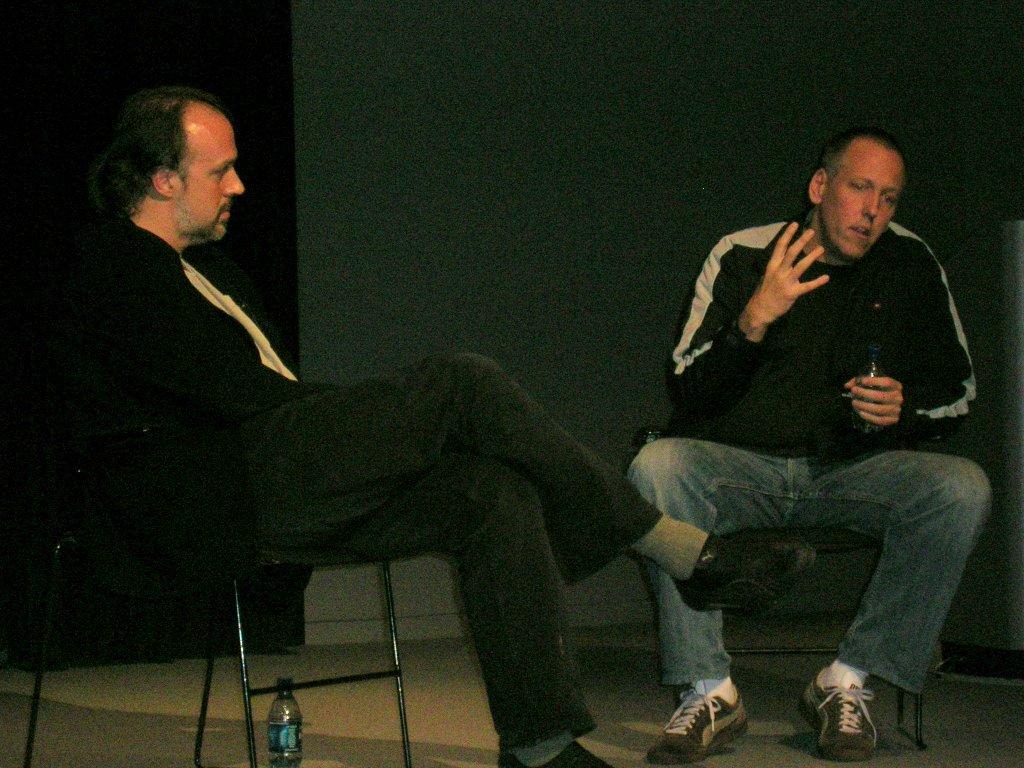
Film critic Kent Jones and director Lodge Kerrigan discuss KEANE at the Wexner Center (Mark Pfeiffer/October 21, 2005)

Lodge Kerrigan
In addition to introducing (and reintroducing) central Ohio cineastes to the best the film world has to offer, the Wexner Center also possesses an enviable record of bringing in the people who make the films. Capping their latest visiting filmmaker program was the area premiere of KEANE followed by Kent Jones' post-film discussion with director Lodge Kerrigan. (His other features, CLEAN, SHAVEN and CLAIRE DOLAN, screened last Friday. Unfortunately I was unable to attend.)
While I wouldn't rank KEANE among the year's best films, Kerrigan's rigorous and empathetic examination of a mentally ill man, intensely played by Damian Lewis, is recommended viewing.
Wednesday, October 19, 2005
The Lull
Allow me to make my periodic post apologizing for the lull generated by my lack of posting of late. The reasons aren't anything exotic: no avian flu or blockbuster deal with web portal. Rather, it's a combination of being exceptionally busy and desiring to tinker with reviews I've already written for television. The busy part has interfered with the plan to lengthen what I've already delivered on NOW PLAYING.
I'll get around to posting a few reviews soon, hopefully beginning after returning from the Antonoio Banderas ZORRO sequel that has taken an unusually long amount of time to get to the screen. (Maybe it isn't so unusual. This year has turned up follow-up films arriving several years after their forebears [DEUCE BIGALOW: EUROPEAN GIGOLO, MISS CONGENIALITY 2].) Then again, I'm going to have the latest episode of LOST waiting on the DVR when I get home.
This time might as well be as good a time as any for an unscientific study. If you're a regular reader of this blog--and I hope you are--please feel free to let me know you're out there, what brought you here in the first place, what keeps you coming back, and from where you're reading (city, country, etc.--not "in front of the computer"). The comments section is probably the best place, but if you'd prefer to e-mail me, that's fine too. I have a general idea of the readership from looking at the site traffic reports, but I know they're imperfect.
Saturday, October 01, 2005
Trailer Tricks
For an object lesson in how editing and music in trailers can make enormous differences in setting expectations, take a look at the clever mock trailers for THE SHINING and WEST SIDE STORY.
THE SHINING has been transformed into a heartwarming domestic comedy while WEST SIDE STORY becomes a horror film. The former is a brilliant piece of work. If I didn't know any better, I wouldn't suspect that it completely perverts what the film is actually like. The rejiggered WEST SIDE STORY trailer is pretty good too, although it "cheats" in adding some well-placed special effects to enhance the illusion.
(Credit to Rob Blackwelder for posting these links on the Online Film Critics Society forum)
Addendum: I found another one linked on the P.S. 260 blog. It applies the horror film template to TITANIC. Not bad but not as inspired as the other two.
Wednesday, September 28, 2005
On Offensive Film Depictions
(Spoiler warning: Although I'm trying to keep this entry vague, there's really no way to comment without revealing key information about FLIGHTPLAN.)
Is it possible to make a film without offending any special interest group?
From today's Los Angeles Times:
I think audiences are capable of distinguishing between fiction and reality, so flight attendants shouldn't worry that air travellers will now suspect them of being terrorists. If you're not a "rude, unhelpful, and uncaring" worker, then such a depiction in FLIGHTPLAN probably isn't going to trigger a sea change in passenger attitudes.
Look, I understand that how people are portrayed in films can affect attitudes and matters to those reflected on screen; however, if you take every complaint like this to its logical, offense-free end, then any less-than-perfect behavior, not to mention villains, must be banished from cinematic depictions. The flight attendants would have a point if there were rampant examples of films showing them to be terrorists. It's hard to make a case that having one flight attendant in one film characterized in such a way causes undue harm.
I can only wonder what the nation's restaurant workers will have to say about WAITING, a toxic "comedy" that paints them in the most unfavorable light possible.
Overall, though, everyone needs to cool down about perceived slights and digs in movies. The most innocuous things are getting overpoliticized. Luckily JUST LIKE HEAVEN wasn't released in the midst of that outrageous Terri Schiavo situation. I'm unaware of any group hijacking the Reese Witherspoon romantic comedy to promote their agenda--a silly tactic since the film is one big flight of fantasy--but in these increasingly hostile and polarized political times, it wouldn't surprise me if an organization did. Conservatives and liberals need to accept that sometimes a cigar is just a cigar and not a call for the dismantling of corporate America or the expression of individual choice.
Is it possible to make a film without offending any special interest group?
From today's Los Angeles Times:
Three flight attendant groups are calling for a boycott of "Flightplan," which debuted at No. 1 last weekend, claiming that the depictions of a flight attendant and air marshal are outrageous and disrespectful.Also:
According to a statement, the groups were also troubled by the depiction of the non-villianous flight attendants, who were "rude, unhelpful and uncaring."So I suppose the Arab passengers should have been the bad guys, right?
Early in the film, flight attendants are seen rolling their eyes over a family with boisterous children, with one telling another something like: "It's OK to hate the passengers."
I think audiences are capable of distinguishing between fiction and reality, so flight attendants shouldn't worry that air travellers will now suspect them of being terrorists. If you're not a "rude, unhelpful, and uncaring" worker, then such a depiction in FLIGHTPLAN probably isn't going to trigger a sea change in passenger attitudes.
Look, I understand that how people are portrayed in films can affect attitudes and matters to those reflected on screen; however, if you take every complaint like this to its logical, offense-free end, then any less-than-perfect behavior, not to mention villains, must be banished from cinematic depictions. The flight attendants would have a point if there were rampant examples of films showing them to be terrorists. It's hard to make a case that having one flight attendant in one film characterized in such a way causes undue harm.
I can only wonder what the nation's restaurant workers will have to say about WAITING, a toxic "comedy" that paints them in the most unfavorable light possible.
Overall, though, everyone needs to cool down about perceived slights and digs in movies. The most innocuous things are getting overpoliticized. Luckily JUST LIKE HEAVEN wasn't released in the midst of that outrageous Terri Schiavo situation. I'm unaware of any group hijacking the Reese Witherspoon romantic comedy to promote their agenda--a silly tactic since the film is one big flight of fantasy--but in these increasingly hostile and polarized political times, it wouldn't surprise me if an organization did. Conservatives and liberals need to accept that sometimes a cigar is just a cigar and not a call for the dismantling of corporate America or the expression of individual choice.
Tuesday, September 27, 2005
Junebug
JUNEBUG (Phil Morrison, 2005)
A cosmopolitan art dealer meets her husband’s family for the first time in JUNEBUG. Embeth Davidtz plays Madeleine, a gallery owner specializing in outsider art. She and new husband George (Alessandro Nivola) travel from Chicago to North Carolina in hopes of securing a deal with an artist whose work incorporates Civil War imagery and phalluses. George hasn’t seen his family for three years, but since the artist lives nearby, he and Madeleine take a side trip to spend time with his folks. Although eager to ingratiate herself to her in-laws, Madeleine finds resistance from George’s resentful mother and hostile brother. On the other hand, George’s pregnant sister-in-law Ashley (Amy Adams) cottons to her immediately.
JUNEBUG does a wonderful job of capturing the regional flavor and finding humor in the people and place without holding the southern characters up for ridicule or scorn. Director Phil Morrison shows respect for simple, quiet lives of close-knit families and church carry-in dinners while also examining the wariness such insularity breeds toward outsiders.
JUNEBUG is seen through Madeleine’s eyes, a natural choice considering her unfamiliarity with this way of life despite her interest in the area’s folk art. Davidtz handles this tricky role quite well, making Madeleine neither the target of vilification nor the model of perfection.
There’s a niggling sense, though, that George should be JUNEBUG’S focus. At times he seems to be eminently comfortable in his old stomping grounds—he sings a hymn for the congregants at the church social, showing a part of himself that Madeleine has likely never witnessed—but he has not seen his family for a long time and spends much of the film avoiding them. It then comes as a big surprise when he takes his wife to task for not placing family above work when Ashley goes into labor at the same time Madeleine faces a crisis in finalizing a deal with the local artist. When they leave for Chicago, George expresses relief at getting away from his family. JUNEBUG would be a more successful film if George weren’t a cipher. As it stands, his contradictions contribute to the film’s mixed message.
What’s abundantly clear is that Adams steals the film as the irrepressible Ashley. She brings warmth and hilarity to a quirky character who never has less than everyone’s best interests at heart.
JUNEBUG has a good feel for its environment and gets many details right, but the major inconsistency (or glaring lack of understanding) regarding George throws the rest out of balance.
Grade: C
Tim Burton's Corpse Bride
TIM BURTON’S CORPSE BRIDE (Tim Burton and Mike Johnson, 2005)
A groom practicing his vows unwittingly weds the dead in TIM BURTON’S CORPSE BRIDE. For the stop-motion animated film Johnny Depp provides the voice of Victor, a nervous husband-to-be who places a ring on what turns out to be the skeletal finger of a murdered woman. The corpse bride (Helena Bonham Carter) is sweet, but there’s the little matter of their very wrong engagement being contrary to the natural order.
CORPSE BRIDE’S protagonists are kindred spirits with the sensitive, pale, black-clad heroes who populate Burton’s body of work. He and co-director Mike Johnson have made the first film perfect for parents who were teenage goths and their angst-ridden children. After all, in CORPSE BRIDE the after life is where color is found. The world of the living is draped in black, white, and the bluish gray of a dead body. The ghastly elegant visual style and macabre humor are indebted to Edward Gorey’s illustrations.
For all its death fixations, CORPSE BRIDE is a film alive with inventiveness and devil-may-care attitude. Certainly it’s darker than the Burton-produced stop-motion classic THE NIGHTMARE BEFORE CHRISTMAS, enough that it may mortify unsuspecting moms and dads, yet the creepiness should elicit gleeful shudders from children rather than bad dreams.
It’s all in good fun, something in evidence with jokes including a maggot that sounds like Peter Lorre, a secondhand shop that gives new meaning to such a place, and a gag with a skeleton whose reaction to a shocking revelation is a literal jaw-dropper. There’s also a funny, inadvertent warning of the perils of wedding a lass so thin that her ribcage is actually visible. (The corpse bride has select spots where what’s underneath her rotted flesh is exposed.)
CORPSE BRIDE continues a perfect marriage between Burton’s creativity and a technique rarely used for feature films.
Grade: B
Just Like Heaven
JUST LIKE HEAVEN (Mark Waters, 2005)
Reese Witherspoon and Mark Ruffalo form a cosmic connection in JUST LIKE HEAVEN. As Elizabeth Masterson, Witherspoon plays a hardworking doctor who can’t find time for anything else, least of all a relationship. On the way to her sister’s house, Elizabeth’s car meets with a semi truck, an accident that leaves her in a coma. Ruffalo’s David Abbott is still deep in mourning for his deceased wife when he sublets Elizabeth’s apartment. Somehow Elizabeth’s soul separates from her body and continues to inhabit her residence, which convinces David that he may have finally cracked.
JUST LIKE HEAVEN’S time-tested and timeworn formula may not require much brain exertion, but it provides celestial stars for the thinking man and woman in the forms of Witherspoon and Ruffalo. Witherspoon projects intelligence even when playing the ditziest of characters. Here she’s quite funny coping with the collision of Elizabeth’s professional practicality and utter befuddlement in personal matters. Seeing her blithe spirit revive the rumpled, brooding David is a primary source of the film’s charms. Ruffalo pulls several laughs reacting to someone no one else can see, particularly when Witherspoon talks him through an emergency surgery. Witherspoon and Ruffalo underplay the broad comedy and their characters’ attraction, which is why their chemistry ultimately proves to be so satisfying.
In addition to the boundless appeal of its stars, JUST LIKE HEAVEN brings in a scene-stealing supporting character and a director with sharp comic timing. Jon Heder follows up his breakthrough NAPOLEON DYNAMITE role with a funny turn as an occult bookstore employee who can commune with spirits. On the heels of the FREAKY FRIDAY remake and MEAN GIRLS, director Mark Waters shows his ability to deliver good mainstream comedies, a talent less common than you might think.
Grade: B
Thursday, September 22, 2005
Upcoming radio appearance
They can't keep me off Columbus radio. They can only hope to contain me...or something like that.
I join John DeSando for this week's It's Movie Time on 90.5 WCBE. (I'm filling in for the vacationing Clay Lowe.) We discuss JUST LIKE HEAVEN and TIM BURTON'S CORPSE BRIDE. The show airs at 3:01 p.m. and 8:01 p.m. on Friday, September 23. Out-of-towners or those not near radios can hear it live via streaming audio. Remember to account for time differences if you're not in the eastern time zone.
I think it turned out well, so make sure to catch it.
Wednesday, September 21, 2005
A Wexner Plug
For those in the Columbus area, I highly encourage you to visit the newly reopened and renovated Wexner Center film and video space this Thursday or Friday. Arnaud Desplechin's KINGS AND QUEEN, which currently sits atop my best films of 2005 list, returns. Circumstances are probably going to prevent me from seeing it again, but I'd go if I could. It's a head-spinning masterpiece that deserves to be seen on a big screen.
Kudos to the Wexner folks for improving their screening room. The new seats are much more comfortable than the old ones, and the clarity of the sound is noticeably better as well.
Kudos to the Wexner folks for improving their screening room. The new seats are much more comfortable than the old ones, and the clarity of the sound is noticeably better as well.
Monday, September 19, 2005
Trading Faces
Science fiction becomes science fact, sort of, with news of a Cleveland doctor's search for candidates to undergo the first face transplant. It's not quite FACE/OFF territory--Nicolas Cage couldn't swap his face for John Travolta's and look just like him--but it does seem the recipients might have to deal with issues of identity as in the John Woo film.
Here's the most shudder-inducing passage from the story:
Here's the most shudder-inducing passage from the story:
But her critics say the operation is way too risky for something that is not a matter of life or death, as organ transplants are. They paint the frighteningly surreal image of a worst-case scenario: a transplanted face being rejected and sloughing away, leaving the patient worse off than before
Tuesday, September 13, 2005
The Constant Gardener
THE CONSTANT GARDENER (Fernando Meirelles, 2005)
In THE CONSTANT GARDENER a British diplomat stationed in Kenya receives news that his activist wife has been found murdered. Ralph Fiennes stars as Justin Quayle, the husband who diligently digs for the truth about her death. Rachel Weisz plays Tessa, a headstrong woman whose investigation into pharmaceutical corporation malfeasance in Africa may have brought about her demise. Rumors persist, though, that Tessa and her travel companion, a doctor who has gone missing, were having an affair. The conventional wisdom is that Tessa’s murder is nothing more than a crime of passion, but Justin finds indications of a greater conspiracy at work.
As he did with the astonishing CITY OF GOD, director Fernando Meirelles captures intimacy and an authentic sense of place in THE CONSTANT GARDENER. Handheld camerawork has become shorthand for “edgy” filmmaking, but Meirelles utilizes it not as a gimmick but as an essential means for telling the story. THE CONSTANT GARDENER’S power comes in the private, tender scenes between Justin and Tessa and the immediacy of being thrust into crowded locations, places where a roving camera can get with greater ease.
Adapted from a John Le Carré book, the film brims with the intrigue and surprises expected from the espionage novelist. Although the storyline is relatively complicated, Meirelles’ deft direction and Jeffrey Caine’s incisive screenplay delineate the twisty plot. Fiennes and Weisz add the emotional heft to the film’s sociopolitical machinations and message.
In spite of all the thriller elements, THE CONSTANT GARDENER is a love story in which Justin’s affection for his wife intensifies as he discovers the truth about a woman he didn’t know completely. Fiennes, who often plays the tortured lover, comes to life as Justin arrives at revelations that far exceed what he anticipated. Weisz excels as the feisty, conscientious Tessa, playing her with the right mix of bravado and composure.
A brisk, galvanizing journey through the political thicket in Africa, THE CONSTANT GARDENER positions Meirelles as a leading director of electrically charged dramas with social consciences.
Grade: B+
Transporter 2
TRANSPORTER 2 (Louis Leterrier, 2005)
Jason Statham returns as ex-Special Forces operative Frank Martin in TRANSPORTER 2. An elite fighter and driver, his current job shuttling a wealthy family’s son to school and the doctor’s office might seem like an underutilization of his talents. The boy’s father is a top government drug agency official, which means the youngster is a natural target for abduction by bad, bad people. Frank unwittingly enters a trap and loses the kid, which leads to the authorities considering him the prime suspect in the kidnapping. Having promised to protect the boy and wishing to clear his name, Frank hunts for the abductors while dodging the cops.
With this year’s UNLEASHED and TRANSPORTER 2, Louis Leterrier demonstrates that he’s an up-and-coming director of action films. He understands where to put the camera and how long to hold shots so the audience can follow the action. TRANSPORTER 2 uses quick edits but not so quick that the action becomes abstract. A great example is the tour de force fight scene in and around a boat. As in UNLEASHED’S bathroom fight, Leterrier proves himself an expert in depicting hand-to-hand combat in small spaces, in this case using tight camerawork and bone-crunching sound effects editing to heighten the impact.
Corey Yuen, who directed the first TRANSPORTER, choreographs the martial arts again. Like its predecessor, TRANSPORTER 2 boasts creative and witty fight scenes that play like live-action cartoons. Frank makes excellent use of available items. He pursues a bus on a jet ski (on the highway, no less), takes down a room full of thugs with a fire hose, and uses melons as improvised boxing gloves. It’s all pretty silly stuff—look no further than the lingerie clad, raccoon-eyed villainess with a fondness for automatic weapons or a preposterous battle in a tail spinning plane—but as pure action filmmaking, TRANSPORTER 2 is exhilarating.
Statham cuts an imposing figure and exhibits a knack for various fighting styles. His dry, straightforward performance is the perfect anchor for a film so over the top. TRANSPORTER 2 bursts with outrageous driving stunts, sublimely absurd fight scenes, and a sense of humor that ties it together.
Grade: B
Answering the Call: Ground Zero's Volunteers
ANSWERING THE CALL: GROUND ZERO'S VOLUNTEERS (Lou Angeli, 2005)
ANSWERING THE CALL: GROUND ZERO’S VOLUNTEERS shares the stories of those who helped with the World Trade Center rescue mission in the days and weeks following the attack on September 11, 2001. Narrated by Kathleen Turner, the documentary features local and national emergency personnel, relief workers, and citizen volunteers who assisted with the effort to rescue any possible survivors and remove the mountain of debris from the site. Director Lou Angeli is a volunteer firefighter. He’s also a filmmaker who shot footage at Ground Zero, which is being shown for the first time in ANSWERING THE CALL.
Everyone has a story, and ANSWERING THE CALL attempts to fit in as many as possible. The problem with Angeli’s approach is that the dozens of accounts blur as the film skips from person to person. The numerous statements about the incomprehensible devastation and invocations of American resilience have value, but the film would have been better served by focusing on a few exceptional stories or providing a thorough overview of the operation than relying on platitudes. ANSWERING THE CALL is at its best when it details the rescue and recovery teams’ procedures on the pile, such as how to work safely on the rubble and how dogs were used. Although many people speak about their experiences, the sheer volume and unanimity keep any significant personal stories from breaking through the clutter. From a technical standpoint, the film makes beginner’s mistakes in employing unnecessary video effects and including distracting jump cuts. ANSWERING THE CALL’S noble intentions are unquestionable, but the scattershot reporting keeps it from amounting to little more than a string of too-similar witness testimonies.
In addition to honoring the victims and heroes, ANSWERING THE CALL may have a secondary agenda. One interviewee who stands out is a Scientologist. At first I thought he had a novel viewpoint, one which I hadn’t heard reported, and thus worthy of inclusion even if the man in question received undue time. When the issue of sick rescue workers was raised, the film goes in an unusual direction. In addressing respiratory illnesses and other sicknesses afflicting site workers, the film gives an unchallenged assertion on the effectiveness of an L. Ron Hubbard-designed regimen for these people. No medical doctors or conventionally treated patients speak in this section of the film, an odd omission considering the number of physicians who must have been on site and examined ill workers and volunteers after the fact.
Grade: C
The Man
THE MAN (Les Mayfield, 2005)
Wisconsin dental supply salesman Andy Fidler, played by Eugene Levy, happens to be at the wrong place at the wrong time in THE MAN. Through what must be the least efficient means of arranging a blind buy, Andy is mistaken for Samuel L. Jackson’s Special Agent Vann, who is trying to catch the seller of guns stolen from the police vault. The criminal’s error makes Andy’s help imperative, so Vann detains him to help crack the case.
On those occasions when I see a really terrible movie, it can feel like the life force has been drained from me. Watching THE MAN left me feeling downright sluggish. THE MAN is a stale mismatched buddy comedy in which not a single interesting thing happens. Far too much time and energy is devoted to the investigation and Vann’s failed personal life, elements which are secondary to the humorous tension that is supposed to exist between Andy and Vann. The only remotely amusing moment is when Vann is required to attest to his subservience to Andy—in other words, proclaiming that he is Andy’s bitch to the gunrunners—but even that isn’t as funny as it sounds. THE MAN delivers not one but two scenes about Andy’s noxious flatulence, one with an elevator full of nuns, a joke so shopworn that it’s amazing it made the cut, so to speak. It’s a strong indication of the screenplay’s lack of originality that even the most overused jokes get repeated. Unsurprisingly, that makes THE MAN one of the year’s worst films.
Grade: F
Wednesday, September 07, 2005
Happy Birthday to Me
That's right, it's my birthday. Last year's birthday post lists who else shares the big day with me. What was good enough last year is good enough this year. I did find out, though, that I also share a birthday with ESPN.
It's been slow around these parts the past two weeks because I've been busy on vacation. I'd like to tell you I did something exciting, but the reality was that I spent much of the time straightening up and making improvements to my apartment. The glamorous life of a film critic, right? Posting should be picking up again.
It's been slow around these parts the past two weeks because I've been busy on vacation. I'd like to tell you I did something exciting, but the reality was that I spent much of the time straightening up and making improvements to my apartment. The glamorous life of a film critic, right? Posting should be picking up again.
Thursday, September 01, 2005
Help for hurricane victims
As you must know by now, Hurricane Katrina has caused unbelievable devastation in New Orleans and other places in the Gulf Coast. Watching the news coverage of the situation is continually shocking and heartrending. If you are able to donate to the Red Cross, please click on the ad in the righthand sidebar of this site.
Monday, August 29, 2005
Red Eye
RED EYE (Wes Craven, 2005)
Lisa (Rachel McAdams) and Jackson (Cillian Murphy) meet in line waiting to catch the night's last flight from Dallas to Miami. They engage in some polite small talk and a little flirtation but nothing more. Fortuitously, they end up seated next to one another on the plane. The seating arrangement is no coincidence, though, and RED EYE is not a romance.
Jackson is involved in a plot to kill Department of Homeland Security Deputy Secretary Charles Keefe (Jack Scalia), and Lisa's job as a luxury hotel manager puts her in a position to help him fulfill his duty. All he needs Lisa to do is call her hotel, where Keefe is scheduled to stay, and have his room changed. To persuade her, Jackson has a man ready to kill her father (Brian Cox) if she fails to cooperate.
RED EYE is a nimble thriller that doesn't waste an opportunity to ratchet up the tension. Although not staged in real time, the film's immediacy and confined quarters force the characters to react instinctively rather than having the benefit of contemplation and possible escape. Director Wes Craven has crafted a lean film in which everything seen--even as insignificant as a Dr. Phil self-help book or a novelty pen--has a purpose.
RED EYE doesn't depend on deep characterization, but Carl Ellsworth's screenplay provides just enough clues to who these people are to make their behaviors believable in the situation. The leads do a wonderful job of filling in the blanks, McAdams in particular. She has seemed primed for stardom for awhile, although in actuality her rise to prominence has come in less than the past year and a half. If enough people see RED EYE, this could be the film to put her on the path to the predicted Julia Roberts-type stardom, if she chooses to follow that career track. As in WEDDING CRASHERS and THE NOTEBOOK, here she's the embodiment of The Girl Next Door. Pretty, friendly, down to earth, and able to fend for herself, McAdams is immensely likeable and familiar in a way that's rare for movie stars. (She also has a go-for-broke flair for comedy, which isn't on display in RED EYE but has been witnessed in MEAN GIRLS and, of all places, THE HOT CHICK.) McAdams' performance may be most notable for what it isn't. She's neither an action star nor a damsel in distress but a regular, headstrong woman.
Murphy also underplays his part, as unlikely as that sounds considering he's playing a terrorist with the improbable, malevolent name of Jackson Rippner. His character's motivation is to go unnoticed. Using his devilish charm, Murphy's vaguely dangerous portrayal of Jackson is what he makes him all the more seductive, even to someone like Lisa.
RED EYE is a wind-up machine of elegant simplicity, an increasingly uncommon breed among today's bloated genre films. Craven uses today's fears of domestic terrorism and the frustrations borne of it to make something exciting, heroic, and funny.
Grade: B
The Brothers Grimm
THE BROTHERS GRIMM (Terry Gilliam, 2005)
In THE BROTHERS GRIMM the collectors of German fairy tales are recast as traveling swindlers who exploit villagers’ beliefs in local legends. Wilhelm and Jacob Grimm, played by Matt Damon and Heath Ledger, put on an elaborate production to convince townsfolk that they have rid their area of curses, enchantments, and all other supernatural afflictions. The Grimms’ bluff gets called, though, when they are sent to Marbaden, where children are disappearing and the forest truly is haunted.
Whether battling with the studio or being defeated by Mother Nature, director Terry Gilliam often faces great difficulty in making films that match his visions. The upside of the turmoil is that the end result is usually a fascinating film. THE BROTHERS GRIMM is fascinating but only in the way that watching a good director misfire this badly can be. Gilliam has never been the tidiest of storytellers, but in working from Ehren Kruger’s screenplay, he wallows into a mess that feels as if significant chunks are missing. Parts of the original Grimm tales are cleverly worked in, frequently with the darker tones that get bowdlerized for the bedtime versions. Although likely restricted in budget, Gilliam’s visual imagination is as unlimited as ever, which is the only aspect of THE BROTHERS GRIMM that makes it remotely watchable. Occasionally some Pythonesque humor slips through, such as in a torture scene, but the tone and plot are so muddled and muddied that the audience is reduced to looking for those rays of light to stay engaged with the film.
Grade: D+
The Cave
THE CAVE (Bruce Hunt, 2005)
Scientists and divers find a nasty surprise on their underground expedition in THE CAVE. Cole Hauser, Morris Chestnut, and Piper Perabo are among those making the fateful trip into the cave network below the Carpathian Mountains in Romania. There they encounter demonic winged creatures that are as dangerous in the water as they are in the air.
Early in THE CAVE there’s a great shot in the ocean of a diver squeezing through a crevice that he wriggles through somehow. It summons the suffocating feeling of claustrophobia, something which the rest of the film should have done but never replicates. While the monsters are the obvious attraction for THE CAVE, the scenario lends itself to concentrating on the terror of being trapped miles below the earth without a foreseeable exit. Emphasizing the natural tension might mitigate the film’s uninteresting elements, like the drab, interchangeable characters, the predictable infighting that starts almost as soon as they set foot in the cave, and the lack of humor. THE CAVE also suffers from a common malady in contemporary films. It’s all noise and motion that blurs the action to the point of incomprehensibility. With nothing invested in the characters and little ability to decipher what we’re seeing, THE CAVE plays out like a dull bombardment of the senses.
Grade: D
Tuesday, August 23, 2005
Laura Cantrell in concert

Laura Cantrell
(Sorry for the grind to a halt over the past week. I've been busy with other things, but for the time being, here are some photos and the setlist from Laura Cantrell's concert at the Beachland Ballroom tavern in Cleveland, Ohio on August 16. A more thorough report to follow, hopefully.)

Beachland Ballroom entrance

Laura Cantrell and band
1. What You Said
2. Early Years
3. Poor Ellen Smith
4. California Rose
5. Khaki and Corduroy
6. Letters
7. 14th Street
8. All Blue (Cheri Knight cover)
9. The Old, Old House (George Jones cover)
10. Wishful Thinking
11. Bees
12. Not the Tremblin' Kind
13. All the Same to You

Laura Cantrell and band
Encore:
14. I'll Remember You (Elvis cover)
15. The Whiskey Makes You Sweeter
16. Yonder Comes a Freight Train

Laura Cantrell and Mark Spencer, with Jeremy Chatzky on bass
Tuesday, August 16, 2005
Murderball
MURDERBALL (Henry Alex Rubin and Dana Adam Shapiro, 2005)
Upon learning that MURDERBALL is about quadriplegics who play wheelchair rugby, the first question that comes to mind is “How?” Henry Alex Rubin and Dana Adam Shapiro’s lively documentary clears up the common misconception that quadriplegics don’t have use of their arms and then proceeds to show these athletes ramming themselves into one another in pursuit of victory on the court.
The filmmakers train their cameras on the charismatic individuals of the 2002 U.S. quad rugby team competing in the World Championships and 2004 Paralympic squad. MURDERBALL pays special attention to Mark Zupan, a muscular, tattooed star of the sport, and Joe Soares, a legend for his aggressiveness and nail-hard attitude but also an aging player who’s losing his edge. When Soares is dropped from the team, he takes a job as the captain for archrival Canada, placing the man in direct, heated competition with his former teammates.
MURDERBALL is a thorough examination of how quadriplegics go about their day-to-day lives. Most of it is shot from the perspective of being in a wheelchair, and the co-directors incorporate similar camera moves, such as court-long push-ins that introduce the various quad rugby teams. Rubin and Shapiro’s interviews range from Keith Cavill, a recently injured motocross racer coming to terms with his condition, to Soares, who has been a quadriplegic since childhood. (The degree of the players’ impairment also varies greatly. Players are ranked on a point system from .5, the most impaired, to 3.5, the least impaired. The four-man team on the court must not exceed eight points.)
MURDERBALL drives home how quad rugby gives hope to the participants, many who led active, athletic existences before their injuries and can’t envision a lifetime of sitting still. When Keith tests a wheelchair specially made for quad rugby—much to the concern of those who see him as fragile—he lights up. It’s no wonder. For someone who has spent a lifetime racing bikes—and lost his full mobility from an accident on one—the chance to continue his passion in some form may make a big difference in his recovery.
While it’s an effective sports film—there’s great potential for a terrific narrative feature based on this material—the players and their enormous spirits take precedence over the outcome of the games. MURDERBALL isn’t soaked in cheap sentiment and doesn’t soften the hard edges of the more irascible people profiled. They don’t perceive themselves as victims, and many probably don’t view themselves as role models. Still, one can’t help but be inspired by how these guys have adjusted to their circumstances and live to the fullest.
Like the players, MURDERBALL is funny and brash. It’s a deeply felt film with outsized personalities. Zupan and Soares are a combustible duo and MURDERBALL’S ostensible stars. Their hostility toward one another gives the film a terrific rivalry, but just as powerful as their enmity are the stories of their lives off the court. Zupan reunites with the friend who has never forgiven himself for getting behind the wheel in the accident that led to his injuries. Soares grapples with the fallout of his fierce competitiveness and how to accept his sports-averse son. Uplifting, informative, and energetic, MURDERBALL shreds preconceptions and entertains like few films can.
Grade: A+
(This review originally appeared in different forms in my coverage of the 2005 Cleveland International Film Festival for The Film Journal and in the program for the Deep Focus Film Festival.)
Deuce Bigalow: European Gigolo
DEUCE BIGALOW: EUROPEAN GIGOLO (Mike Bigelow, 2005)
Let the war against film critics begin, at least if DEUCE BIGALOW: EUROPEAN GIGOLO star Rob Schneider has his way. In February he blasted L.A. Times critic Patrick Goldstein in a full page Variety ad. Prior to the release of the DEUCE BIGALOW sequel, Schneider went on the offensive against Roger Ebert (see the third item here). He has his work cut out for him, though, if he’s planning on going after the people giving his films bad reviews. At the time of going to print, none of the films in which he plays the lead role comes anywhere close to a “fresh” percentage (60% or greater) on the Tomatometer:
DEUCE BIGALOW: MALE GIGOLO (1999): 24%
THE ANIMAL (2001): 29%
THE HOT CHICK (2002): 22%
DEUCE BIGALOW: EUROPEAN GIGOLO (2005): 10%
Maybe he can take solace that David Manning was in his corner.
Unfortunately critical revulsion and the statute of limitations did not expire after six years on a DEUCE BIGALOW sequel. How tragic. Thus we get DEUCE BIGALOW: EUROPEAN GIGOLO, although in fairness to the EU, Deuce never strays outside the den of imagined iniquity that is Amsterdam.
Male prostitutes are being murdered, so under the guidance of his pimp T.J. (Eddie Griffin) Deuce resumes his gigolo ways to search for the killer. As in the first film, Deuce encounters clients who could be out of a freak show. He also finds a new love interest in the obsessive-compulsive Eva (Hanna Verboom), who is just the person to brighten his mood after months spent mourning his shark-eaten wife.
If the endless repetition of “man-whore” and gender-reversed prostitution and sex lingo (“she-john”, “mangina”) sends you into fits of laughter, then DEUCE BIGALOW: EUROPEAN GIGOLO is the movie for you. For the rest of us, though, it’s anything but a laughing matter. EUROPEAN GIGOLO is essentially a repeat of its unfunny predecessor, with a new setting and stupid murder mystery added. Most of the punchlines are visible from a distance. It’s a lazy, uninspired comedy that wallows in mean-spirited humor toward women and homosexuals. Griffin’s shtick quickly wears thin while Schneider is a non-presence.
This summer has witnessed the reemergence of quality raunchy comedies. The R-rated WEDDING CRASHERS and THE 40 YEAR-OLD VIRGIN and the unrated THE ARISTOCRATS cleverly work blue. DEUCE BIGALOW: EUROPEAN GIGOLO recycles its lowest common denominator dirty joke even though it wasn’t very good the first time. It’s easily one of the year’s worst films.
Grade: F
(A shorter version of this review first aired on the August 16, 2005 NOW PLAYING)
The Great Raid
THE GREAT RAID (John Dahl, 2005)
In THE GREAT RAID it is 1945 and five hundred Allied prisoners of war are barely surviving their third year in a harsh Japanese camp in the Philippines. Lt. Colonel Henry Mucci, played by Benjamin Bratt, decides to lead the Sixth Ranger Battalion on a rescue mission of these men even though the operation has little to no strategic value. Joseph Fiennes is one of the POWs, and Connie Nielsen is a nurse who works with the underground to get needed medicine to the prisoners.
John Dahl’s solemn staging of the rescue mission will likely earn him points from military aficionados, but THE GREAT RAID is terminally dull. The period is lovingly recreated in detail. The battle scenes are well executed. The earnest, old-fashioned performances recall the combat films made during and after the Second World War. Dahl moves the chess pieces according to the rules, but he fails to give THE GREAT RAID a human connection. The three storylines never converge in a satisfying way, and no character garners much interest. Along with his brother Ralph, Joseph Fiennes has had ample opportunities to refine his acting of on-screen suffering. His sickly, stoic POW Major Gibson is what passes for a character of any depth; however, this comes with the huge miscalculation of adding a heaping dose of tragic, long distance romance between Gibson and Nielsen’s nurse. Whether their relationship is based in fact or not, the subplot feels like a cheap ploy to introduce a love story into a film where it is out of place. THE GREAT RAID may do an admirable job of honoring the story’s real men and women, but it’s a less than stimulating film.
Grade: C-
(A shorter version of this review first aired on the August 16, 2005 NOW PLAYING)
The Skeleton Key
THE SKELETON KEY (Iain Softley, 2005)
Hospice nurse Caroline Ellis, played by Kate Hudson, is tiring of what she sees as an uncaring system. In THE SKELETON KEY, Caroline accepts a lucrative opportunity to care for a stroke victim (John Hurt) at his big home in Louisiana swampland. She gets to provide more personal care than she could at the facility and has just an hour’s drive back to her friends and the night life in New Orleans. The patient’s wife, Violet Devereaux (Gena Rowlands), is a little eccentric—she insists that no mirrors hang on the walls—but otherwise the job fits her fine until she finds a hoodoo room in the attic. The lady of the house claims to have never been in the room, which was used by the previous owner’s servants. Caroline’s friend reassures her that hoodoo is a harmless regional custom. Curious nonetheless, Caroline dabbles in hoodoo and begins to suspect something sinister is going on in the Devereaux home.
THE SKELETON KEY conjures a spooky atmosphere steeped in the mystique of folk magic and medicine and suspicion of the deep South. (Scratchy, old records, especially if blues albums or incantation recordings, are also scary!) In the film, hoodoo is explained as being powerless against those who do not believe. Director Iain Softley plays with the idea in fun ways, turning a routine chase into a match of wits with brick dust. In the years since her Oscar-nominated ALMOST FAMOUS role, Hudson has yet to find a character as interesting as Penny Lane. Hudson gives a credible performance in a thankless part as a caregiver who comes to believe she and her patient need protection from the supernatural. Due to a minimal cast of characters, THE SKELETON KEY leaves little room for surprise, save for a final twist that unnecessarily stretches out the conclusion and plays like a screenwriting gimmick. Ultimately, Softley’s deft handling of tone and Hudson’s effective portrayal compensate for THE SKELETON KEY’S less original and expected moments.
Grade: B-
(A shorter version of this review first aired on the August 16, 2005 NOW PLAYING)
Wednesday, August 10, 2005
What Big Brother teaches us
If you must know, yes, I'm ashamed to watch BIG BROTHER, now in its sixth season on CBS. Watching the show can be like eating Pringles. Try as I might to restrain myself, eating a few can lead to downing most or all of a can in short time, which then leads to swearing the things off for awhile. My consumption of the insidious reality show follows the same arc: enjoy the first few episodes, keep watching for no good reason, and then giving up on it or sticking with it but being disgusted.
BIG BROTHER is one of the most mundane of all the reality shows. (It's certainly one of the least visually interesting ones, although the producers have jazzed up the house's interior decoration this season.) The cast's personalities and their interactions are the crux of the show, yet an overwhelming percentage of the time is devoted to uninteresting conversations among increasingly irritable people. It doesn't help that the houseguests tend to have the maturity levels of high schoolers or the stereotypical participants in college Greek life. Still, the train wreck appeal of their scheming and backbiting can be entertaining up to the point when all of the houseguests come off as completely unappealing.
After struggling with the format for a couple seasons, the producers have figured out the basis for each episode. Saturday nights are when two houseguests are nominated for eviction. Tuesday nights feature the competition for the power to veto a nomination. Thursday nights are focused on the eviction. Unlike SURVIVOR and THE AMAZING RACE, BIG BROTHER'S competitions are not very interesting, and the nomination process alone doesn't make for compelling television. Also unlike those other shows, anyone with access to the internet can find out who won the competitions and who has been nominated before the shows air. The television show, as opposed to the live internet feeds, are nearly worthless to the most ardent fans.
If there's one thing that drives me batty about reality shows, it's all of the self-reflexive talk about "the game" that contestants engage in. BIG BROTHER is the worst at this, probably because the houseguests have little else to do but navelgaze about their situation.
I won't even start on Julie Chen, whose irony-free hosting of the show on eviction night makes for some of the most cringe-worthy TV.
If the show has any value, it is in making this sociological observation:
We cannot abide liars.
That seems obvious enough, but what BIG BROTHER illustrates is how hardwired we are to detest lying. More than other shows of its ilk, here's one in which the gameplay is predicated on being untruthful. It doesn't matter if you have any survival skills, physical endurance, or puzzle-solving abilities. You have to be able to persuade others. While persuasion doesn't require lying, the reality of the cutthroat game is that you're going to be forced to make promises you can't keep and to hide your true intentions. Whether to indicate assent or dissent, lies of omission and commission are essential. The houseguests have little else to do but talk, usually about the game, so a strategy of 100% truthtelling is the surest way to be voted out of the house.
All of the houseguests know this--or should--yet each season people get predictably bent out of shape when the others don't tell them the truth. Typically charges of "playing dirty" are levied against the prevaricators. Oftentimes those damning the houseguest in question lie just as much. While some of it may be strategy--to deflect the target onto the accused, for instance--I think the anger and hurt is genuine. People normally react that way when lied to, and it's hard to turn off feelings of betrayal even in the context of a game.
In the case of BIG BROTHER, it may be even harder to accept lies. The confined surroundings and lack of contact with anyone but their housemates--save for questions from the producers and host--breeds an unusually high degree of intimacy mixed with distrust.
Tuesday, August 09, 2005
Hard-Boiled (Lashou shentan)
HARD-BOILED (LASHOU SHENTAN) (John Woo, 1992)
HARD-BOILED, director John Woo's last Hong Kong film before heading to the States, delves into the world of ruthless Hong Kong Triads. Chow Yun-Fat is Tequila, a tough, no-nonsense police detective. Crime in the city has reached a fever pitch. The police are using undercover agents to infilitrate gangs, but their lives are in jeopardy as much from their fellow officers, who are unaware of their true identities, as they are from the crime lords.
Tequila encounters Johnny Wong (Anthony Wong), a disrespectful young mob boss, and one of his newest men Tony (Tony Leung). Eventually Tequila will realize that Tony is an undercover agent. Will they be able to work together to win the battle, or will Tony have to turn on Tequila to retain his cover?
John Woo's poetically violent action sequences are his trademark, and HARD-BOILED features three stunning examples. An early scene takes place in a tearoom dotted with birdcages. A fierce gunfight breaks out. Bullets zip through the small space, and it's difficult to know exactly who are the good guys and who are the bad guys. Tequila packs heat in both hands and blasts his way through the villains. It's a crackling way to begin the film. Tequila's strength is established, and Woo gives us a taste of what will follow.
The second big action setpiece is set in a warehouse. Johnny Wong's gang raids the opposition's arsenal. They descend upon the warehouse as a vicious pack on motorcycles. Again, the high-octane action is chaotic.
The third major action sequence happens in a hospital and stretches over most of the film's second half. Woo gives his heroes plenty of obstacles to overcome, including hidden chambers in the ingenious production design. Some of the scenes in the hospital are shocking because the violence spills into places we aren't used to seeing it go. Innocent patients are gunned down. A bravura display of action occurs in the baby ward. Woo balances the reprehensible actions of the gang with the protective nature of the police but doesn't let it dip into exploitation or sentimentality.
HARD-BOILED houses an excessive amount of violence, although it is well in keeping with the Hong Kong tradition that extends from the Peking Opera. Since it is stylized violence, it doesn't feel as gratuitous or glorified as it might in an American film, and in fact, the domestic pictures which have mimicked Woo's style often seem coarser and uglier. The difference is the honor and respect that the heroes and some villains have for life. At one point in the hospital Tony faces off with Mad Dog (Philip Kwok). Patients and nurses fill the space between them. Both internally know they should lay their guns down until the innocent can get out of their way. It's an unusual scene for an action picture, as is what soon happens after they put their guns down.
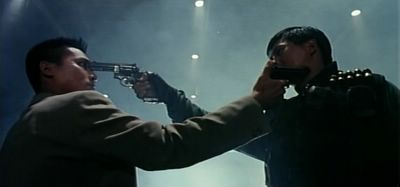
The duality of good and evil is a central theme in Woo's films. HARD-BOILED compares Tequila and Tony instead of juxtaposing one with the villain. Tony is working to uphold the law, but in the process he must commit murderous acts, possibly against other police officers. He's also conflicted because he must destroy the people whose trust he has gained. Tony has a fond relationship with Mr. Pang (Philip Chan), one not unlike the Joe Pistone-Lefty Ruggiero connection in DONNIE BRASCO. One senses that turning in Mr. Pang and his sons would be hard enough, but Tony must commit a far worse betrayal. In order to protect the law, Tony must knowingly kill the guilty and innocent. Tequila, on the other hand, believes he is serving the public and taking out the enemy, but unwittingly he kills those on his side. Amid the many loud action scenes, a quiet conversation between Tequila and Tony captures the core of this struggle.
Grade: B
(This is a revised version of my Criterion DVD review. Follow the link for more information on the quality of and features on the DVD.)

HARD-BOILED, director John Woo's last Hong Kong film before heading to the States, delves into the world of ruthless Hong Kong Triads. Chow Yun-Fat is Tequila, a tough, no-nonsense police detective. Crime in the city has reached a fever pitch. The police are using undercover agents to infilitrate gangs, but their lives are in jeopardy as much from their fellow officers, who are unaware of their true identities, as they are from the crime lords.
Tequila encounters Johnny Wong (Anthony Wong), a disrespectful young mob boss, and one of his newest men Tony (Tony Leung). Eventually Tequila will realize that Tony is an undercover agent. Will they be able to work together to win the battle, or will Tony have to turn on Tequila to retain his cover?
John Woo's poetically violent action sequences are his trademark, and HARD-BOILED features three stunning examples. An early scene takes place in a tearoom dotted with birdcages. A fierce gunfight breaks out. Bullets zip through the small space, and it's difficult to know exactly who are the good guys and who are the bad guys. Tequila packs heat in both hands and blasts his way through the villains. It's a crackling way to begin the film. Tequila's strength is established, and Woo gives us a taste of what will follow.
The second big action setpiece is set in a warehouse. Johnny Wong's gang raids the opposition's arsenal. They descend upon the warehouse as a vicious pack on motorcycles. Again, the high-octane action is chaotic.

The third major action sequence happens in a hospital and stretches over most of the film's second half. Woo gives his heroes plenty of obstacles to overcome, including hidden chambers in the ingenious production design. Some of the scenes in the hospital are shocking because the violence spills into places we aren't used to seeing it go. Innocent patients are gunned down. A bravura display of action occurs in the baby ward. Woo balances the reprehensible actions of the gang with the protective nature of the police but doesn't let it dip into exploitation or sentimentality.
HARD-BOILED houses an excessive amount of violence, although it is well in keeping with the Hong Kong tradition that extends from the Peking Opera. Since it is stylized violence, it doesn't feel as gratuitous or glorified as it might in an American film, and in fact, the domestic pictures which have mimicked Woo's style often seem coarser and uglier. The difference is the honor and respect that the heroes and some villains have for life. At one point in the hospital Tony faces off with Mad Dog (Philip Kwok). Patients and nurses fill the space between them. Both internally know they should lay their guns down until the innocent can get out of their way. It's an unusual scene for an action picture, as is what soon happens after they put their guns down.

The duality of good and evil is a central theme in Woo's films. HARD-BOILED compares Tequila and Tony instead of juxtaposing one with the villain. Tony is working to uphold the law, but in the process he must commit murderous acts, possibly against other police officers. He's also conflicted because he must destroy the people whose trust he has gained. Tony has a fond relationship with Mr. Pang (Philip Chan), one not unlike the Joe Pistone-Lefty Ruggiero connection in DONNIE BRASCO. One senses that turning in Mr. Pang and his sons would be hard enough, but Tony must commit a far worse betrayal. In order to protect the law, Tony must knowingly kill the guilty and innocent. Tequila, on the other hand, believes he is serving the public and taking out the enemy, but unwittingly he kills those on his side. Amid the many loud action scenes, a quiet conversation between Tequila and Tony captures the core of this struggle.
Grade: B
(This is a revised version of my Criterion DVD review. Follow the link for more information on the quality of and features on the DVD.)
Monday, August 08, 2005
The Rocketeer
THE ROCKETEER (Joe Johnston, 1991)

In 1999 Joe Johnston directed a film about rocket boys (OCTOBER SKY); eight years earlier he made a movie about a rocket man. THE ROCKETEER, based on Dave Stevens’ graphic novel, is an old-fashioned adventure set in 1938 Los Angeles.
A stolen jetpack is stashed at the airfield where pilot Cliff Secord (Bill Campbell) and mechanic/engineer/inventor A. “Peevy” Peabody (Alan Arkin) work. Cliff finds the rocket-powered backpack hidden under the seat in an old plane and can’t wait to give it a whirl. Before strapping it on he wisely uses a test dummy of sorts to see how it operates. Peevy works out the pack’s design kinks and constructs a stylish helmet. When disaster threatens to strike at an air show, Cliff dons the pack and helmet to save a fellow pilot. His heroics dazzle the audience and press, and the next thing Cliff knows he’s on the front page of the paper and dubbed “the rocketeer”.
Of course, a jetpack doesn’t appear out of thin air, and soon enough the feds, gangsters, and a giant henchman are all in hot pursuit of Cliff. Howard Hughes (Terry O’Quinn) created the contraption, and Neville Sinclair (Timothy Dalton), the third biggest box office attraction in Hollywood, hired the tough Eddie Valentine (Paul Sorvino) and his men to steal it. The government hoped to employ it as a military weapon in the war against the Nazis. Now they just want to get it back lest it fall into the wrong hands.
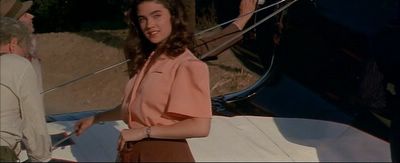
Cliff’s voluptuous girlfriend Jenny Blake (Jennifer Connelly), an aspiring starlet consigned to non-speaking extra roles, is placed in danger when Neville learns Cliff has the jetpack. Neville charms the porcelain-skinned beauty and then abducts her to force the hero to exchange the rocket-propelled transport for the girl.
THE ROCKETEER is steeped in the 30s serials that also inspired the Indiana Jones films, and it briskly delivers one cliffhanger after another. It isn’t difficult to imagine seeing this in segments spread over several weeks with breaks at key moments, such as when Jenny is taken to Neville’s home or when the climactic battle ensues on a zeppelin. Audiences in 1938 might have greatly anticipated the next episode. Maybe that period specificity was part of its downfall at the box office as 1991 crowds shelled out a mere $46.7 million, not quite the success needed for a blockbuster or franchise starter. THE ROCKETEER isn’t as thrilling as RAIDERS OF THE LOST ARK or the other two Indy movies, but it possesses a uniquely innocent charm. This is the kind of movie in which someone can exclaim, “Gosh!” without drawing snickers, at least if the viewers aren’t too jaded. Those in search of a good family film would do well to sample THE ROCKETEER.
THE ROCKETEER succeeds as an origination tale even if Campbell makes for too bland of a hero to command the screen. Cliff is a straight arrow with tunnel vision, which essentially drains him of comedic possibilities, but Campbell does have a boyish sincerity that serves him well. If Campbell lacks pizzazz, Dalton makes up for it as the lusty Errol Flynn-like villain. Connelly provides a hint of the sexpot that would emerge in other roles.
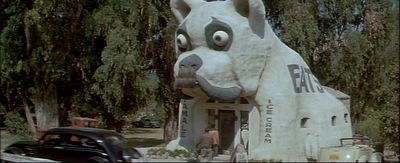
The film’s most memorable aspect is its beautiful reconstruction of the period. Cliff and other pilots hang out at the Bulldog Café, an example of then popular kitsch architecture. Production designer Jim Bissell and art director Christopher Burian-Mohr bring the decade to life with lush art deco sets. (Sadly, the outstanding art deco poster used for THE ROCKETEER'S theatrical release has been replaced on the DVD cover with a conventional montage of film images.)
THE ROCKETEER is a throwback to when movie heroes weren’t burdened by irony or existential angst. Although THE ROCKETEER was an anachronism upon its release, and is probably even more of one fourteen years later, in the dedicated, workmanlike Cliff it presents the great American hero. He does whatever is necessary to protect his loved ones and his country with no regard for personal safety or glory. THE ROCKETEER may not have the coolest or most exciting hero, but the film is worth revisiting to remind us of personal qualities that never go out of style.
Grade: B-
(This is a revised version of my DVD review. Follow the link for more information on the quality of and features on the DVD.)

In 1999 Joe Johnston directed a film about rocket boys (OCTOBER SKY); eight years earlier he made a movie about a rocket man. THE ROCKETEER, based on Dave Stevens’ graphic novel, is an old-fashioned adventure set in 1938 Los Angeles.
A stolen jetpack is stashed at the airfield where pilot Cliff Secord (Bill Campbell) and mechanic/engineer/inventor A. “Peevy” Peabody (Alan Arkin) work. Cliff finds the rocket-powered backpack hidden under the seat in an old plane and can’t wait to give it a whirl. Before strapping it on he wisely uses a test dummy of sorts to see how it operates. Peevy works out the pack’s design kinks and constructs a stylish helmet. When disaster threatens to strike at an air show, Cliff dons the pack and helmet to save a fellow pilot. His heroics dazzle the audience and press, and the next thing Cliff knows he’s on the front page of the paper and dubbed “the rocketeer”.
Of course, a jetpack doesn’t appear out of thin air, and soon enough the feds, gangsters, and a giant henchman are all in hot pursuit of Cliff. Howard Hughes (Terry O’Quinn) created the contraption, and Neville Sinclair (Timothy Dalton), the third biggest box office attraction in Hollywood, hired the tough Eddie Valentine (Paul Sorvino) and his men to steal it. The government hoped to employ it as a military weapon in the war against the Nazis. Now they just want to get it back lest it fall into the wrong hands.

Cliff’s voluptuous girlfriend Jenny Blake (Jennifer Connelly), an aspiring starlet consigned to non-speaking extra roles, is placed in danger when Neville learns Cliff has the jetpack. Neville charms the porcelain-skinned beauty and then abducts her to force the hero to exchange the rocket-propelled transport for the girl.
THE ROCKETEER is steeped in the 30s serials that also inspired the Indiana Jones films, and it briskly delivers one cliffhanger after another. It isn’t difficult to imagine seeing this in segments spread over several weeks with breaks at key moments, such as when Jenny is taken to Neville’s home or when the climactic battle ensues on a zeppelin. Audiences in 1938 might have greatly anticipated the next episode. Maybe that period specificity was part of its downfall at the box office as 1991 crowds shelled out a mere $46.7 million, not quite the success needed for a blockbuster or franchise starter. THE ROCKETEER isn’t as thrilling as RAIDERS OF THE LOST ARK or the other two Indy movies, but it possesses a uniquely innocent charm. This is the kind of movie in which someone can exclaim, “Gosh!” without drawing snickers, at least if the viewers aren’t too jaded. Those in search of a good family film would do well to sample THE ROCKETEER.
THE ROCKETEER succeeds as an origination tale even if Campbell makes for too bland of a hero to command the screen. Cliff is a straight arrow with tunnel vision, which essentially drains him of comedic possibilities, but Campbell does have a boyish sincerity that serves him well. If Campbell lacks pizzazz, Dalton makes up for it as the lusty Errol Flynn-like villain. Connelly provides a hint of the sexpot that would emerge in other roles.

The film’s most memorable aspect is its beautiful reconstruction of the period. Cliff and other pilots hang out at the Bulldog Café, an example of then popular kitsch architecture. Production designer Jim Bissell and art director Christopher Burian-Mohr bring the decade to life with lush art deco sets. (Sadly, the outstanding art deco poster used for THE ROCKETEER'S theatrical release has been replaced on the DVD cover with a conventional montage of film images.)
THE ROCKETEER is a throwback to when movie heroes weren’t burdened by irony or existential angst. Although THE ROCKETEER was an anachronism upon its release, and is probably even more of one fourteen years later, in the dedicated, workmanlike Cliff it presents the great American hero. He does whatever is necessary to protect his loved ones and his country with no regard for personal safety or glory. THE ROCKETEER may not have the coolest or most exciting hero, but the film is worth revisiting to remind us of personal qualities that never go out of style.
Grade: B-
(This is a revised version of my DVD review. Follow the link for more information on the quality of and features on the DVD.)
Sunday, August 07, 2005
The Bridges at Toko-Ri
THE BRIDGES AT TOKO-RI (Mark Robson, 1955)
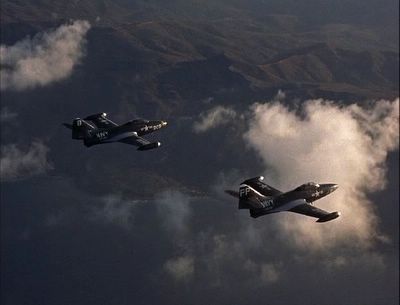
U.S. Navy reservist Lt. Harry Brubaker (William Holden) is summoned to active duty for a key mission during the Korean War in THE BRIDGES AT TOKO-RI. Harry struggles with the reality of being pulled from his job, home, and family, but he soldiers on with the knowledge that he has the rare skills necessary to complete a tactical air strike.
Harry’s mission has two equally dangerous components. First he and another pilot must make a reconnaissance flight over the targeted bridges and area. Then they will lead others in a risky attempt to destroy these strategically vital passageways.
Harry’s harrowing return to military duty begins when he must abandon his plane while flying over the ocean. Coming to his rescue are the hotheaded helicopter pilot Mike Forney (Mickey Rooney) and his assistant Nestor Gamidge (Earl Holliman). Rear Admiral George Tarrant (Frederic March) fears for Harry’s safety, especially since he reminds him of a son he lost during the war.

Harry receives a bit of good fortune when his politically connected wife Nancy (Grace Kelly) finagles her way to Japan. She brings their two daughters, and Harry gets to spend some time with his family before the mission commences. While this break raises his spirit, it also weighs heavily upon him as the flights loom.
Based on James A. Michener’s novel, the film tells a story modest in scale but large in impact. THE BRIDGES AT TOKO-RI effectively depicts the sacrifices and courage of those who went to war. An air of doom lingers over the film, and two of the most powerful scenes acknowledge the coiled despair felt by those involved. Admiral Tarrant speaks to Nancy of his losses in war and what her husband and she will be facing. This sets the stage for a melodramatic bedroom conversation she has with Harry. Kelly, luminous as always, displays the barely concealed fear that any spouse would feel in such a situation.
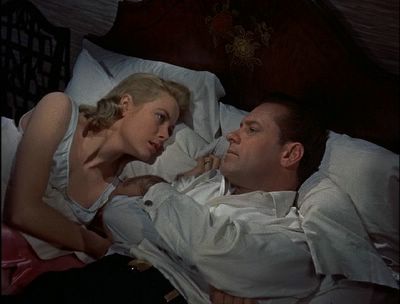
Holden has a silent, tragic quality that suits him well for the part. Harry recognizes the importance of his task and the inherent danger. He has difficulty reconciling the two, but ultimately he is dedicated to fulfilling what is asked of him.
Harry’s actions are brave and noble, but THE BRIDGES AT TOKO-RI doesn’t bludgeon us with blustery displays of patriotism or swelling string sections on the soundtrack. Instead it captures the loneliness and fear these courageous men experience. Fairly long stretches are silent except for radio transmissions. A lot of actual footage was obtained with the help of the Naval Air and Surface Forces of the Pacific fleet, and it dramatically underscores the plight of the men. Whether it’s a special mission or a comparatively routine accomplishment, such as landing a plane on an aircraft carrier whose deck may be bucking like a bronco, they must have nerves of steel to succeed and keep themselves alive. The real footage is more impressive than any CGI-created effects could have been.
Grade: B
(This is a revised version of my DVD review. Follow the link for more information on the quality of and features on the DVD.)

U.S. Navy reservist Lt. Harry Brubaker (William Holden) is summoned to active duty for a key mission during the Korean War in THE BRIDGES AT TOKO-RI. Harry struggles with the reality of being pulled from his job, home, and family, but he soldiers on with the knowledge that he has the rare skills necessary to complete a tactical air strike.
Harry’s mission has two equally dangerous components. First he and another pilot must make a reconnaissance flight over the targeted bridges and area. Then they will lead others in a risky attempt to destroy these strategically vital passageways.
Harry’s harrowing return to military duty begins when he must abandon his plane while flying over the ocean. Coming to his rescue are the hotheaded helicopter pilot Mike Forney (Mickey Rooney) and his assistant Nestor Gamidge (Earl Holliman). Rear Admiral George Tarrant (Frederic March) fears for Harry’s safety, especially since he reminds him of a son he lost during the war.

Harry receives a bit of good fortune when his politically connected wife Nancy (Grace Kelly) finagles her way to Japan. She brings their two daughters, and Harry gets to spend some time with his family before the mission commences. While this break raises his spirit, it also weighs heavily upon him as the flights loom.
Based on James A. Michener’s novel, the film tells a story modest in scale but large in impact. THE BRIDGES AT TOKO-RI effectively depicts the sacrifices and courage of those who went to war. An air of doom lingers over the film, and two of the most powerful scenes acknowledge the coiled despair felt by those involved. Admiral Tarrant speaks to Nancy of his losses in war and what her husband and she will be facing. This sets the stage for a melodramatic bedroom conversation she has with Harry. Kelly, luminous as always, displays the barely concealed fear that any spouse would feel in such a situation.

Holden has a silent, tragic quality that suits him well for the part. Harry recognizes the importance of his task and the inherent danger. He has difficulty reconciling the two, but ultimately he is dedicated to fulfilling what is asked of him.
Harry’s actions are brave and noble, but THE BRIDGES AT TOKO-RI doesn’t bludgeon us with blustery displays of patriotism or swelling string sections on the soundtrack. Instead it captures the loneliness and fear these courageous men experience. Fairly long stretches are silent except for radio transmissions. A lot of actual footage was obtained with the help of the Naval Air and Surface Forces of the Pacific fleet, and it dramatically underscores the plight of the men. Whether it’s a special mission or a comparatively routine accomplishment, such as landing a plane on an aircraft carrier whose deck may be bucking like a bronco, they must have nerves of steel to succeed and keep themselves alive. The real footage is more impressive than any CGI-created effects could have been.
Grade: B
(This is a revised version of my DVD review. Follow the link for more information on the quality of and features on the DVD.)
Saturday, August 06, 2005
The Rock
THE ROCK (Michael Bay, 1996)

Usually people attempt to break out of prison, not into it. Yet that’s exactly the challenge facing the crack team assembled by the United States government in THE ROCK.
General Francis X. Hummel (Ed Harris) is a decorated military man, but the government’s failure to acknowledge the deaths and compensate the families of some of his soldiers has driven him to desperate measures. General Hummel organizes a squad to steal poisonous gas. Next they take the tourists visiting Alcatraz hostage and set up their base on the site of the old, closed prison. They point several rockets containing the gas toward San Francisco. Hummel informs the government of his demand and intention. He orders the transfer of $100 million, which will be distributed to the families and those helping in the mission, or else he will unleash the efficiently lethal poison on an unsuspecting populace.
FBI agent Stanley Goodspeed (Nicolas Cage) specializes in chemicals and is called to be part of the unit. Stanley is a straight arrow--a Boy Scout, if you will--who works well under pressure but doesn’t have much practical experience in the field. He’s used to sitting at a desk instead of penetrating a highly guarded base run by domestic terrorists. A team of Navy SEALs will assist in the siege on Alcatraz, but there’s one major problem. No one knows how to find a way around the prison, no one, that is, except for the mysterious John Patrick Mason (Sean Connery).

Mason is a British spy who was forgotten in jail and has been rotting there ever since. He is the only person to escape alive from Alcatraz, so naturally he is brought in to delineate a plan of action for traversing the Rock. The FBI superiors don’t intend for Mason to go with the squad, but as he explains, the only map he had of Alcatraz was in his head. Reluctantly, he is placed on the unit. The team lands on the island under the cover of night, beginning their attack.
THE ROCK director Michael Bay was groomed in the Jerry Bruckheimer-Don Simpson school of action picture filmmaking. (Until this summer's THE ISLAND Bruckheimer served as producer on all of Bay's films.) The kinetic camera work and quick cutting that dominate Bay's style bring a sense of urgency to the wild action scenes dispersed throughout the film.
THE ROCK'S fast pace also sets up the story in a relatively short period of time. We know the identity of the villain, who will try to thwart his efforts, and how they will go about the process. The screenplay, attributed to David Weisberg, Douglas S. Cook, and Mark Rosner but honed by several others, does a sneaky thing on the way to Alcatraz. The two heroes are developed, or at least as much as one can expect for a standard action film. The action is diverted to the streets of San Francisco and a first-rate car chase. After an hour into the running time, the focus switches to the site in the movie’s title.
These things are important in that they keep the film from stretching out the time spent on Alcatraz and becoming bloated on unnecessary action scenes. The audience has invested its interest in the heroes and can enjoy the shootouts now that more is on the line.

A distinguishing characteristic of THE ROCK is the shades of gray involved with General Hummel. He could easily have been a moustache-twirling villain concocting his evil scheme and cackling the entire time but he isn’t. Hummel is infinitely more interesting because he is conflicted in his actions but feels he has no other recourse. Harris gives a marvelous performance. His steely eyes and strong cheekbones make him look like a force with which to be reckoned. Hummel is an unyielding man driven by moral certainty, and Harris comports himself in such a way to communicate this strongly.
Cage and Connery have a lot of fun in their roles. Connery gets to play James Bond if he were a politically oppressed prisoner. He has that movie star twinkle in his eyes, which shows he’s having a good time. Cage has good screen rapport with Connery, and their forged relationship is the source of many of the film’s laughs. In addition to the three major actors, THE ROCK has a healthy supporting cast of familiar character actors, including Michael Biehn, William Forsythe, and David Morse, to enliven the film.
A rousing action picture with generous dashes of humor, THE ROCK remains the much-maligned director's best film.
Grade: B+
(This is a revised version of my Criterion DVD review. Follow the link for more information on the quality of and features on the DVD.)
Tuesday, August 02, 2005
Hustle & Flow
HUSTLE & FLOW (Craig Brewer, 2005)
Smalltime Memphis pimp DJay dreams of a better life in HUSTLE & FLOW. Living in one of the Dirty South and crunk hot spots, DJay, smoothly played by Terrence Howard, believes his ticket out is cutting a hip hop track. He hooks up with Key (Anthony Anderson), a producer and former classmate, and beat master Shelby (DJ Qualls) to tell of his streetwise experiences. DJay then hopes to get the tape to Skinny Black (Ludacris), a former acquaintance who ascended to rap stardom.
HUSTLE & FLOW writer-director Craig Brewer possesses considerable formal skill and a great ability for capturing location. The grainy film stock soaks up the heat and grime of Memphis. The visual style, down to the title font, references the 70s blaxploitation films that give a gritty vibe to an otherwise conventional showbiz tale. For all of its earthiness, though, it’s a slick and deceptive bit of filmmaking that uses its environmental and movie authenticity—it feels real based on other film portrayals of these character types—to scam audiences into accepting DJay as a good guy.
Credit for DJay’s seductiveness goes to Howard, a gifted actor whose unadorned performance oozes out of him like sweat from the moist southern summer. There’s a natural impulse to hope the best for DJay, not only because he’s the protagonist but also because Howard plays the part with total conviction and urgency.
HUSTLE & FLOW navigates into problematic territory when it swallows DJay’s woeful story as tragedy intended to make him sympathetic. It isn’t fair to expect a film about a pimp to take a feminist perspective. Where Brewer gets himself into trouble isn’t who and what his characters are—pimps, prostitutes, and drug dealers—but in how he directs the audience to feel about them. It may be hard out there for a pimp, as the hook of DJay’s single proclaims, but it doesn’t redeem him. The film swoons when DJay and Shug (Taraji P. Henson), one of his pregnant hookers, clinch before he goes out in hopes of convincing Skinny Black to pass his tape to the right industry people. Nevermind that he has treated her with contempt through much of HUSTLE & FLOW and she is portrayed as a simple-minded woman who bends to his commands. Shug is the film’s female ideal, and their embrace is it’s romantic peak. Overlooked in all this is DJay’s casual cruelty in putting the prostitute Lexus (Paula Jai Parker) and her child on the street when she dares to challenge him.
Even more troublesome is how HUSTLE & FLOW presents the producer’s wife, Yevette (Elise Neal). She’s the only woman in the film who isn’t a hooker, yet from the outset she’s viewed as an overbearing nag. (Her first appearance is a dinner scene with Key in which she prattles on and on about work while he ignores her but humorously nods his head in affirmation.) Yevette turns out to be just another obstacle in DJay’s path to success until she does a complete turnaround and brings sandwiches to the pimp’s house during the recording sessions. Coming from a middle class existence, her behavior and blithe acceptance of the circumstances ring deeply false.
In spite of its dubious intent, HUSTLE & FLOW can be quite absorbing. The film works best when showing the intricacies of building tracks. The scenes with DJay, Key, and Shelby in the makeshift recording studio sizzle, and the songs are relentlessly catchy.
Like DJay, Brewer exhibits talent for what he does, but too much of it is in service of hogwash.
Grade: C
(A shorter version of this review first aired on the August 2, 2005 NOW PLAYING)
Subscribe to:
Posts (Atom)