January 22-28, 2013
Film
15. HANSEL & GRETEL: WITCH HUNTERS (Tommy Wirkola, 2013) (2K DCP) (3D) (Arena Grand) (January 25)There
are indications within HANSEL & GRETEL: WITCH HUNTERS that this was
supposed to be a comedy rather than whatever it turned out to be. Will
Ferrell and Adam McKay are credited as producers, which doesn’t mean
anything in and of itself other than funny movies being their business.
Then there are the comedic touches hinting at a more irreverent film
than the fantasy-action hybrid that dominates. Drawings of missing
children are attached to milk bottles. When a young beauty is accused
of being a witch before the assembled villagers, some of the shouted
comments recall Monty Python. Hansel has diabetes from his youthful
captivity and has to give himself a shot on a regular basis. These
elements suggest this might have been developed as an elaborate goof
along the lines of CASA DE MI PADRE. Except apparently it isn’t. Grade: D/3016. MOVIE 43 (Various directors, 2013) (2K DCP) (Gateway Film Center) (January 25)It’s
common practice for folks to harp on SATURDAY NIGHT LIVE for the
lameness of its sketches, but after seeing MOVIE 43, a loosely linked
collection of gross-out one-upmanship short films, I think everyone
ought to cut them a break. The worst of what SNL writers come up with
in a week is exponentially better than everything in MOVIE 43, which
took years to make. The
ads have touted the galaxy of stars appearing in it, which
is true enough and meaningless in the grand scheme of things. Maybe they were doing favors for friends who needed a
break. Maybe they wanted to make something silly in their free time,
except someone decided their horsing around ought to be released to the
public. Maybe a marketer designed it as a test to see if a movie could
be sold on the basis of a poster with as many little heads in boxes as
possible.The
jokes are supposed to be daring, but this is outrageousness in scare
quotes. Kate Winslet is horrified to discover that blind date Hugh
Jackman has a scrotum on his neck that no one else seems to notice!
Anna Faris wants Chris Pratt to poop on her! Chloë Grace Moretz is
having her first period, and the boys and man in the house don’t know
what to do! African-American basketball players don’t realize that
they’ll crush their white counterparts on the court! Stephen Merchant
and Halle Berry’s blind date becomes a series of escalating offensive
challenges! Imagine if an iPod was a life-size naked woman with a
cooling fan put in an orifice where it might cause damage to its aroused male owners!The
one short with potential features Liev Schreiber and Naomi Watts as
parents who are giving their son the full public school experience
despite educating him at home. They subject the teen to all the
bullying he’s otherwise missing out on, which is worth a couple laughs
with Watts as a mean girl. This short is also the only one with any
discomfiting content, as mom and dad don’t want to deny their boy a
dating life. It doesn’t all work, but at least it’s shooting for
something subversive that the others aren’t. The
through line finds Dennis Quaid as an aspiring filmmaker holding studio
executive Greg Kinnear hostage as he pitches his ludicrous ideas and
forces him to bankroll it. MOVIE 43 looks extraordinarily cheap and
doesn’t have the energy to stick to its barely developed concept by the
end. No explanation is provided for the generic title. .Grade: F/1617. PARKER (Taylor Hackford, 2013) (35mm) (AMC Dublin Village) (January 26)I’ve
probably disliked more Jason Statham movies than I’ve liked, but if
he’s the lead, I’ll give the film a shot. (The same goes for Dwayne
Johnson/The Rock.) Based on a character from a series of books Donald
Westlake wrote under the name Richard Stark, PARKER is a more
respectable entry in Statham’s filmography than the actioners that could
pass for (or are) direct-to-video fodder. The career criminal Parker
could be his James Bond, the defining character he returns to every
couple years and eventually passes on to someone else. PARKER’s box
office performance probably scuttles any ideas of sequels, which is
unfortunate even though I don’t think this film is good enough.The
heist at the Ohio State Fair gets PARKER off to a good start, and
that’s not just me feeling local pride because this part was shot in Columbus. (Alas, the butter cow didn’t make it into the film.) From
there it’s a decent mix of hard-nosed guys roughing each other up and
Parker plotting, plus an inordinate amount of time given to Jennifer
Lopez’s real estate agent and her troubles. Lopez plays her as being
too nice for the conniving she gets involved in. She could have stood
to flash her OUT OF SIGHT toughness.PARKER
ends up being to Statham what JACK REACHER is to Tom Cruise: an
average, book series-adapted programmer with an above-average cast and
ultimately unsatisfying arc. In other words, it’s a perfect movie to
run endlessly on cable TV.Grade:C/5218. KILLER JOE (William Friedkin, 2011) (HD stream) (January 27)I
first saw KILLER JOE at the 2011 Toronto International Film Festival
and was not entirely sure what to make of it. I found it somewhat
off-putting in its excessiveness and funny in a really bleak way.
Mixing uneasiness and humor can be a volatile combination, especially
in a film so eager to rub the viewer’s nose in it all, and I couldn’t
tell if I was supposed to be laughing at parts when I was repulsed by
others. On
second viewing I felt like I had a better grip on the tone William
Friedkin is striving to maintain. It is primarily a comedy, just an
exceedingly dark one. I also realized I’d made one major
misinterpretation. I mistook the age of Juno Temple’s character, who’s
given to the contract killer as a retainer in case her father and
brother can’t pay. At one point she says she claims to be a
twelve-year-old. She means that’s her mindset in a specific moment, not
her actual age, but I thought she was speaking literally. KILLER JOE
goes pretty far in trying to shock, but even it has limits.So
KILLER JOE played better to me this time, and the performances of the
four main actors look all the stronger for it. The film’s view of
society is pretty jaded, but this is a fairly accomplished, if nasty,
piece of work. (Review)
Grade: B/66Shorts-AVANT-GARDE MASTERS: A DECADE OF PRESERVATION (URBAN & RURAL LANDSCAPES)I’m
trying to stretch myself as a viewer, so I went back to the Wexner
Center for another round with experimental cinema. Chalk it up to
physical weariness--I worked out for an hour before the program--or the
struggles I can have with non-narrative works, but I had to fight off
the desire to fall asleep. The ideas of both films play better to me in
memory than they did during the experience of watching them. Maybe
that just means I was tired, or maybe it’s indicative of me only being
able to appreciate this type of cinema to a point. Time will tell.

10s. SIDE/WALK/SHUTTLE (Ernie Gehr, 1992) (35mm) (Wexner Center for the Arts) (January 24)
In
theory SIDE/WALK/SHUTTLE should be a good gateway film for me. The
strong horizontal and vertical lines that make up downtown San Francisco
are displayed like an architectural Mondrian, and the shifting
perspectives of these buildings and streets grants unique views of the
urban landscape. The camera rides up and down on an elevator to provide
different, sometimes disorienting ways of seeing the space. Ernie Gehr
doesn’t need any CGI to make INCEPTION’s folding city. At least for me
on this night, though, a little of it went a long way
11s. BARN RUSHES (Larry Gottheim, 1971) (16mm at 18fps) (Wexner Center for the Arts) (January 24)
A
little going a long way applies tenfold (or more) to BARN RUSHES. This
study of light presents virtually identical tracking shots of a barn at
different times of the day and year. While there is an aesthetically
pleasing element to seeing how the object transforms according to the
quality of the light, the repetition wore on me.
Music
12. Frank Ocean CHANNEL ORANGE (2012)
Noel
Murray wrote about how his reaction to this good album didn’t match the
extraordinary reception and wondered if the hype ultimately is doing a disservice to the artist and record. In reading what he considers the
albums shortcomings, I found he was pointing out why I never embraced
CHANNEL ORANGE with the enthusiasm that the music press did. Listening
to it again, I appreciate it more than I did last summer, but it still
sounds like a rough draft. If the album’s highs were plucked out and
sprinkled throughout a playlist, I’d be tempted to agree that it’s the
contemporary R&B classic that many believe it to be. On its own I
find plenty to like and enough to be frustrated by in its incompletion
or doodling.
Key tracks: “Sweet Life”, “Pyramids”, “Lost”, and “Bad Religion”
Live Music
2. BONNIE “PRINCE” BILLY (Wexner Center for the Arts Performance Space - Columbus, Ohio) (January 25)
I
know what kind of music Will Oldham plays and some of the various names
he releases his work under, but I’m not well acquainted with his
artistic output. Watching OLD JOY is probably the most time I’ve spent
with anything he’s done. I had no intention of going to this concert,
but a preview article about this show in the next-to-last issue of THE
OTHER PAPER, a Columbus alternative weekly, convinced me that I really
ought to check it out. That was the right decision.
Accompanied
by Cheyenne Marie Mize and Emmett Kelly, Oldham’s somber folk songs
cast a spell over the room. His occasional stage patter lightened the
mood, even when he favored saying darkly humorous things about the end
of the world. The best live music can catch you in the moment and
transport you. This performance did that for me in a major way. It’s a
greater achievement because I was coming into the concert unfamiliar
with anything that would be played. Guess I have some digging to do
into the music of Oldham and his collaborators.
Live Sports
2. NHL: Dallas Stars at Columbus Blue Jackets (Nationwide Arena - Columbus, Ohio) (January 28)
What
a difference a week makes. The previous Monday the arena was sold out
and rocking. In my regular seat this night, I had the entire row to
myself. (My seat is about as low in my preferred section as it’s
possible to get in a package, so it’s not like it’s out of the way.)
Attendance was over 10,000, so the crowd wasn’t nonexistent, just
spread out and more subdued. For good reason. The Blue Jackets came
out really flat early yet somehow managed to pull out a regulation win.
You
always want your team to come out on top--no complaints there for this
game--but live sporting events are more fun when the whole place is into
it. I’ll give credit to game operations for working hard to keep folks
engaged, especially when the play on the ice is less than stellar.
Having been to two games this season, it seems like they’re emphasizing
the sport more during breaks and being more judicious in peppering the
audience with ads and silly time-fillers. In other words, it seems like
there’s a bit less pandering to the casual fans. If there’s one thing
that can be tiresome at games these days, it’s the scoreboards and sound
systems practically screaming, “ARE YOU NOT ENTERTAINED?” when there’s
the briefest lull in the action. If the Blue Jackets are dialing it
back a little in favor of game-focused content, that’s terrific.
January 15-21, 2013

Film
10. MAMA (Director, 2013) (35mm) (Arena Grand) (January 18)
In
short time Jessica Chastain has become one of the best working
actresses. It’s surprising to check her filmography and find little
there prior to her breakout 2011. Granted, she amassed several projects
that all happened to see the light of day in the same year, but her
emergence felt like it occurred overnight even if it didn’t. While she
won’t be winning any awards for MAMA, she’s very good in this
contemporary fairy tale by way of a horror movie. This kind of film can
often feel like it comes off the assembly line, but MAMA displays some
thoughtfulness and visual flair to set it apart. (Review)
Grade: B-/63
11. BROKEN CITY (Allen Hughes, 2013) (35mm) (Arena Grand) (January 18)
Forget
it Mark Wahlberg, it’s the Big Apple. Allen Hughes tries to make New
York City’s version of CHINATOWN. He has the look and feel down, but
the intricate twists and turns in Brian Tucker’s screenplay lack much in
the way of surprises.
The
more interesting elements tend to be in the margins. The girlfriend of
Wahlberg’s character is an aspiring actress, and they attend the
premiere of her independent film. What we see of it are pretty
terrible--intentionally so--and hysterically funny. This section
provides a more incisive and witty look below the surface of official
public statements than the political scenes. I also liked Alona Tal as
Wahlberg’s administrative assistant. Her give-and-take with the boss
snaps.
Grade: C/47
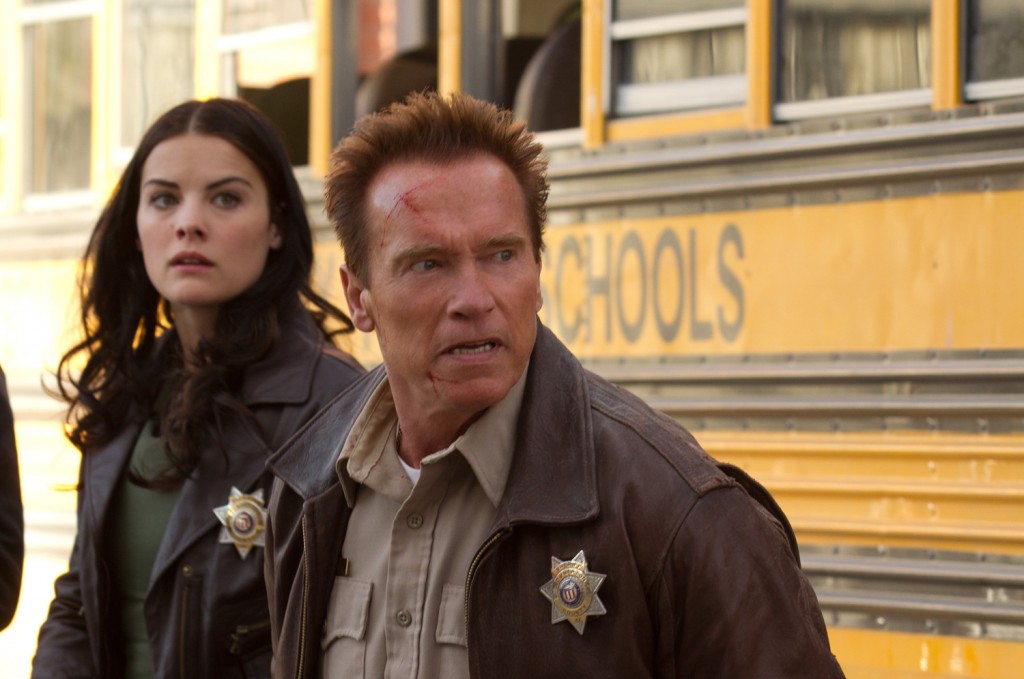
12. THE LAST STAND (Kim Jee-woon, 2013) (2K DCP) (Rave Polaris) (January 19)
I
elected to keep these observations out of my review, but this seems
like the right space for them. Can THE LAST STAND be read as a
conservative fantasy? The hero is jaded about life in the big city and
gives it up for peace and quiet in quintessential small town America.
The feds are either corrupt or unsuccessful at their job. It falls
upon the local officials to get the job done properly. The good guys
even require a citizen’s private arsenal to fight back. The hero and
villain chase and duel with American-made cars. Or maybe it’s just the
form and this is all reading more into it than is intended? (Review)
Grade: B-/60
13. BEVERLY HILLS COP (Martin Brest, 1984) (HD stream) (January 20)
A
by-the-numbers crime story drags down this would-be comedy. As the
fast-talking and ingratiating prankster policeman, Eddie Murphy shows
why he’s a star even though his films are, by and large, not very good.
He’s very appealing in BEVERLY HILLS COP as he orders room service for
the officers staking him out and stuffs bananas in their tailpipes to
shake them, but Murphy’s personality isn’t enough to carry a film more
devoted to the boilerplate TV procedural plot. There’s literally zero
mystery in the investigation. The tepid fish-out-of-water humor fails
to mine the comedy in a streetwise Detroit detective visiting swanky
California. And hey, there’s Jonathan Banks as a bad guy! There’s
nothing remarkable about what he does here, but for anyone who’s seen
him on BREAKING BAD, it goes to show the talent that often goes
unnoticed in disposable parts like this one.
Grade: C/46
14. ZERO DARK THIRTY (Kathryn Bigelow, 2012) (35mm) (Arena Grand) (January 21)
Just as riveted seeing it a second time. And what I said about Chastain in MAMA? That goes double or triple for her here. (Review)
Grade: A/90
Shorts
9s. REJECTED (Don Hertzfeldt, 2000) (YouTube) (January 16)
“My
anus is bleeding!” Proof that I don’t always need humor to be
sophisticated. I laughed myself silly when I saw this in THE ANIMATION
SHOW and did so again when showing it to some students the day after
taping a show in which we reviewed IT’S SUCH A BEAUTIFUL DAY.
Grade: A/90

Literature
1. GONE GIRL (Gillian Flynn, 2012)
Through
a conventional mystery Gillian Flynn dissects a troubled marriage and
explores what we think we know about the people we see, be it in
everyday life or in the media. She alternates chapters of the husband’s
thoughts when his wife goes missing on their anniversary and her diary
entries. It’s an ingenious way of studying how individuals construct
the selves they reveal to others and the assumptions society makes based
on available information, especially in sensational news stories. GONE
GIRL can be very cynical about how men and women relate to one another
and how people use others for their own purposes, but it’s a fascinating
and often thrilling read.
While
reading the novel, I felt like it could be best translated as a short
order TV series, maybe two or three seasons. After I finished GONE
GIRL, it was announced that David Fincher may direct the film adaptation. He’s a sensible choice. Reportedly Reese Witherspoon may
play the lead female role. This should be a whale of a part. The only
thing of note she’s done in recent years is HOW DO YOU KNOW, so it would
be nice to have her return with something worthy of her talent.
Music
10. Van Halen THE BEST OF BOTH WORLDS (2004)
Other
than excluding “Ice Cream Man”, this 2-CD greatest hits set includes
pretty much all the album-oriented rock radio staples by one of the
biggest rock bands of the 1970s, ‘80s, and early ‘90s. A collection
like this would be hard to mess up, yet the sequencing has to be among
the worst of any band’s best-of compilation. The listener can fix this
in the MP3 era, but if you pop this into a car CD player, as I did this
week, the order is maddening.
The
first disk begins with “Eruption”, inexplicably separated from their
cover of “You Really Got Me”, and three mediocre-to-bad new songs. From
then the set lurches between eras, alternating between songs with David
Lee Roth and Sammy Hagar as lead singer. The only consecutive Roth-era
songs are tracks 13 and 14 on the second CD, and they’re promptly
followed by three live cuts with Hagar plowing through Diamond Dave
classics. Clearly the sequencing is a middle finger from the band to
Roth, but they’re also insulting fans and making themselves look bad.
If anything, the stark contrast makes the Hagar-era songs pale in
comparison to when Roth was the front man.
I
used to prefer the so-called Van Hagar lineup, probably because those
songs were more melody-inclined, but put me down now as recognizing that
the group was far superior when Roth was in the band. His goofball
persona used to be what put me off, but listening now I can hear how
he’s a better fit, especially at selling the double entendre-laden
lyrics. Hagar sounds too earnest in comparison.
Key
tracks: “Ain’t Talkin’ ‘Bout Love”, “And the Cradle Will Rock...”,
“Unchained”, “Panama”, I’ll Wait”, and “Runnin’ with the Devil”
11. The Walkmen HEAVEN (2012)
At
this point when Spoon puts out yet another great album, it’s taken for
granted. Quietly The Walkmen are in the process of doing the same
thing. I’m slowly trying to put together a favorite albums of 2012
list, so I popped their latest in and was reminded (and kind of stunned)
how great it is. Maybe I should have gone down to campus this week to
see them in concert again. (I caught them in Cincinnati opening for The
New Pornographers in 2011 and was suitably impressed.)
Key tracks: “We Can’t Be Beat”, “Love is Luck”, “The Witch”, and “The Love You Love”

TV
-BUNHEADS (ABC Family)
Also
file under Unfortunately Named Television Series. I’m clearly not the
target audience for a program about a Las Vegas showgirl reassessing her
life while instructing ballerinas in small town California. I’ve never
watched anything on ABC Family or an episode of creator Amy
Sherman-Palladino’s GILMORE GIRLS. Nevertheless, I don’t know if
there’s another current show that leaves me feeling as good after an
episode as this one. Delightful repartee, appealing characters, and
inventive dance numbers make it the complete drama-comedy package.
I
don’t dance and possess little understanding of the art, but over the
years I’ve noticed that I really enjoy dance films. THE RED SHOES is an
all-time favorite. I also like the Japanese original and American
remake SHALL WE DANCE?, THE COMPANY, STEP UP 2: THE STREETS,.and CENTER
STAGE, among others. There’s just something about communicating feeling
through motion that moves me immensely. For example, Jeanine Mason
gets a beautiful single shot solo in the third episode of the first
season’s second half that is unspeakably light and charming, which says
everything about the idealized character she plays. Julia Goldani
Telles caps that BUNHEADS episode with an emotional piece expressing her
character’s fear. For a series so reliant on fast-flung words, the
dance scenes can be the most revealing and powerful.
I
can’t write about BUNHEADS and not mention Sutton Foster, who I first
saw in ANYTHING GOES on Broadway in 2011. She has the old-fashioned
entertainer qualities that surely would have made her a film superstar
in the screwball era. Her comic timing is aces, and she looks
effortless in her dancing.

Live sports
1. Detroit Red Wings at Columbus Blue Jackets (Nationwide Arena - Columbus, Ohio) (January 21)
During
the NHL lockout I was ambivalent about the season being saved. The
Columbus Blue Jackets were likely in for another bad season, and I was
busy enough with other things that its absence in the fall didn’t stand
out. I was a little disappointed to miss out on attending the All-Star
skills competition, but once the lockout reached deep enough into the
original schedule, it was all for the better. What fun would All-Star
game activities be they were being performed as a duty in a compromised
season?
Nevertheless,
when the lockout ended and a revised 48-game schedule was released, I
found myself ramped up for hockey’s return. I even bought a ticket for
opening night. Deals were plentiful because the CBJ had a week to sell
tickets for the first game and needed to make overtures to fans angry
about the lockout. As a quarter season package owner, I was offered
lower bowl seats for $25 through February. Ticketmaster fees were even
waived for the first week. They got me.
Opening
night in Columbus, the team’s second game, was a lot of fun. The place
was sold out, no doubt due to the ticket bargains and the opponent, the
hated Red Wings. The mammoth new scoreboard is a beauty and was
utilized better in terms of showing replays and keeping the “fan
experience” stuff (kiss cam, movie clips to prod enthusiasm) to a
minimum. The crowd was as energetic as I’d experienced it in some time,
perhaps since the first (and only) year the Blue Jackets made the
playoffs. The team played hard and almost pulled out a win. Losing 4-3
in a shootout was not the preferred outcome, but it was an entertaining
game that suggests maybe this team will be a fun one to watch.
Realistically, that’s what I’d like.
WARM BODIES (Jonathan Levine, 2013)
What’s
a hunky, sensitive, undead guy like R (Nicholas Hoult) supposed to do
after the apocalypse? It’s been eight years since a plague left many,
including him, as shuffling, brain-hungry vessels called corpses. When
he’s not chowing down on some gray matter, R trudges around the airport,
shares knowing grunts with his best friend M (Rob Corddry), and kicks
back on the plane he’s made home by getting misty listening to records.
(He’s a vinyl aficionado because it delivers better audio reproduction,
natch.)Like
his fellow corpses in WARM BODIES, R is unable to recall his pre-zombie
life. He can make an educated guess about who he was based on his
clothes and thinks he knows the first letter of his first name but
that’s it. While zombies have no memories of their own, eating brains
isn’t just part of a healthy diet. It also allows them to absorb their
victims’ memories. While
hunting for food R and company encounter human survivors who’ve
ventured beyond their walled city to scavenge for pharmaceuticals. R
feasts on the brain of Perry (Dave Franco) and the poor guy’s
affectionate thoughts for his girlfriend Julie (Teresa Palmer). This
has a strange effect on R. He develops feelings for the pretty blonde
and chooses to whisk her out of the situation’s immediate danger and
into safe hiding on his jet.At
first Julie is understandably anxious about the arrangement, but
gradually R’s gentlemanly manner puts her at ease. She can tell that
under his cold, dead skin is a warm and generous heart, metaphorically
speaking at least. He is unwavering in protecting her from the corpses
and the boneys, the name given to the faster, animalistic undead who
have peeled off their skin. Julie becomes fond of R, but how can she
explain this star-crossed romance to her friends or her dad (John
Malkovich), who’s leading the uninfected’s fight against their undead
predators?

This
zombified version of ROMEO AND JULIET ups the stakes in placing the
couple between rungs on the food chain rather than feuding families, but
it trivializes the love story because R’s devotion is not genuine. He
might as well have sipped a magic potion in secret, except in this case
he’s gobbled some choice cerebrum. R is having a vicarious experience
performing the role of adoring boyfriend to an unknowing Julie, opening
up WARM BODIES to the potential satire of idealization in relationships
or projected familiarity in the communication age. Instead
writer-director Jonathan Levine reduces the allegorical components to
their simplest terms and recycles the love-conquers-all motif in a
scenario that doesn’t earn the payoff. Although
based on a novel, WARM BODIES feels like the product of a studio
executive who thinks Shakespeare’s play is great except it could use a
happy ending. Oh, and zombies are popular at the moment, so might as
well add them too. The reappropriated plot works out an acceptable
revised resolution, even if it’s betraying its primary influence. The
genre trappings are en vogue, perhaps cynically so, but using the undead
as a prism for viewing tragic romance could have been a valid creative
choice if the protagonists’ connection wasn’t forged how it is,
especially because brain consumption in zombie lore doesn’t imply or
require memory transference.The
lovers’ names, main struggle, and the balcony scene make the overlays
with ROMEO AND JULIET unmistakable, but R and Julie get along like
Tarzan and Jane as well. He saves her from the threats in his untamed
environment. She humanizes the savage in place of serving as a
civilizing influence on him. Whether the Edgar Rice Burroughs parallels
are intended or not, combining Shakespeare and zombies creates the
expectation that the text will be treated with some irreverence, but to a
baffling degree WARM BODIES is played mostly straight. To Hoult and
Palmer’s credit, they don’t look ridiculous articulating the earnest
romance between the living and undead. If only the film around them
reflected the humor in it. Grade: C
KILLER JOE (William Friedkin, 2011)
Chris Smith (Emile Hirsch) has little time remaining to repay six thousand bucks to some bad men or else he’ll be killed. Desperate to remedy the matter, he approaches his similarly broke father Ansel (Thomas Haden Church) with a solution. His mother Adele, Ansel’s ex-wife, has a $50,000 life insurance policy to which Chris’ younger sister Dottie (Juno Temple) is the sole beneficiary. All they need to do to set their personal finances straight is hire Joe Cooper (Matthew McConaughey), a Dallas Police Department detective who kills people on the side, to bump off Adele.
After agreeing to split the money four ways--Ansel insists his wife Sharla (Gina Gershon) gets a cut--they’re ready to put the plan in motion except for one minor problem. They can’t pay Joe $25,000 for the service they want him to render until they get the claim check. Joe is prepared to break off a business agreement with them, but he has his cold blue eyes fixed on Dottie and proposes they give her to him as a retainer.
The world according to KILLER JOE is a scuzzy Texas trailer park where the family plots to kill one member for a windfall and will pimp out another to make it possible. The innocent in the middle is a weary girl already so jaded by what life’s dealt her that she signs off on her mother’s murder and embraces being sold to a contract killer because he shows interest in her. The only person following a code is a moonlighting hit man. Say what you will about his ideas of right and wrong, but at least it’s an ethos.

Transcending
basic instincts is unimaginable when choices are guided entirely by the
reptilian brain. The stupid and venal characters in KILLER JOE cast
fun house mirror reflections of a society seeking its best interests
while excluding accepted principles. Director William Friedkin and
screenwriter Tracy Letts, adapting his play, place the bad behavior in a
dark comedy about the depths of depravity. Like Wile E. Coyote assured
that this time he’ll catch The Road Runner, Hirsch plays Chris as
someone who thinks he’s smarter than he really is and has the bruises to
show for his lack of good judgment. Church’s slack-jawed caricature of
Ansel amuses as he serves as lunkheaded lackey to Chris’ would-be
mastermind. Gershon draws laughs with the brazen disrespect she shows
her husband and stepson.
Temple
interprets Dottie as a tarnished angel in seek of salvation however it
may come. Acting younger and simpler than her character’s years would
signify--her bed teems with stuffed animals, and the bedroom door is
decorated with teen idol magazine headshots of Justin Bieber, 3RD ROCK
FROM THE SUN-era Joseph Gordon-Levitt, and others--Temple reveals the
glimmers of youthful goodness that, if permitted to flourish, might
emerge from this hellhole. There’s no tragedy in the other Smiths’
bumblings, but her light hasn’t been snuffed out entirely yet.
McConaughey
is funny and fearsome in the title role, the devil holding the family
accountable for their choices. Despite Joe’s capacity for violence,
McConaughey presents him as the pragmatic businessman and courtly
gentleman. When he drops the cool reserve and southern civility in the
intense final act, KILLER JOE produces a reckoning to make the
unbelieving wish for divine intervention. Under the sun’s pounding rays
and the night’s garish neon and fluorescent lights, there’s no hiding
from one’s actions in this provocative and wickedly humorous film
Grade: B
MAMA (Andrés Muschietti, 2013)
A
distraught father of two little girls comes home, kills their mother,
and takes the kids with him before the authorities arrive in MAMA. His
reckless driving results in the car sliding off the icy country road and
being totaled. All three escape with just some scratches and bruises
and make their way to a ramshackle cabin deep in the forest, but the
one- and three-year-old sisters have not found safety. Their tearful
father still intends to murder them. As he’s about to pull the trigger,
a spectral figure comes to the rescue. Regardless
of the time and expense, their Uncle Lucas (Nikolaj Coster-Waldau) pays
men to search for the missing girls. Five years later six-year-old
Lilly (Isabelle Nélisse) and eight-year-old Victoria (Megan Charpentier)
are found, but his nieces have turned feral in the intervening time.
While under psychiatric supervision, they draw pictures and speak of
someone they call Mama. Dr. Dreyfuss (Daniel Kash) wants to get to the
bottom of this mystery, so he helps Lucas and his girlfriend Annabel
(Jessica Chastain) become their custodians on the condition that he will
continue to have access to the troubled siblings.Victoria
and Lilly resist adapting to their new home environment. The girls are
still drawn to someone or something they know as Mama and often hostile
to their caregivers, especially Annabel. She wasn’t necessarily eager
to become a mother and is put in the difficult position of watching them
on her own when Lucas is hospitalized after nearly being killed by the
jealous and protective entity that has followed his nieces to the house.

Within
the context of a modern Brothers Grimm fairy tale MAMA considers the
range of maternal instincts from dutiful indifference to selfish
sheltering. Director and co-writer Andrés Muschietti lays out an
ingenious comparison and contrast between Annabel and Mama in which more
admirable qualities are associated with the antagonist. Mama is a
fierce guardian of the girls from the moment she encounters them whereas
Annabel struggles with the role she’s forced to adopt. Mama plays with
Victoria and Lilly while Annabel prefers to bide her time sticking to
her interests and relates to the kids as required in a legal capacity.
Chastain
has developed into one of today’s best actresses through more reputable
fare than this horror film, yet she invests the role with the same
commitment given to characters embodying eternal grace and searching for
Osama bin Laden. Under an unflattering black pixie wig, Chastain
reveals rock band bassist Annabel as a reluctant mother torn between her
inclinations and obligations. In what becomes an affecting journey,
Chastain gradually exposes her character’s evolving feelings for the
girls as Annabel is able to step outside herself.MAMA
has its share of screenplay contrivances to be overlooked, which is
often par for the course with genre films, but it succeeds where it
matters most. Muschietti utilizes screen space well, particularly in
scenes in which Mama is present but unseen to Annabel. He maintains a
good balance of atmosphere to jump scares and enhances the former with
sepia tone visuals suggestive of legend. (The brown-tinted images pop
the most in a haunting flashback/nightmare sequence.) Thrillingly, MAMA
builds to an ending that summarizes its theme in a beautiful and
astonishing manner. Grade: B-
THE LAST STAND (Kim Jee-woon, 2013)
Ray
Owens (Arnold Schwarzenegger) experienced more than enough danger and
action for a lifetime as a Los Angeles narcotics cop, which is why he
gave it up to become sheriff of a sleepy southwest Arizona border town.
With its postcard-perfect Main Street, Sommerton Junction is the kind
of place where a local farmer delivers fresh milk to the diner and
strangers stopping for a bite to eat stand out. As almost everyone has
left town to watch the high school football team play in the state
championship, it promises to be another quiet weekend for Ray and his
three bored deputies in THE LAST STAND. Meanwhile,
drug kingpin Gabriel Cortez (Eduardo Noriega) escapes from the FBI
despite the high level of security and secrecy surrounding his prison
transfer in Las Vegas. Cortez’s subordinates supply him with a
supercharged Corvette boosted from an auto show. The one-time race car
driver speeds toward Mexico with an agent (Genesis Rodriguez) as his
hostage. Agent John Bannister (Forest Whitaker) and his team eventually
determine that Cortez plans to cross over in Sommerton but are
incapable of catching up to him in time. It falls upon Ray and his
ragtag crew, which includes a prisoner (Rodrigo Santoro) and a local
eccentric with an arsenal (Johnny Knoxville), to block Cortez’s road to
freedom.Schwarzenegger
eases into his full-fledged return to the movies after his terms as
California governor. Like an athlete shaking the rust off after time
away from his sport, he warms up with routine police work and
self-effacing humor in THE LAST STAND’s table-setting first half. When
the film smoothly shifts into non-stop combat, Schwarzenegger turns on
the charisma and brute force that made him one of the biggest action
stars in the world. His corny one-liners seem more obligatory than
amusing, but despite getting up there in years, the star’s
broad-shouldered brawn is still built for manhandling bad guys. He may
not be the superhuman he was in the ‘80s and ‘90s, but when
Schwarzenegger is wearing a badge, he can credibly claim to be the
roughest, toughest lawman on screen.

To
its detriment THE LAST STAND doesn’t provide Schwarzenegger with a
worthy antagonist. While the small scale of Cortez’s scheme is
refreshing in an age of action films with outlandishly high stakes, he
doesn’t do much, mainly because he’s isolated behind the wheel of a car
most of the time. Cortez is also less imposing or funny than his
henchman Burrell (Peter Stormare), who wallows in his sleaziness and
disregard for those who get in his way.Once
the bullets are flying director Kim Jee-woon shoots the barely
contained chaos with a clear understanding of physical space often
neglected in the hypercut, CGI-heavy spectacles of today. At its core
THE LAST STAND is a throwback film, an old-fashioned western updated
with 20th and 21st century weaponry and vehicles. The lengthy gun battle
in the middle of Sommerton delivers the simple pleasures of watching
heroes and villains exchange fire and trying to outflank one another.
The subsequent car chase through a cornfield and hand-to-hand fight
thrill with the one-on-one showdowns between machines and men.The
streamlined ticking clock plot pushes THE LAST STAND along during its
pokier moments, and the supporting characters, like Luis Guzman as the
comic relief deputy and Harry Dean Stanton as a crotchety farmer, liven
up the wait for the face-off with the bad guys. At a time when most
cinematic action stars receive significant special effects enhancement,
if not existing entirely in computers, it’s nice to have Schwarzenegger
back and practical effects showcased. THE LAST STAND doesn’t find him
in peak form, but it’ll suffice as a sturdy exhibition of his talents. Grade: B-
January 8-14, 2013
Second
week in and already it’s a challenge to keep up with this. I’ll blame
it on coming down with the crud that’s going around, writing for the TV
show, and consuming quite a bit. Better late than never, right?
Film
5. IT’S SUCH A BEAUTIFUL DAY (Don Hertzfeldt, 2012) (DVD) (January 8)
At
the end of last year the champions of this animated feature came out of
the woodwork and for good reason. Don Hertzfeldt made a funny,
achingly sad, and empathetic movie that defies expectations. (Review)
Grade: B+/75
6. GANGSTER SQUAD (Ruben Fleischer, 2013) (35mm) (Arena Grand) (January 11)
Everyone
I’d tell that this was no good kept saying, “But that cast!” True, an
impressive cast is assembled, but they’re not credible because Ruben
Fleischer applies the comic book team-up film aesthetic (ie., MARVEL’S
THE AVENGERS) to a period gangster picture that provides scant
characterization. The tongue-in-cheek humor doesn’t mix well with the
off-the-books (but totally OK because they’re cops) violence. Ryan
Gosling does something weird with his voice, at least in his first
scene. The Chinatown sequence is put together nicely enough--is this
the replacement scene for the section removed after the Aurora, Colorado
movie theater shootings--and the final stand-off isn’t too shabby
either. Ultimately, though, it feels like everyone’s playing dress-up
as hard-boiled heroes and villains.
Grade: C-/45
7. BARBARA (Christian Petzold, 2012) (2K DCP) (Gateway Film Center) (January 11)
Although
BARBARA is, in part, a thriller and a melodrama, it resists feeling
anything at all until the protagonist must make a crucial decision.
Nina Hoss is inscrutable but intriguing as the title character, a
doctor banished to the countryside in 1980 East Germany. The film
supplies few details about her and is all the better for it as the
larger picture of who she is comes into focus. BARBARA’s strength is
not knowing which direction it may lead us at any moment.
Grade: B/70
8. DJANGO UNCHAINED (Quentin Tarantino, 2012) (35mm) (AMC Dublin Village) (January 12)
The
second time seeing DJANGO UNCHAINED was the charm for me. I liked it
during my first viewing but wasn’t entirely sure that it was complete.
It opened up on a repeat visit, proving to be much deeper and more
controlled than I gave it credit. My favorite films of 2012 tended to
require being seen multiple times, which I’ll choose to characterize as a
sign of their richness and not my deficiency as a viewer. (Review)
Grade: A/92
9. THE IMPOSSIBLE (Juan Antonio Bayona, 2012) (DVD) (January 13)
The
tsunami sequence is suitably impressive, and the period in which mother
and son, played by Naomi Watts and Tom Holland, must try to get to
safety is ripe with drama. Then they receive some help, and all the air
seems to go out of the film. My NOW PLAYING co-host respectfully
disagrees with that point, but the effort to reunite the family, if
everyone survived, felt perfunctory to me more often than not. (Review)
Grade: C+/58
Shorts
AVANT-GARDE MASTERS: A DECADE OF PRESERVATION (Wexner Center for the Arts) (January 10)
I’ll
be the first to admit that I don’t have much familiarity with
experimental cinema, and sometimes what little I’ve seen completely
baffles me as to its appeal. Still, I try to remain open to
appreciating the work being done off the beaten path. I’m acquainted
with the person who introduced this particular program, so I thought I’d
show support and check it out. I also feel it’s important to support
the Wexner Center’s Film/Video department, as the folks there do an
excellent job of providing chances to see films like these on celluloid.
As it turned out, I enjoyed this particular restored shorts program
overall and noted how some of these have had clear influences on music
videos.
For accounting purposes in this journal, I’m counting shorts separately from features.
1s. COSMIC RAY (Bruce Conner, 1961) (16mm)
Most
of the energetic COSMIC RAY features a nude woman dancing to Ray
Charles’s “What’d I Say”. If this have never been projected in the
background at a Flaming Lips concert, someone let Wayne Coyne know about
it. It’s exactly the sort of thing that I could see playing behind the
band.
2s. RABBIT’S MOON (Kenneth Anger, 1950-70) (35mm)
The
only other Kenneth Anger film I’ve seen is LUCIFER RISING, which played
on a bill with Olivier Assayas’s DEMONLOVER and David Cronenberg’s
VIDEODROME. I found that Anger film to be pretty silly, although I did
see it ten years ago, an eternity in cinema literacy terms. Still...
RABBIT’S
MOON, on the other hand, is a lovely tragedy about a clown’s romance
with the moon. There’s some revelatory matching of the doo-wop
soundtrack with the images on screen. The print shown was outstanding.
3s. VELVET UNDERGROUND IN BOSTON (Andy Warhol, 1967) (16mm)
The
longest short in the program was also the most trying. Andy Warhol’s
document of a Velvet Underground concert has its moments, mainly in
revealing details with archival/historical interest, but at 33 minutes I
found it to be a real slog. It’s composed of whatever happened to
interest Warhol during the show, making it kind of like his version of a
Frederick Wiseman documentary.
4s. PIXILLATION (Lillian Schwartz, 1970) (16mm)
5s. OLYMPIAD (Lillian Schwartz, 1971) (16mm) (3D)
6s. ENIGMA (Lillian Schwartz, 1972) (16mm) (3D)
Sensory
overload with colors and shapes rendered in early computer animation
set to electronic music proved to be the program’s most visually
stimulating segments. My favorite was ENIGMA, the most aggressive of
the three.
7s. PREFACES (Abigail Child, 1981) (16mm)
The
sound collage is impressive, even if I couldn’t always follow it very
well. Chalk this one up to appreciating the technique but not being
grabbed by it much otherwise.
8s. AMERICA IS WAITING (Bruce Conner, 1981) (16mm)
Conner’s
montage of what I presume is stock footage is set to the music of David
Byrne and Brian Eno, again making his influence on music videos seem
apparent to me. I want to say something by Ministry resembles this
short, but who knows if that’s right. It feels like something I’ve seen
mimicked a lot.
Literature
Still working (slowly) on GONE GIRL and THE ONE YEAR BIBLE (NEW LIVING TRANSLATION).
Music
8. David Bowie STATION TO STATION (1976)
Not much to say other than what a weird, wonderful album. I look forward to the new album he’ll be releasing this year.
Key tracks: “Golden Years”, “Word on a Wing”, and “TVC 15” (although I should just put the whole album here)
9. Kylie Minogue X (2007)
-Kylie Minogue FEVER
Kylie
Minogue’s tenth studio album is more of the same. No complaints here.
These two albums--I wrote a little about FEVER last week--kept me
moving at the gym this week.
Key tracks: “2 Hearts”, “In My Arms”, “Speakerphone”, and “Sensitized”
Live music
1. Jeff Mangum (Opening acts: The Briars of North America and Tall Firs) (Southern Theatre - Columbus, Ohio) (January 14)
Because
of the near-unanimous praise for Neutral Milk Hotel’s IN THE AEROPLANE
OVER THE SEA on a Guided by Voices LISTSERV I was subscribed to in 1998,
I bought the album unheard. So what if the band’s name was weird and I
had no idea what the album would sound like. Once I got my hands on
it, I thought it was as great as it had been touted. Little did I
expect this album to attain the modern classic status it enjoys. It
seemed more like an underground secret.
Fifteen
years later, including a period where it seemed like no one knew what
Jeff Mangum was doing or what happened to him, I finally got to see him
perform songs from IN THE AEROPLANE OVER THE SEA. I didn’t really have
any expectations. Even if I had, they would have been exceeded. I
pretty much had the chills through his entire set. Except for when a
member of The Briars of North America came out to add French horn or
trumpet, it was just him on stage playing an acoustic guitar and belting
out his songs with a voice like a brass instrument. If I had a weaker
constitution, I might have cried through the whole show. From the
opener “Oh Comely” to the encore “In the Aeroplane Over the Sea”, it was
so painfully beautiful.
That
reaction may sound like hyperbole, but this was a concert where the
normal rules were thrown out. After the first song Mangum invited
people to come closer and sing along. The Southern Theatre isn’t really set up for a standing room crowd, yet a good number
of folks surged forward. Fourteen rows back I could still see him and,
like some other rear orchestra stragglers, had the row almost to myself.
The concert was still very intense and had a worshipful air. (The
discomfort I did feel was for Mangum when people would shout out extreme
praise at him, which was fairly common between songs. As I understand
it, part of the reason he went “missing” was because he couldn’t handle
his previous success.)
As
for the opening acts, The Briars of North America played an enjoyable
set of folk/chamber pop while the duo Tall Firs plodded through one
mid-tempo song about death after another.

TV
-DON’T TRUST THE B---- IN APARTMENT 23 (ABC)
File
under Unfortunately Named Television Series. It’s not in the top tier
of current TV comedies, but it’s finding its legs during the second
season and deserves a chance to develop. Too bad the way it’s being
aired--leftover season one episodes that break continuity scattered
among season two shows--indicates it isn’t long for this world.
DON’T
TRUST THE B---- IN APARTMENT 23 can push the limits on TV’s standards
and practices--note the title--but the raunchy humor here has the
cleverness that seems to be missing in pop culture free to be as nasty
as it wants to be. I’ll concede that I’m not crazy about excessively
vulgar humor, so this show may hit the sweet spot for me of challenging
boundaries but being restrained from obliterating them. The
obstructions require creativity to work around them.
The
push and pull between Krysten Ritter’s cheerful wickedness and Dreama
Walker’s idealistic stodginess is balanced quite nicely. There’s room
for both characters to be who they are without casting judgments on
their opposite personalities and worldviews. I’ve grown weary of the
washed-up celebrity playing himself/herself for easy laughs in movies
and TV shows, but James Van Der Beek is very funny playing James Van Der
Beek. The series has given him something to do rather than just stand
around debasing himself as has-been for our amusement. Ray Ford steals
scenes as JVDB’s loyal assistant.
-THE 70TH ANNUAL GOLDEN GLOBES AWARDS (NBC)
I
couldn’t care less who wins the Golden Globes, but this year’s ceremony
was entertaining by awards show standards. Or it was worth paying
attention to while following the comments of a significant portion of my
Twitter stream. It’s too bad that hosts Tina Fey and Amy Poehler
didn’t get to do much beyond a solid opening monologue, but that’s how
these programs usually go. (Loved the DOG PRESIDENT nominees, though.)
Funny how there’s such a fuss about who’s hosting when they don’t get
much time.
DJANGO UNCHAINED (Quentin Tarantino, 2012)
Quentin
Tarantino loves mixing low and high art in his films, but until DJANGO
UNCHAINED he never combined disparate ingredients to make a cocktail of
the Molotov variety. Through exploitation film violence and articulate
dialogue--fancypants talk, as the film’s villains might say--the
writer-director creates a lurid, funny, and smart entertainment that
sneaks in potent commentary on racism in America and the movies. DJANGO
UNCHAINED can be enjoyed purely for its numerous surface
pleasures--Robert Richardson’s widescreen cinematography, the screenplay
structure mirroring Germanic legend, and the clever, unconventional
soundtrack cues--but careful study reveals it also to be a work
expressing historical and contemporary fury. The
film opens in 1858, roughly two years before the start of the Civil
War, with German bounty hunter Dr. King Schultz (Christoph Waltz)
enlisting the help of slave Django (Jamie Foxx) in his pursuit of three
brothers with nice prices on their heads. Django is glad to cooperate,
as the wanted men heaped abuse on him and Broomhilda (Kerry Washington),
the wife he’s recently been separated from. Schultz promises to pay
Django and give him his freedom once they’ve found and killed the
Brittle brothers, but rather than parting ways, they become partners in
acquiring Broomhilda’s independence.They
learn that she was sold to Calvin Candie (Leonardo DiCaprio), the
Francophile owner of a notorious Mississippi plantation. To make
Candie’s acquaintance Schultz pretends to be interested in getting into
the mandingo fight game, in which slaves spar to the death. Django will
pose as Schultz’s expert, a black slaver. While their ruse might fool
Candie, his head house slave Stephen (Samuel L. Jackson) is more
suspicious of their motives.Playing
a role is one of the recurring themes in DJANGO UNCHAINED, and it’s a
sly way for Tarantino to discuss how African-Americans are often
required to adapt to pass in what gets defined as mainstream culture.
Django must swallow his pride and put forth a different appearance to
achieve what he desires. In that manner he’s no different than Stephen,
an Uncle Tom whose demeanor shifts enormously when addressing blacks or
whites and within a group or in private. (Even Schultz, who does not
bear the burden of being a racial outsider but is a foreigner, must
adopt an exaggerated appearance of propriety and intellect to be
perceived as less threatening.) Not breaking character is literally a
matter of life and death.

Tarantino
also dissects politeness as a defensive weapon, with the artful in-joke
that Waltz’s Dr. King is expertly practiced in it, and the dropping of
formal civility as an offensive action. After all, DJANGO UNCHAINED
turns on the refusal to shake hands. Passive resistance and dampened
emotions can’t help but be unleashed in a more explosive form after so
long of a struggle to keep them in check. It’s a neat trick that
Tarantino evokes the volatility of the 1960s civil rights campaign and
the Civil War battlefield with a bloody shootout inside a plantation
house. Tarantino’s
films have a complicated relationship with violence. He enjoys bloody
revenge fulfilled on screen yet can be repulsed by having the basest of
impulses satisfied. DJANGO UNCHAINED is no different. Tarantino’s
expert use of sound and suggestion convey the horrific treatment of
slaves without lingering over it. (His reputation for depicting violent
acts is greater than what’s actually visible.) The violence exacted
upon the villains, almost all white, is more explicit visually, but in
featuring blood geysers taken from the trashy movies that inspire him,
it’s cartoonish too. Somehow he finds a way to be responsible with
on-screen violence and wallow in its disreputable appeal.Django
must hold his passion in reserve for much of the film, which makes it
all the easier to overlook Foxx’s subdued performance. The character
mustn’t betray his feelings, so the power of Foxx’s work is found in his
eyes and posture and how he withholds the anger burning inside him. If
ever an actor was born to deliver Tarantino’s words, it’s Waltz. He
savors the ornate sentences and brings lightness to the heavy narrative
lifting he’s called upon to execute. Waltz also displays crack comic
timing that he shows off when he walks Django through his method of
doing business. DiCaprio relishes playing the self-regarding creep and
does a dazzling flip from southern-fried hospitality to menace. Jackson
gets the difficult task of acting the part of a classic Hollywood
stereotype, but he fleshes out his despicable character as Django’s
opposite. A white man gave Stephen the opportunity to have some
latitude too and he took it. Tarantino supports the fantastic performances
by letting major conversation-driven scenes play out in wide shots and
thus allows observing the dynamics between multiple characters at once.DJANGO
UNCHAINED presents Tarantino as a film critic and cultural analyst.
He’s a highly gifted filmmaker whose work is more thoughtful and
nuanced than the statements he sometimes offers while playing the manic
provocateur part in publicity appearances. This bloody, hilarious,
shocking, and righteously angry film is the kind of great art and great
trash he aspires to make. Grade: A
IT’S SUCH A BEAUTIFUL DAY (Don Hertzfeldt, 2012)Basic
techniques yield complex results in Don Hertzfeldt’s hand-drawn
animated and mixed media epic IT’S SUCH A BEAUTIFUL DAY. The feature
film is comprised of three shorts (EVERYTHING WILL BE OK, I AM SO PROUD
OF YOU, and IT’S SUCH A BEAUTIFUL DAY) in which Bill, a stick figure
everyman, wrestles with existential despair, health problems, and a
family history of mental illness.Underneath
IT’S SUCH A BEAUTIFUL DAY’s simple surface and droll humor is a
philosophical core as dense as any film’s. Hertzfeldt’s trenchant
examination of the human condition cuts to the essence of what keeps
people awake at nights and occupies our minds in those moments when the
noise and distractions of everyday life are quieted. Bill frets over
germs in the produce aisle and awkward social interactions. He also
dwells on what could be a wasted life and the death that will all too
quickly end it at some unknown point. Although
Bill expends untold neurotic energy on the things he can’t control,
IT’S SUCH A BEAUTIFUL DAY also acknowledges the exquisite blessings
surrounding us that often go unnoticed until circumstances force
appreciation for even the tiniest marvel. As the put-upon protagonist
gains compassion for the people in his past and the answer to the
meaning of life, Hertzfeldt transforms sorrow and existential agitation
into triumphant acceptance of life in its entirety, including its
culmination. To put it in the film’s comedically askew terms, what’s
the use in worrying about contracting a fatal disease when there’s
always the chance of getting run over by a train. Rather
than emphasizing a nihilistic streak, the bittersweet tone of IT’S SUCH
A BEAUTIFUL DAY comforts with the assurance that everyone shares these
fears and doubts. The stripped-down style enhances identification with
Bill and permits subtle expressiveness to be interpreted in his
reactions. Hertzfeldt’s acerbically funny and deeply moving
experimental film does a lot with a little. Grade: B+
THE IMPOSSIBLE (Juan Antonio Bayona, 2012)THE
IMPOSSIBLE dramatizes one incredible true story to emerge from the 2004
Indian Ocean tsunami, the deadliest natural disaster of its kind on
record. Like many others, Henry and Maria Bennett (Ewan McGregor and
Naomi Watts) and their three boys have come to Khao Lak, Thailand for
Christmas vacation. They’re relaxing by the resort’s pool when the
tsunami hits the southeast Asian coast.Maria
and her oldest son Lucas (Tom Holland) surface from the floodwater near
each other. He’s scraped up but otherwise in good shape. She’s
received large wounds in her leg and side but, with her son’s
assistance, is able to hobble to the safety of a tree. They suspect the
rest of their family is dead. Their own survival is also a question.
Some
locals eventually discover them and provide help. Maria is taken to
the hospital, but her injuries and a staff overwhelmed by the number of
patients mean that she’s far from being in the clear.Director
Juan Antonio Bayona stages the tsunami as though an enormous monster
has risen from the ocean. The birds are spooked, and in the distance
trees in its path are toppled like blades of grass by a lawnmower. Then
the wave spills into the resort, casting people aside like rag dolls
and smashing the buildings. In the even more terrifying sequence that
follows, survivors are desperate to keep their heads above water while
being swept across the flooded landscape. Potentially dangerous
obstacles bob along the surface while even more hide below. With
heart-stopping immediacy, Bayona plunges into the midst of the disaster
while making it seem unimaginable that anyone could make it out alive if
near the shore when the giant wave first reaches land.The
challenges in the disaster’s aftermath are anything but minor, yet once
the survivors reach safe ground, THE IMPOSSIBLE loses dramatic urgency.
For as tragic and horrific an event as this was, the Bennetts have a
relatively easy time of it in retrospect. At least that’s how the
screenplay frames their experiences, especially in comparison to the
hardships of their fellow tourists and the mostly ignored Thai
residents. The post-tsunami period brings chaos of a different kind,
but the protagonists manage to navigate it as though it’s but an
inconvenience.Few
actresses suffer as expressively on screen as Watts. In THE IMPOSSIBLE
she beautifully conveys a mother’s will to endure her suffering for the
sake of those she loves. Holland does good work as a kid who is forced
to be strong in an unthinkable situation. THE IMPOSSIBLE doesn’t turn a
blind eye to the physical and emotional devastation, but the
comparatively uncomplicated path it follows to arrive at a reassuring
conclusion minimizes the impact.Grade: C+