Showing posts with label Jennifer Connelly. Show all posts
Wednesday, April 09, 2014
Noah
NOAH (Darren Aronofsky, 2014)
At the center of the Biblical story of Noah is the kind of spectacular visual event suited for an effects-driven Hollywood production. A vengeful God floods the entire planet to eliminate all living beings from the land except one family and the pairs of creatures of the ground and air that the patriarch is instructed to collect in an ark. The basis for disaster films resides in the oral and written traditions through which the tale has survived. What’s not included, though, are the characterization, plot details, and dialogue that the feature-length cinematic form needs, leaving writer-director Darren Aronofsky and co-writer Ari Handel to fill in the gaps in NOAH. Although their version deviates from what is taught in Sunday school, they use artistic license for an often thrilling examination of Noah’s psychological challenges in carrying the burden of such a calling and the construction of a sense of the supernatural more prevalent at the time.
Descended from the line of Seth, Noah (Russell Crowe) is a righteous man living off the rocky land with his wife Naameh (Jennifer Connelly) and their young sons Ham, Shem, and Japheth. They try to avoid the descendants of Cain, who live in cities where all manner of evil is engaged in. Having received visions of a great flood to come, Noah and his family travel to consult his grandfather Methuselah (Anthony Hopkins) about what is being asked of him. Along the way they add a girl, Ila, to their numbers after finding her as the lone survivor of a slaughtered group.
Noah understands that God is angry with the corrupt humans and plans to drown every person and creature with a great flood. As Noah has found favor with the Creator, he is to build an ark to house his family and the males and females of every kind of animal and bird. After the waters subside, they will repopulate Earth. The Watchers, fallen angels encased in rock and mud, assist Noah and his clan with the years-long task of preparing for the floodwaters to come and protect it from the king Tubal-Cain (Ray Winstone) and the panicking masses trying to get aboard the ark.
The ancient world of NOAH is more connected to the mystical than contemporary mankind, so glowing stones, a magical snakeskin, and the interpretation of the Nephilim as rock monsters work within the film’s context. Through these enchanted means Aronofsky and Handel tell the allegorical tale in a way that might have seemed logical to early human generations. Although these aspects are likely to be the most contentious departures from the familiar source, creating an air of unreality helps to root NOAH in another time when more active spiritual intervention was assigned responsibility for what was happening. Incorporating fantastical elements also make the antediluvian period feel more real, as it corresponds to how those who followed may have understood the nature of things.
While NOAH excites and amazes by establishing a bygone era through THE LORD OF THE RINGS-like fantasy, it’s greatest power comes in empathizing with the person directed to carry out a divine mission. What is required of Noah is enough to lead one to madness. Crowe invests the character with steadfast faithfulness while also expressing the physical and mental strains of the task at hand. To the doomed Noah behaves like a villain in a horror film. When he seeks wives for his sons he witnesses the depravity in the city that will lead God to wipe all but the chosen few from existence. Noah believes this decision is just and thus must make horrifying choices, yet despite the outcome from his assent to God’s instructions, Noah is also a victim. Shot in close-up inside the ark, Noah listens to the wailing swirl around him as the wicked suffer horrible deaths that he could prevent if told to do otherwise. God is not given an audible voice in NOAH, which makes the protagonist’s struggle to see his job through all the difficult.
Adapting religious texts for popular entertainment will always be a dicey proposition. While there are a sufficient number of creative choices in NOAH to draw the objections of some, Aronofsky’s dynamic rendition of the flood finds room to respect the source while allowing for divergences that help to keep the story relevant.
Grade: B
Tuesday, April 17, 2012
Career Opportunities
CAREER OPPORTUNITIES (Bryan Gordon, 1991)
When I was in high school I entertained the notion that spending a full 24 hours with friends in Meijer, a Midwestern supermarket supercenter chain, would be a fun thing to do. Everything one could want or need would be under that enormous roof. I could eat three square meals, watch the row of display TVs, play the floor model video game console, read a book or magazine, and probably grab a nap in the camping section if a little shuteye was necessary.
Since Meijer is open 24 hours a day, attempting this feat was feasible, assuming management didn’t get suspicious of teenagers hanging out for such a long time. I suppose a day of roaming the aisles of mega-commerce could be pulled off today if this feat still sounded appealing in any way. Maybe the attraction would return if Jennifer Connelly wanted to accompany me on the adventure. After all, according to CAREER OPPORTUNITIES a woman like her is attainable at your monolithic neighborhood discount retailer.
In the 1991 comedy 21-year-old Jim Dodge (Frank Whaley) is living up to his surname as far as adulthood is concerned. He has been fired from countless jobs, spins wild fictions of his activities, resides with his parents, and doesn’t show any concern that such an undistinguished existence is his present and foreseeable future in sleepy, working class Monroe, Illinois.
Jim’s dad (John M. Jackson) gives him one more chance to get his act together. Otherwise it’s off to St. Louis to work for his uncle. Jim is dropped at the front doors of Target and expected to come home with employment. Things are looking up when he negotiates a plum hiring package from a middle manager (an uncredited John Candy), but it turns out Jim was mistaken for an operations manager candidate. The offer is immediately withdrawn. Instead Jim is presented with a virtually minimum wage job as the night janitor or nothing.
On his first night the head custodian (William Forsythe) locks Jim in the superstore and explains that he’ll be back at 7 a.m. Jim puts his nose to the grindstone for a bit, but it isn’t long before he’s availing himself of the store’s wares and roller skating up and down the aisles in his underwear. Then he glimpses a girl. And not just any girl but The Girl. Josie McClellan (Connelly), the beautiful daughter of the town’s wealthiest man, is there looking back at him.
Josie fell asleep in the dressing room while hiding there and weighing whether or not to shoplift. As she explains to Jim, she resents her father and feels like her life peaked with high school. A little petty theft might rattle her dad and grant her the personal freedom she doesn’t feel is available without drastic action, although she inevitably lacks the courage to follow through on her ill-considered plan.
During their overnight talks Josie senses that Jim is a kindred spirit in spite of their obvious differences. Neither is happy with their current lots, but she has enough cash in her purse that they can pick a place on the map, run off together, and start anew. Before they can follow through on their impetuous decision, a pair of bumbling crooks (Dermot Mulroney and Kieran Mulroney) break into the store and hold them hostage, sort of.
Although Bryan Gordon directs CAREER OPPORTUNITIES, the film so distinctly bears producer and screenwriter John Hughes’ fingerprints that one can be forgiven for thinking he’s behind the camera. Jim is a deluded washout, yet he’s a character very much in the tradition of Ferris Bueller. (Never mind that Whaley’s performance is in the register of Woody Allen as a ‘50s-styled Midwestern gentile.) His verbal dexterity and flair for bold acts are meant to recall that high school hero, except the best Jim can do is impress grade school kids who readily swallow the baloney he feeds them. Jim’s hometown knows him as a liar--Josie says so--yet the film can’t help but inexplicably view him as a charming dreamer. Ferris Bueller pushed the limits but had the good sense not to be as self-sabotaging as Jim.
Jim and Josie don’t set all manner of painful traps to fend off the thieves, but HOME ALONE is also imprinted on CAREER OPPORTUNITIES. Like an unattended child doing what mom and dad won’t allow, Jim indulges his whims with Target to himself...and so can you during regular shopping hours in their 1763 stores in 49 states. (I have no idea what Target’s financial involvement was with the film, but surely it was a cozy corporate relationship. Target’s bullseye logo is used in the on-screen opening title.) The stupid robbers who interrupt Jim’s blissful evening with Josie might as well have driven across the state from failed burglaries in HOME ALONE’s Chicago suburb to Monroe.
The class-conscious romance is pure Hughes, although in this instance it hardly seems credible in spite of some nice moments Josie and Jim share as they open up to each other and discuss their disappointments. Hughes displays a deft touch in Jim’s initial failure to listen to Josie as she reveals deep fears of what awaits her. He’s so caught up in his own neuroses that he can’t take the time to pay attention to her in a way that it seems no one ever has. Hughes’ skill in tapping adolescent longing is also evident in Jim’s remembrance of the brief contact he had with Josie in high school. While he vividly recalls the time they danced not even for the duration of one song and wishes it could have been slightly more, she retains no knowledge of it.
Such interactions and the confessions therein might have amounted to something substantial if CAREER OPPORTUNITIES were stripped to their heartfelt conversations. That’s where the film’s modest strengths are found. Instead the romance is broken up by the aforementioned criminals, Josie’s father (Noble Willingham) and a police officer (Barry Corbin) searching the town for her, and, most unnecessarily, cutaways of Jim’s dad engaged in a late night bout of stress eating. With these regular diversions the bond between Jim and Josie becomes too easily forged, especially considering the distance with which Connelly plays her poor little rich girl character and the happy ending envisioned for these two.
For better and worse, CAREER OPPORTUNITIES plays like a hodgepodge of Hughes’ greatest hits. The themes resonate while the particulars don't translate as well to young adults. The confidence that Jim and Josie can break out of their ruts and thrive together would be more convincing if they were headed to college and not a working world they are unequipped for. The problem isn’t that CAREER OPPORTUNITIES devotes its heart to romantic fantasy but that it throws reason and reality to the wind for an off-putting guy and shortsighted girl. After all, in the early morning hours sweeping floors at Target, you’re more likely to come face to face with a mess in aisle three needing cleaned up than the girl of your dreams with $52,000 in cash and looking to run away to California with you.
Grade: C-
When I was in high school I entertained the notion that spending a full 24 hours with friends in Meijer, a Midwestern supermarket supercenter chain, would be a fun thing to do. Everything one could want or need would be under that enormous roof. I could eat three square meals, watch the row of display TVs, play the floor model video game console, read a book or magazine, and probably grab a nap in the camping section if a little shuteye was necessary.
Since Meijer is open 24 hours a day, attempting this feat was feasible, assuming management didn’t get suspicious of teenagers hanging out for such a long time. I suppose a day of roaming the aisles of mega-commerce could be pulled off today if this feat still sounded appealing in any way. Maybe the attraction would return if Jennifer Connelly wanted to accompany me on the adventure. After all, according to CAREER OPPORTUNITIES a woman like her is attainable at your monolithic neighborhood discount retailer.
In the 1991 comedy 21-year-old Jim Dodge (Frank Whaley) is living up to his surname as far as adulthood is concerned. He has been fired from countless jobs, spins wild fictions of his activities, resides with his parents, and doesn’t show any concern that such an undistinguished existence is his present and foreseeable future in sleepy, working class Monroe, Illinois.
Jim’s dad (John M. Jackson) gives him one more chance to get his act together. Otherwise it’s off to St. Louis to work for his uncle. Jim is dropped at the front doors of Target and expected to come home with employment. Things are looking up when he negotiates a plum hiring package from a middle manager (an uncredited John Candy), but it turns out Jim was mistaken for an operations manager candidate. The offer is immediately withdrawn. Instead Jim is presented with a virtually minimum wage job as the night janitor or nothing.
On his first night the head custodian (William Forsythe) locks Jim in the superstore and explains that he’ll be back at 7 a.m. Jim puts his nose to the grindstone for a bit, but it isn’t long before he’s availing himself of the store’s wares and roller skating up and down the aisles in his underwear. Then he glimpses a girl. And not just any girl but The Girl. Josie McClellan (Connelly), the beautiful daughter of the town’s wealthiest man, is there looking back at him.
Josie fell asleep in the dressing room while hiding there and weighing whether or not to shoplift. As she explains to Jim, she resents her father and feels like her life peaked with high school. A little petty theft might rattle her dad and grant her the personal freedom she doesn’t feel is available without drastic action, although she inevitably lacks the courage to follow through on her ill-considered plan.
During their overnight talks Josie senses that Jim is a kindred spirit in spite of their obvious differences. Neither is happy with their current lots, but she has enough cash in her purse that they can pick a place on the map, run off together, and start anew. Before they can follow through on their impetuous decision, a pair of bumbling crooks (Dermot Mulroney and Kieran Mulroney) break into the store and hold them hostage, sort of.
Although Bryan Gordon directs CAREER OPPORTUNITIES, the film so distinctly bears producer and screenwriter John Hughes’ fingerprints that one can be forgiven for thinking he’s behind the camera. Jim is a deluded washout, yet he’s a character very much in the tradition of Ferris Bueller. (Never mind that Whaley’s performance is in the register of Woody Allen as a ‘50s-styled Midwestern gentile.) His verbal dexterity and flair for bold acts are meant to recall that high school hero, except the best Jim can do is impress grade school kids who readily swallow the baloney he feeds them. Jim’s hometown knows him as a liar--Josie says so--yet the film can’t help but inexplicably view him as a charming dreamer. Ferris Bueller pushed the limits but had the good sense not to be as self-sabotaging as Jim.
Jim and Josie don’t set all manner of painful traps to fend off the thieves, but HOME ALONE is also imprinted on CAREER OPPORTUNITIES. Like an unattended child doing what mom and dad won’t allow, Jim indulges his whims with Target to himself...and so can you during regular shopping hours in their 1763 stores in 49 states. (I have no idea what Target’s financial involvement was with the film, but surely it was a cozy corporate relationship. Target’s bullseye logo is used in the on-screen opening title.) The stupid robbers who interrupt Jim’s blissful evening with Josie might as well have driven across the state from failed burglaries in HOME ALONE’s Chicago suburb to Monroe.
The class-conscious romance is pure Hughes, although in this instance it hardly seems credible in spite of some nice moments Josie and Jim share as they open up to each other and discuss their disappointments. Hughes displays a deft touch in Jim’s initial failure to listen to Josie as she reveals deep fears of what awaits her. He’s so caught up in his own neuroses that he can’t take the time to pay attention to her in a way that it seems no one ever has. Hughes’ skill in tapping adolescent longing is also evident in Jim’s remembrance of the brief contact he had with Josie in high school. While he vividly recalls the time they danced not even for the duration of one song and wishes it could have been slightly more, she retains no knowledge of it.
Such interactions and the confessions therein might have amounted to something substantial if CAREER OPPORTUNITIES were stripped to their heartfelt conversations. That’s where the film’s modest strengths are found. Instead the romance is broken up by the aforementioned criminals, Josie’s father (Noble Willingham) and a police officer (Barry Corbin) searching the town for her, and, most unnecessarily, cutaways of Jim’s dad engaged in a late night bout of stress eating. With these regular diversions the bond between Jim and Josie becomes too easily forged, especially considering the distance with which Connelly plays her poor little rich girl character and the happy ending envisioned for these two.
For better and worse, CAREER OPPORTUNITIES plays like a hodgepodge of Hughes’ greatest hits. The themes resonate while the particulars don't translate as well to young adults. The confidence that Jim and Josie can break out of their ruts and thrive together would be more convincing if they were headed to college and not a working world they are unequipped for. The problem isn’t that CAREER OPPORTUNITIES devotes its heart to romantic fantasy but that it throws reason and reality to the wind for an off-putting guy and shortsighted girl. After all, in the early morning hours sweeping floors at Target, you’re more likely to come face to face with a mess in aisle three needing cleaned up than the girl of your dreams with $52,000 in cash and looking to run away to California with you.
Grade: C-
Friday, January 14, 2011
The Dilemma
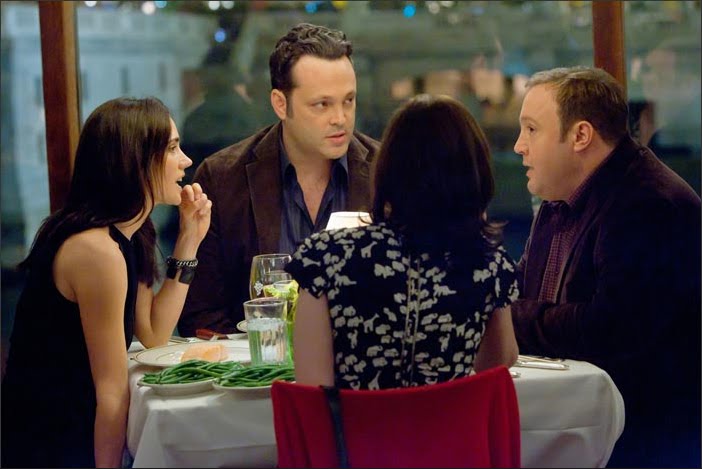
THE DILEMMA (Ron Howard, 2011)Best friends and business partners Ronny (Vince Vaughn) and Nick (Kevin James) are in the middle of a major project that could make or break their auto design company when Ronny sees Nick’s wife Geneva (Winona Ryder) kissing another man. Ronny knows that Nick is already under a lot of pressure at work, so rather than drop the news on his friend, he attempts to fix the situation by talking to Geneva about it first.
When he confronts her, she threatens to to tell Nick about a one night stand she had with Ronny in college before she met her husband-to-be and lie about Ronny making advances on her for years. Due to the circumstances, Ronny can’t tell his longtime girlfriend Beth (Jennifer Connelly) what he knows, so his secretive behavior makes it appear as though his gambling problems have resurfaced.
Rather than the rollicking comedy that the ads make it out to be, THE DILEMMA is more along the lines of THE BREAK-UP, another dramedy starring Vaughn that took a tougher look at trust in relationships than most of its cinematic brethren do. Although not without laughs, THE DILEMMA seriously examines the movie cliché of swallowing a burning secret and the ill effects suffered from doing so. Consider it a corrective to the hundreds of films in which a simple misunderstanding or problem could be cleared up if one person would simply speak up.
In this case, Ronny doesn’t have an easy choice. Withholding the information is ruining Ronny’s peace of mind and relationship with his girlfriend, but if he tells Nick, particularly at this sensitive point in time, the truth could wreck their friendship and company. Plus, it comes to light that Nick and Geneva’s picture perfect marriage may not be as unblemished as it seems from the outside.
The barbed humor comes in observing the smooth-talking Vaughn take his lumps as he tries to figure out the right thing to do while backed into a corner. THE DILEMMA requires a director willing to indulge the dark comedy to its fullest. One name that style doesn’t bring to mind for the job is Ron Howard, yet that’s who is at the helm. Howard tries to tame the film into becoming more agreeable and leaven the discomfort with good cheer and silliness. The clash in tones reaches its apex with Ronny’s awkward speech at the anniversary celebration for his girlfriend’s parents. The train wreck of a monologue could have been a terrific summation of the film’s theme, but the harsh and misguided sincerity in it has to be exaggerated to the point that no one would blurt out the things Ronny finds himself saying.
In spite of its commendable aspiration to put a nuanced spin on the value of truth-telling in relationships, THE DILEMMA struggles to be honest with itself as to its sober nature.
Grade: C+
Grade: C+
Subscribe to:
Posts (Atom)