Showing posts with label Winona Ryder. Show all posts

Thursday, November 19, 2015

Experimenter: The Stanley Milgram Story


EXPERIMENTER: THE STANLEY MILGRAM STORY (Michael Almereyda, 2015)

In EXPERIMENTER: THE STANLEY MILGRAM STORY social psychologist Stanley Milgram (Peter Sarsgaard) studies obedience at Yale beginning in 1961. Volunteers in the experiment are given the role of teacher to a man they’ve met but who is not visible in the adjoining room during the test. This person is referred to as the learner, and he is asked to remember word pairings. If the learner supplies an incorrect answer, the teacher is instructed to give an electric shock of 45 volts. The voltage increases with wrong replies up to 450 volts. The learner is not actually being shocked but makes exclamations of pain and requests to stop, which can be heard through the wall. Although an observer in the room with the teacher will tell the participant to continue with the experiment, the teacher could quit. Milgram found that most do not. The experiment makes him famous but draws criticism that follows him through life.

EXPERIMENTER is staged as if it takes place within an artificial environment. Obvious chromakey backgrounds are used for period settings. The confines of the research space, the classroom, and other private spaces suggest the feeling that every action and utterance is presented for observation behind a one-way mirror. The muted visual strategy points to the clinical nature of this biographical portrait, although it’s not an outsider looking into who the experimental psychologist is. Sarsgaard as Milgram frequently addresses the camera directly, as if the film is the experimenter’s investigation into himself.

With this unconventional approach writer-director Michael Almereyda avoids the trappings of biopic cliches. While EXPERIMENTER touches upon Milgram’s most famous work, it isn’t a checklist of big life moments but a psychological probing of how his background and obsessions informed him to study the banality of evil. Sarsgaard conveys the seriousness of Milgram’s pursuit but retains awareness of the humor and absurdity that can emerge in such labor.

Grade: A-

Friday, January 14, 2011

The Dilemma

THE DILEMMA (Ron Howard, 2011)

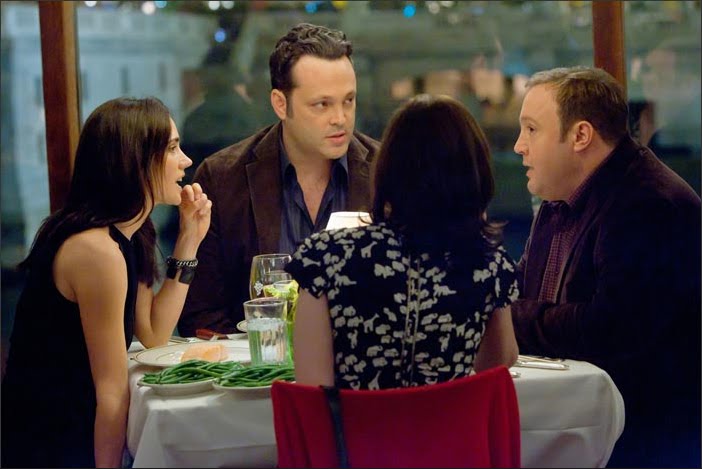
Best friends and business partners Ronny (Vince Vaughn) and Nick (Kevin James) are in the middle of a major project that could make or break their auto design company when Ronny sees Nick’s wife Geneva (Winona Ryder) kissing another man. Ronny knows that Nick is already under a lot of pressure at work, so rather than drop the news on his friend, he attempts to fix the situation by talking to Geneva about it first.

When he confronts her, she threatens to to tell Nick about a one night stand she had with Ronny in college before she met her husband-to-be and lie about Ronny making advances on her for years. Due to the circumstances, Ronny can’t tell his longtime girlfriend Beth (Jennifer Connelly) what he knows, so his secretive behavior makes it appear as though his gambling problems have resurfaced.

Rather than the rollicking comedy that the ads make it out to be, THE DILEMMA is more along the lines of THE BREAK-UP, another dramedy starring Vaughn that took a tougher look at trust in relationships than most of its cinematic brethren do. Although not without laughs, THE DILEMMA seriously examines the movie cliché of swallowing a burning secret and the ill effects suffered from doing so. Consider it a corrective to the hundreds of films in which a simple misunderstanding or problem could be cleared up if one person would simply speak up.

In this case, Ronny doesn’t have an easy choice. Withholding the information is ruining Ronny’s peace of mind and relationship with his girlfriend, but if he tells Nick, particularly at this sensitive point in time, the truth could wreck their friendship and company. Plus, it comes to light that Nick and Geneva’s picture perfect marriage may not be as unblemished as it seems from the outside.

The barbed humor comes in observing the smooth-talking Vaughn take his lumps as he tries to figure out the right thing to do while backed into a corner. THE DILEMMA requires a director willing to indulge the dark comedy to its fullest. One name that style doesn’t bring to mind for the job is Ron Howard, yet that’s who is at the helm. Howard tries to tame the film into becoming more agreeable and leaven the discomfort with good cheer and silliness.

The clash in tones reaches its apex with Ronny’s awkward speech at the anniversary celebration for his girlfriend’s parents. The train wreck of a monologue could have been a terrific summation of the film’s theme, but the harsh and misguided sincerity in it has to be exaggerated to the point that no one would blurt out the things Ronny finds himself saying.

In spite of its commendable aspiration to put a nuanced spin on the value of truth-telling in relationships, THE DILEMMA struggles to be honest with itself as to its sober nature.

Grade: C+