JIM BROWN: ALL-AMERICAN (Spike Lee, 2002)
In the Buddhist parable of the blind men and the elephant each man feels a different part of the animal. Understandably, this leads to their varying perceptions of what an elephant is.
A group of people need not be blind to hold diverging views of who they think Jim Brown is. He’s the Cleveland Browns running back and all-time NFL great who hung up his cleats while still in his prime. He’s the action star who appeared in THE DIRTY DOZEN and THREE THE HARD WAY. He’s an activist in the African-American community who founded the Amer-I-Can Foundation. He’s a controversial figure whose history with women has led to brushes with the law, including accusations of throwing a girlfriend over a balcony and raping a woman.
Spike Lee’s HBO documentary JIM BROWN: ALL-AMERICAN looks at the different facets of this polarizing man. Lee traces a familiar biographical arc, going to Brown’s birthplace of St. Simon’s Island, documenting his rise in amateur and professional football, and concluding with his post-NFL life.
Lee, a well-documented sports fan, assembles the football section with gusto. Plays are broken down so that even non-fans can appreciate what Brown accomplished on the field. The excellent use of spot shadowing helps the untrained eye follow how plays are executed.
The energy employed in showing Brown’s athletic achievements doesn’t carry over to the rest of the film, though. Usually Lee is a dynamic filmmaker, but whether it’s the documentary format or his admiration for his subject, he seems to be restraining his style rather than ratcheting up the political and social elements. JIM BROWN: ALL-AMERICAN is a staid film. Considering the provocative material, it’s an approach least expected, especially from this director.
Throughout his career Lee has been criticized for his portrayal of women. He isn’t doing himself any favors when it comes to how he handles Brown’s rocky history with women. While one of the last sections addresses the more notable incidents, including his wife Monique’s call to the police in 1999 and an accusation thirty years earlier of throwing his girlfriend over a balcony, there’s a lingering sense that we’re getting skewed versions of the truth. Most bothersome is that the women accept the blame. His wife even suggests that Brown was the victim. In separating the alleged balcony toss from the film’s mostly linear timeline, the impression is that in delaying troublesome revelations it is hoped we will already like Brown enough to forgive his transgressions. Treating the incidents with kid gloves allows JIM BROWN: ALL-AMERICAN to fit into the encomium template, but a more forthright approach is demanded.
HBO Video presents JIM BROWN: ALL-AMERICAN in its original 1.85: aspect ratio. The rich colors and image’s texture are nicely reproduced in this anamorphic transfer. Even the old game film from Brown’s college and pro days looks excellent. The Dolby Digital 2.0 surround soundtrack gets the job done in its clean presentation of the many interview soundbites. Sound effects have been added to give the archival footage more punch, a technique that calls attention to itself in an otherwise naturalistic film. Optional English, French, and Spanish subtitles are available.
The DVD cover calls this a director’s cut, a term in the DVD age that has been so grossly overused that it has almost lost any value. The DVD has a running time of 132 minutes. The Internet Movie Database entry lists the film’s duration as 140 minutes. Considering that Lee didn’t seem very picky about what he included in the DVD version, I can’t imagine that eight minutes were deleted from the cable telecast; however, assuming faulty information isn’t on IMDB, this may be one of those rare occasions where a director’s cut is shorter than the original.
The lone supplement is a Spike Lee audio commentary. Whether you agree with Lee or not, it stands to reason that it is worth hearing what an important director has to say. Not this time. This is a dry commentary track with silent stretches, particularly during the part touching on Brown’s domestic violence charges. Lee claims that he is letting two people tell their story and allowing us to decide, but it doesn’t strike me as being that simple.
Grade: C
(This review was previously published on DVDMon.com.)
Thursday, October 07, 2004


Wednesday, October 06, 2004
Shaun of the Dead
SHAUN OF THE DEAD (Edgar Wright, 2004)
What do you do when your girlfriend dumps you and the next day you wake up to discover the city crawling with zombies? If you’re the protagonist in SHAUN OF THE DEAD, it’s time to splatter some undead brains and win back your woman. Shaun is stuck in a routine in which he goes to his dead end electronics store job and then retires to the neighborhood pub each night. His girlfriend Liz (Kate Ashfield) fears Shaun will never change and breaks up with him. Distraught over the end of the relationship Shaun and his roommate Ed go on a bender only to awaken to a fate worse than a hangover. Zombies are terrorizing London, so Shaun and Ed set out to save his mom and Liz.
SHAUN OF THE DEAD is a romantic comedy steeped in the tradition of George Romero’s zombie films. Writer-director Edgar Wright and co-writer and star Simon Pegg have terrific fun riffing on zombie lore. The best recurring joke is that there isn’t an appreciable difference how everyone behaves in their pre-zombie and undead states, aside from wanting to munch on the brains of the living. SHAUN OF THE DEAD follows the familiar arc of a zombie film and populates the story with archetypal characters. Somehow, though, the love story and relationships become critically important and pull their dramatic weight in an otherwise silly film. Rather than standing for rampant consumerism, here the undead and potential zombies represent obstacles to two people committing to a relationship. It doesn’t sound like it should work but it does.
Grade: B-
(Review first aired on the September 28, 2004 NOW PLAYING)
What do you do when your girlfriend dumps you and the next day you wake up to discover the city crawling with zombies? If you’re the protagonist in SHAUN OF THE DEAD, it’s time to splatter some undead brains and win back your woman. Shaun is stuck in a routine in which he goes to his dead end electronics store job and then retires to the neighborhood pub each night. His girlfriend Liz (Kate Ashfield) fears Shaun will never change and breaks up with him. Distraught over the end of the relationship Shaun and his roommate Ed go on a bender only to awaken to a fate worse than a hangover. Zombies are terrorizing London, so Shaun and Ed set out to save his mom and Liz.
SHAUN OF THE DEAD is a romantic comedy steeped in the tradition of George Romero’s zombie films. Writer-director Edgar Wright and co-writer and star Simon Pegg have terrific fun riffing on zombie lore. The best recurring joke is that there isn’t an appreciable difference how everyone behaves in their pre-zombie and undead states, aside from wanting to munch on the brains of the living. SHAUN OF THE DEAD follows the familiar arc of a zombie film and populates the story with archetypal characters. Somehow, though, the love story and relationships become critically important and pull their dramatic weight in an otherwise silly film. Rather than standing for rampant consumerism, here the undead and potential zombies represent obstacles to two people committing to a relationship. It doesn’t sound like it should work but it does.
Grade: B-
(Review first aired on the September 28, 2004 NOW PLAYING)
Wimbledon
WIMBLEDON (Richard Loncraine, 2004)
In WIMBLEDON Paul Bettany is pro tennis player Peter Colt, a once highly ranked competitor whose best days are behind him. He hopes to advance a round or two at Wimbledon before retiring. Then he meets rising American tennis star Lizzie Bradury, played by Kirsten Dunst. Sparks fly between them, and soon Peter is playing the best he has in years.
WIMBLEDON succeeds at being an agreeable sports romance. Much of it is conventional, but there’s a reason why film after film follows the formula. It works. Bettany and Dunst make a cute couple that is as fiercely competitive in their love lives as they are on the court. Yet WIMBLEDON strikes me as being Peter’s story. How does an athlete who is very good at what he does deal with falling short of greatness? How does his mind work as he confronts the immediate challenge of playing tennis while personal issues spin through his head? WIMBLEDON explores these competition details enough to complement the light comedy. The film may not amount to much more than the cinematic equivalent of strawberries and cream, but sometimes that hits the spot.
Grade: B-
(Review first aired on the September 28, 2004 NOW PLAYING)
In WIMBLEDON Paul Bettany is pro tennis player Peter Colt, a once highly ranked competitor whose best days are behind him. He hopes to advance a round or two at Wimbledon before retiring. Then he meets rising American tennis star Lizzie Bradury, played by Kirsten Dunst. Sparks fly between them, and soon Peter is playing the best he has in years.
WIMBLEDON succeeds at being an agreeable sports romance. Much of it is conventional, but there’s a reason why film after film follows the formula. It works. Bettany and Dunst make a cute couple that is as fiercely competitive in their love lives as they are on the court. Yet WIMBLEDON strikes me as being Peter’s story. How does an athlete who is very good at what he does deal with falling short of greatness? How does his mind work as he confronts the immediate challenge of playing tennis while personal issues spin through his head? WIMBLEDON explores these competition details enough to complement the light comedy. The film may not amount to much more than the cinematic equivalent of strawberries and cream, but sometimes that hits the spot.
Grade: B-
(Review first aired on the September 28, 2004 NOW PLAYING)
Intimate Strangers (Confidences trop intimes)
INTIMATE STRANGERS (CONFIDENCES TROP INTIMES) (Patrice Leconte, 2004)
INTIMATE STRANGERS pairs the mysterious Anna, played by Sandrine Bonnaire, with the lonely William, played by Fabrice Luchini. They meet when Anna enters William’s office and begins telling some secrets. She mistakenly believes he is the therapist with whom she has an appointment. William doesn’t realize what’s going on until it’s too late to correct her. Even after he acknowledges that he’s not a psychologist, Anna wishes to continue their sessions.
INTIMATE STRANGERS comes from director Patrice Leconte, who has been on a role the last five years with MAN ON THE TRAIN, THE WIDOW OF ST. PIERRE, and GIRL ON THE BRIDGE. He’s among the best today at turning out films in the classic French mode. He’s interested in how humans interact and what they say to one another. INTIMATE STRANGERS is a dialogue driven film that thrills through carefully selected words and actions. Jérôme Tonnerre’s screenplay develops tension by having the characters strategically reveal and hold back information. It’s riveting, especially as the stakes get higher in Anna and William’s game. Bonnaire and Luchini thrive in this setting as they try to peel back the layers of each other. Bonnaire in particular remains inscrutable until the deeply satisfying conclusion. The score indicates that INTIMATE STRANGERS shares traits with film noir. Like William, Leconte makes us work to uncover what that might mean, but it’s worth it in the end.
Grade: B+
(Review first aired on the September 28, 2004 NOW PLAYING)
INTIMATE STRANGERS pairs the mysterious Anna, played by Sandrine Bonnaire, with the lonely William, played by Fabrice Luchini. They meet when Anna enters William’s office and begins telling some secrets. She mistakenly believes he is the therapist with whom she has an appointment. William doesn’t realize what’s going on until it’s too late to correct her. Even after he acknowledges that he’s not a psychologist, Anna wishes to continue their sessions.
INTIMATE STRANGERS comes from director Patrice Leconte, who has been on a role the last five years with MAN ON THE TRAIN, THE WIDOW OF ST. PIERRE, and GIRL ON THE BRIDGE. He’s among the best today at turning out films in the classic French mode. He’s interested in how humans interact and what they say to one another. INTIMATE STRANGERS is a dialogue driven film that thrills through carefully selected words and actions. Jérôme Tonnerre’s screenplay develops tension by having the characters strategically reveal and hold back information. It’s riveting, especially as the stakes get higher in Anna and William’s game. Bonnaire and Luchini thrive in this setting as they try to peel back the layers of each other. Bonnaire in particular remains inscrutable until the deeply satisfying conclusion. The score indicates that INTIMATE STRANGERS shares traits with film noir. Like William, Leconte makes us work to uncover what that might mean, but it’s worth it in the end.
Grade: B+
(Review first aired on the September 28, 2004 NOW PLAYING)
Sky Captain and the World of Tomorrow
SKY CAPTAIN AND THE WORLD OF TOMORROW (Kerry Conran, 2004)
The menacingly named Dr. Totenkopf dispatches giant robots around the planet to do his bidding in SKY CAPTAIN AND THE WORLD OF TOMORROW. Jude Law stars as Joe Sullivan, also known as Sky Captain, the leader of an elite private air force. He and reporter Polly Perkins, played by Gwyneth Paltrow, try to thwart the evil doctor’s plans, whatever they may be.
SKY CAPTAIN AND THE WORLD OF TOMORROW is the fanboy film of 1940 that never was. Writer-director Kerry Conran imagines an adventure cobbled together from serials, comic books, and radio dramas of the 30s and 40s, making something derivative yet unique. It’s an unironic return to screwball comedy banter and rip-roaring action through the innovative use of modern technology. Everything on screen except for the actors and props was created inside a computer. The result is frequently dazzling. Conran is free to indulge the techniques of the era to create something fresh by looking backward. Law and Paltrow’s classic appearances and demeanors make them perfect choices for this sepia-toned throwback film. Many of today’s big special effects pictures feel like the life has been drained from them by too many test screenings and studio executives. SKY CAPTAIN AND THE WORLD OF TOMORROW is a breath of fresh air, an ambitious, stylized epic that entertains with every frame.
Grade: B
(Review first aired on the September 28, 2004 NOW PLAYING)
The menacingly named Dr. Totenkopf dispatches giant robots around the planet to do his bidding in SKY CAPTAIN AND THE WORLD OF TOMORROW. Jude Law stars as Joe Sullivan, also known as Sky Captain, the leader of an elite private air force. He and reporter Polly Perkins, played by Gwyneth Paltrow, try to thwart the evil doctor’s plans, whatever they may be.
SKY CAPTAIN AND THE WORLD OF TOMORROW is the fanboy film of 1940 that never was. Writer-director Kerry Conran imagines an adventure cobbled together from serials, comic books, and radio dramas of the 30s and 40s, making something derivative yet unique. It’s an unironic return to screwball comedy banter and rip-roaring action through the innovative use of modern technology. Everything on screen except for the actors and props was created inside a computer. The result is frequently dazzling. Conran is free to indulge the techniques of the era to create something fresh by looking backward. Law and Paltrow’s classic appearances and demeanors make them perfect choices for this sepia-toned throwback film. Many of today’s big special effects pictures feel like the life has been drained from them by too many test screenings and studio executives. SKY CAPTAIN AND THE WORLD OF TOMORROW is a breath of fresh air, an ambitious, stylized epic that entertains with every frame.
Grade: B
(Review first aired on the September 28, 2004 NOW PLAYING)
Sunday, October 03, 2004
The 101st Post
What better way to commemorate my 100th post to this blog than a little self-promotion. My review of John Waters' A DIRTY SHAME--first available here--can be found in the latest edition of The Film Journal. Issue 10 focuses on genre cinema and features pieces by some of my film critic friends and acquaintances, so check it out. Editor Rick Curnutte has also given the site a striking new look for this issue. Today's Greencine blog entry recaps The Film Journal's contents, including a four-word quote from my review to summarize my thoughts on A DIRTY SHAME.
I have a lot of things on the back burner but hope to catch up on posting more this week and next. (My priorities are on the front burner, which is the place for them as those who have seen John Sayles' SILVER CITY know.)
(October 6, 2004 edit: Apparently the counter on my dashboard page is stuck on 99 as this is actually the 101st post.)
I have a lot of things on the back burner but hope to catch up on posting more this week and next. (My priorities are on the front burner, which is the place for them as those who have seen John Sayles' SILVER CITY know.)
(October 6, 2004 edit: Apparently the counter on my dashboard page is stuck on 99 as this is actually the 101st post.)
Friday, September 24, 2004
Bleak Friday
So what did I do for fun on a Friday night? I watched a documentary about the Cambodian genocide and a verite-style fiction film about two students plotting a school shooting. What a barrel of laughs, right?
OK, so I planned to see S21: THE KHMER ROUGE KILLING MACHINE, although if a second film weren't playing at the Wexner Center tonight, I don't know that I would have bothered with it. I'd read some generally good things about it, and since I was already going to be down there, I figured I might as well catch the first film and avoid the hassle of locating a decent parking place around Ohio State.
S21: THE KHMER ROUGE KILLING MACHINE can be a little dry and repetitive, but I'll cut it some slack because director Rithy Panh often relates the story with one jawdropping technique. Panh has former Khmer Rouge prison camp guards reenact their duties at the actual site. (Needless to say, he didn't ask the same of the rare S21 survivor.) The results are often spooky. The men seem as emotionally distant now as they must have been then to do what they did. It's mindboggling the awful things men could inflict on their fellow countrymen, women and children. Other than the assertion that they were only following orders, the guards are as lost for an answer as anyone.
The main reason I went to the Wexner was for their second offering of SECRET CINEMA. The catch is that you don't know what you will see until the film starts. (Promotional materials promise viewers a rare classic, a new international hit, or "something too bizarre to put in print".) I must admit that I'm a sucker for this gimmick. It's like Christmas for the movie buff, except that you may end up getting something you didn't want. You pay your three dollars and take your chances. The first time the Wexner folk tried this they showed Samuel Fuller's FORTY GUNS, which supposedly has never been released on home video in the United States.
Tonight's surprise turned out to be ZERO DAY, a film that had the misfortune to come out the same time as Gus Van Sant's Palme D'Or-winning, similarly themed ELEPHANT. After learning about the atrocities the Khmer Rouge inflicted, this wasn't how I would have chosen to polish off an evening of moviegoing. Nevertheless, ZERO DAY is a very fine film that tracks two teenage boys in the ten months leading up to their assault on the high school.
The two main characters use a camcorder to document their preparations and their thoughts so that a record will remain for the media. The film is shot and assembled like THE BLAIR WITCH PROJECT, which gives it such a strong sense of realism that it's startling and unsettling. It's also a tribute to the excellent performances by these amateurs that ZERO DAY plays like found footage than fiction filmmaking.
Director Ben Coccio gives us full access to the killers at their most unguarded and posturing moments. In giving us this insight into their privacy ZERO DAY turns our expectations upside down. The most troubling aspect is how likeable Andre (Andre Keuck) and Calvin (Calvin Robertson) are. They're funny and personable, at least with each other, family members, and, in Calvin's case, with a girlfriend. The natural inclination is to hope they won't follow through with their plans because we don't want to see innocents slaughtered. The feeling strengthens, though, because we get to know these two guys and don't want things to turn out badly for them. It's a weird cognitive dissonance that intensifies as zero day approaches. The humor in this film also throws off one's bearings. It's ghoulish to laugh when the guys are preparing to kill themselves and debate whether they should shoot on four (or "go") when counting to three or shoot on three.
I think ZERO DAY is a more satisying film than ELEPHANT. Coccio's film feels immediate and real, so much so that anyone who didn't follow the news for awhile might believe this really happened. Van Sant's film is more recognizably art with a capital a. He's aiming for lyricism and a study in tone. While there's value in this approach, the ending is somewhat underwhelming.
OK, so I planned to see S21: THE KHMER ROUGE KILLING MACHINE, although if a second film weren't playing at the Wexner Center tonight, I don't know that I would have bothered with it. I'd read some generally good things about it, and since I was already going to be down there, I figured I might as well catch the first film and avoid the hassle of locating a decent parking place around Ohio State.
S21: THE KHMER ROUGE KILLING MACHINE can be a little dry and repetitive, but I'll cut it some slack because director Rithy Panh often relates the story with one jawdropping technique. Panh has former Khmer Rouge prison camp guards reenact their duties at the actual site. (Needless to say, he didn't ask the same of the rare S21 survivor.) The results are often spooky. The men seem as emotionally distant now as they must have been then to do what they did. It's mindboggling the awful things men could inflict on their fellow countrymen, women and children. Other than the assertion that they were only following orders, the guards are as lost for an answer as anyone.
The main reason I went to the Wexner was for their second offering of SECRET CINEMA. The catch is that you don't know what you will see until the film starts. (Promotional materials promise viewers a rare classic, a new international hit, or "something too bizarre to put in print".) I must admit that I'm a sucker for this gimmick. It's like Christmas for the movie buff, except that you may end up getting something you didn't want. You pay your three dollars and take your chances. The first time the Wexner folk tried this they showed Samuel Fuller's FORTY GUNS, which supposedly has never been released on home video in the United States.
Tonight's surprise turned out to be ZERO DAY, a film that had the misfortune to come out the same time as Gus Van Sant's Palme D'Or-winning, similarly themed ELEPHANT. After learning about the atrocities the Khmer Rouge inflicted, this wasn't how I would have chosen to polish off an evening of moviegoing. Nevertheless, ZERO DAY is a very fine film that tracks two teenage boys in the ten months leading up to their assault on the high school.
The two main characters use a camcorder to document their preparations and their thoughts so that a record will remain for the media. The film is shot and assembled like THE BLAIR WITCH PROJECT, which gives it such a strong sense of realism that it's startling and unsettling. It's also a tribute to the excellent performances by these amateurs that ZERO DAY plays like found footage than fiction filmmaking.
Director Ben Coccio gives us full access to the killers at their most unguarded and posturing moments. In giving us this insight into their privacy ZERO DAY turns our expectations upside down. The most troubling aspect is how likeable Andre (Andre Keuck) and Calvin (Calvin Robertson) are. They're funny and personable, at least with each other, family members, and, in Calvin's case, with a girlfriend. The natural inclination is to hope they won't follow through with their plans because we don't want to see innocents slaughtered. The feeling strengthens, though, because we get to know these two guys and don't want things to turn out badly for them. It's a weird cognitive dissonance that intensifies as zero day approaches. The humor in this film also throws off one's bearings. It's ghoulish to laugh when the guys are preparing to kill themselves and debate whether they should shoot on four (or "go") when counting to three or shoot on three.
I think ZERO DAY is a more satisying film than ELEPHANT. Coccio's film feels immediate and real, so much so that anyone who didn't follow the news for awhile might believe this really happened. Van Sant's film is more recognizably art with a capital a. He's aiming for lyricism and a study in tone. While there's value in this approach, the ending is somewhat underwhelming.
Wednesday, September 22, 2004
In Defense of Gwyneth
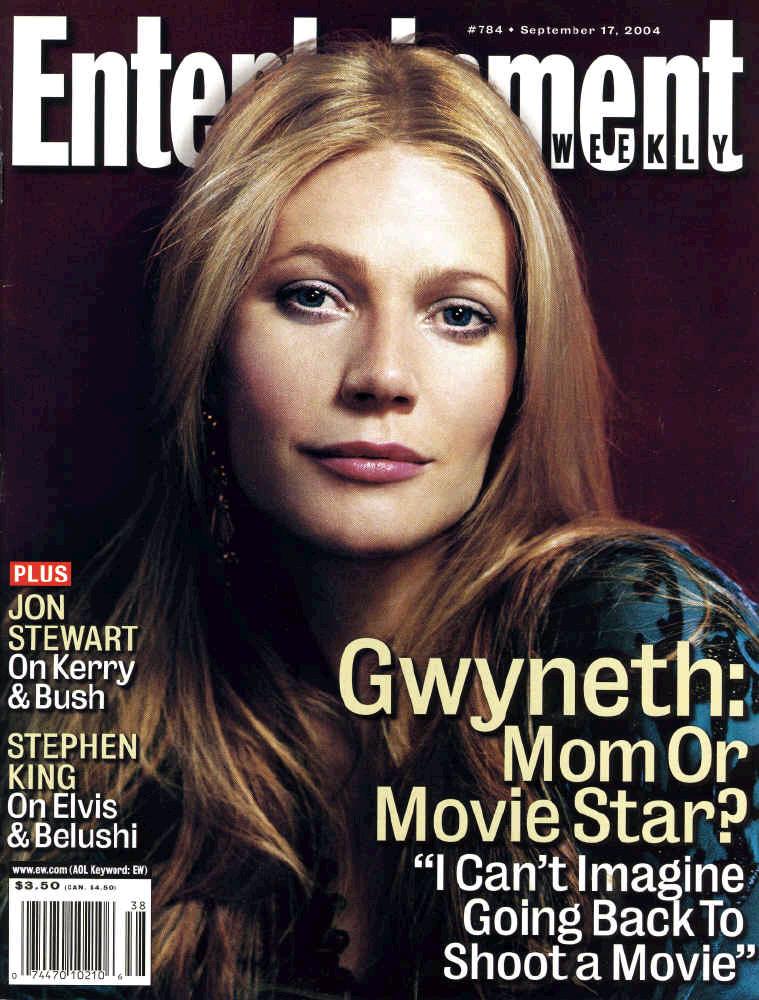
Gwyneth Paltrow on the cover of the September 17,
2004 Entertainment Weekly
Gwyneth Paltrow is one of my favorite actresses, but, as Charles Taylor points out in this excellent essay, she inspires much loathing in her detractors. Usually she makes interesting films with talented filmmakers. HARD EIGHT (Paul Thomas Anderson, 1997), EMMA (Douglas McGrath, 1996), SHAKESPEARE IN LOVE (John Madden, 1998), THE TALENTED MR. RIPLEY (Anthony Minghella, 1999), and THE ROYAL TENENBAUMS (Wes Anderson, 2001) made my top tens. POSSESSION (Neil LaBute, 2002) made my honorable mentions.
Paltrow has scored the most attention for EMMA, a delightful introduction that showcased her grace and ability to carry a film, and SHAKESPEARE IN LOVE. She also turned in very good work in HARD EIGHT and POSSESSION. In general, though, those films have good critical reputations. I thought she turned in one of 2003's best lead performances by a female in SYLVIA, but the minefield crossed in depicting Sylvia Plath's life distracted from a good film and Paltrow's great acting. There are few actresses who could have pulled off the highwire act required in SHALLOW HAL. As Taylor's salon.com piece points out, this lovely performance and the film was largely overshadowed by those with political agendas creating a stir even though they missed the Farrelly brothers' point. Although she plays a minor role in THE ANNIVERSARY PARTY, Paltrow is very funny as a ditzy actress. I was glad to see Taylor support her work in Alfonso Cuaron's GREAT EXPECTATIONS, a remake that works very well in capturing the spirit of the Dickens novel while updating the setting. (At the time I recall reading negative reviews complaining about the film not succeeding as a love story. Of course, this overlooks the fact that it's a coming of age film, not a romance.) I was also pleased that he points out SLIDING DOORS, a wonderful film which I suspect has built a respectable fanbase on home video.
Of her films since 1996, I'd go to bat for all of them except HUSH (Jonathan Darby, 1998), DUETS (Bruce Paltrow, 2000), and VIEW FROM THE TOP (Bruno Barreto, 2003). HUSH is easily the worst of the bunch and possibly the worst of her career. (I haven't seen most of her pre-HARD EIGHT films, going by the order in her Internet Movie Database filmography.) I remember little about the film other than being thankful that it was bad but hilarious. DUETS didn't strike me as the disaster that most were expecting and proclaiming at the time of its release. VIEW FROM THE TOP'S problems are directorial. The film is indecisive about whether it's kitsch or not, although it's almost amusing enough to pull it off.
Currently Paltrow is in SKY CAPTAIN AND THE WORLD OF TOMORROW. Her performance won't garner awards consideration. It shouldn't, not because she's bad--she's perfect for the part and good in it--but because it isn't that sort of thing. She reteams with Madden for PROOF. I've heard nothing but great things about the David Auburn play on which it is based. I look forward to what could be another great performance in an accomplished body of work. The naysayers will just have to deal with it.
Thursday, September 16, 2004
A Dirty Shame
A DIRTY SHAME (John Waters, 2004)
Charging John Waters' latest film A DIRTY SHAME with tastelessness sounds more like a seal of approval than condemnation. Tacky and crude is what Waters does. Only the most unsuspecting moviegoer, one oblivious to the director's filmography, the marketing campaign, and the film's NC-17 rating, will be shocked to see what Waters puts on the screen.
A DIRTY SHAME sends up sexual Puritanism in this country, a topic ripe for the satirical treatment in a year with the much overblown Super Bowl halftime show controversy. Waters borrows the tone of 1950s reactionary films but subverts the genre by positioning the deviants as heroes.
Baltimore housewife and convenience store worker Sylvia Stickles (Tracey Ullman) is uninterested in sex, if not sickened by it. She spurns husband Vaughn's (Chris Isaak) advances in favor of frying scrapple and has locked up gargantuan-breasted exhibitionist daughter Caprice (Selma Blair) to keep her from flaunting her goods at area clubs. An accidental blow to the head awakens Sylvia's carnal stirrings. Before you know it she's slinking around town in leopard print clothes and soliciting any man willing to give her cunnilingus.
Sex saint Ray-Ray (Johnny Knoxville) reveals to Sylvia that she is one of the twelve apostles who will bring about the "resurr-sex-ion" with the discovery of a new sex act. Her fellow freaks include an adult baby, husky and hairy gay men called bears, and a dirt fetishist who gets off from licking the ground and tires, among other unsanitary things. The other apostles also received inadvertent concussions that brought their sexual liberation to the surface.
Needless to say, the good citizens of the community are appalled that Ray-Ray's disciples are practicing and preaching their erotic gospel in public. Big Ethel (Suzanne Shepherd), Sylvia's frigid mother, organizes decency rallies of sexually repressed likeminded "neuters" to fight the indecency.
A DIRTY SHAME is outrageous for the sake of being outrageous, but unlike some of Waters' other films, it's neither shocking nor funny. In recent years the line of good taste has been crossed in mainstream comedies, making it more difficult for Waters to push the envelope like he did with PINK FLAMINGOS and POLYESTER. (THERE'S SOMETHING ABOUT MARY and NATIONAL LAMPOON'S VAN WILDER, to pick examples on opposing ends of the quality spectrum, feature gross-out gags that would be at home in Waters' films.) Waters and his cast think they're being naughty, but the bawdy jokes, repeated ad nauseam, are feeble and frequently telegraphed. Waters loves B and C-list celebrities, but haven't enough David Hasselhoff jokes been made to eliminate any humor in having the BAYWATCH star's CGI turds bonk Chris Isaak on the head? Only Ullman's sex club version of "The Hokey Pokey" performed at a retirement home sustains any comedic momentum.
A DIRTY SHAME also comes across as ideologically confused. The film's sex-positive message is offset by how the repression is erased. Only the concussed are enlightened. Perhaps it's Waters' way of poking fun at those who desire sexual permissiveness, but that isn't the impression A DIRTY SHAME leaves. The prudes serve as the main target, but even the most liberal viewers are likely to object to the notion that public masturbation and intercourse in the streets is healthy for society.
Waters has never been considered the most polished of filmmakers, and that won't change with A DIRTY SHAME. This time around, though, don't expect a Broadway musical adaptation to follow.
Grade: D-
Charging John Waters' latest film A DIRTY SHAME with tastelessness sounds more like a seal of approval than condemnation. Tacky and crude is what Waters does. Only the most unsuspecting moviegoer, one oblivious to the director's filmography, the marketing campaign, and the film's NC-17 rating, will be shocked to see what Waters puts on the screen.
A DIRTY SHAME sends up sexual Puritanism in this country, a topic ripe for the satirical treatment in a year with the much overblown Super Bowl halftime show controversy. Waters borrows the tone of 1950s reactionary films but subverts the genre by positioning the deviants as heroes.
Baltimore housewife and convenience store worker Sylvia Stickles (Tracey Ullman) is uninterested in sex, if not sickened by it. She spurns husband Vaughn's (Chris Isaak) advances in favor of frying scrapple and has locked up gargantuan-breasted exhibitionist daughter Caprice (Selma Blair) to keep her from flaunting her goods at area clubs. An accidental blow to the head awakens Sylvia's carnal stirrings. Before you know it she's slinking around town in leopard print clothes and soliciting any man willing to give her cunnilingus.
Sex saint Ray-Ray (Johnny Knoxville) reveals to Sylvia that she is one of the twelve apostles who will bring about the "resurr-sex-ion" with the discovery of a new sex act. Her fellow freaks include an adult baby, husky and hairy gay men called bears, and a dirt fetishist who gets off from licking the ground and tires, among other unsanitary things. The other apostles also received inadvertent concussions that brought their sexual liberation to the surface.
Needless to say, the good citizens of the community are appalled that Ray-Ray's disciples are practicing and preaching their erotic gospel in public. Big Ethel (Suzanne Shepherd), Sylvia's frigid mother, organizes decency rallies of sexually repressed likeminded "neuters" to fight the indecency.
A DIRTY SHAME is outrageous for the sake of being outrageous, but unlike some of Waters' other films, it's neither shocking nor funny. In recent years the line of good taste has been crossed in mainstream comedies, making it more difficult for Waters to push the envelope like he did with PINK FLAMINGOS and POLYESTER. (THERE'S SOMETHING ABOUT MARY and NATIONAL LAMPOON'S VAN WILDER, to pick examples on opposing ends of the quality spectrum, feature gross-out gags that would be at home in Waters' films.) Waters and his cast think they're being naughty, but the bawdy jokes, repeated ad nauseam, are feeble and frequently telegraphed. Waters loves B and C-list celebrities, but haven't enough David Hasselhoff jokes been made to eliminate any humor in having the BAYWATCH star's CGI turds bonk Chris Isaak on the head? Only Ullman's sex club version of "The Hokey Pokey" performed at a retirement home sustains any comedic momentum.
A DIRTY SHAME also comes across as ideologically confused. The film's sex-positive message is offset by how the repression is erased. Only the concussed are enlightened. Perhaps it's Waters' way of poking fun at those who desire sexual permissiveness, but that isn't the impression A DIRTY SHAME leaves. The prudes serve as the main target, but even the most liberal viewers are likely to object to the notion that public masturbation and intercourse in the streets is healthy for society.
Waters has never been considered the most polished of filmmakers, and that won't change with A DIRTY SHAME. This time around, though, don't expect a Broadway musical adaptation to follow.
Grade: D-
Wednesday, September 15, 2004
Vanity Fair

Vanity Fair poster at a bus stop on the corner of Dupont and Spadina in Toronto (August 27, 2004)
VANITY FAIR (Mira Nair, 2004)
In VANITY FAIR Reese Witherspoon’s Becky Sharp intends to climb the social ladder even if it means trampling others to get higher. She adapts from a poor orphan into an educated governess. This job helps introduce her to a husband, who she hopes will aid her quest to rise in society.
Director Mira Nair follows up her wonderful MONSOON WEDDING with another film that explores the intricacies of social custom. Becky’s adept maneuvering through upper society’s pitfalls is sometimes muddled from too many characters and too little explanation, but Witherspoon remains fun to watch as a spitfire whose desires will not be denied. There’s less separation from the calculation found here and in reality TV’s BIG BROTHER than you might think. VANITY FAIR is at its best when the characters are most selfish and selfless. Eileen Atkins is deliciously sharp-tongued as Miss Matilda Crawley, the crone who gives Becky entrée to a better place in her world. Nair injects a strong Indian flavor to the adaptation of the British novel by Thackeray. The lavish set design, art direction, and costumes provide a stunning backdrop for the competition played according to the rules of the game.
Grade: B-
(Review first aired on the September 14, 2004 NOW PLAYING)
Wicker Park
WICKER PARK (Paul McGuigan, 2004)
The love of Josh Hartnett’s life disappears without a trace in WICKER PARK. A couple years later Matthew thinks he catches a glimpse of her, which sets off an obsessive search for Diane Kruger as Lisa. Matthew has been thinking of marrying his current girlfriend, but he still wonders what became of the woman he wanted to marry and why she vanished.
WICKER PARK is a remake of the excellent French film L’APPARTEMENT. I saw Gilles Mimouni’s Hitchcockian film about a year ago, and as far as I recall, this Hollywood version hews reasonably close to the original. Sets, color schemes, and some shots duplicate their forebears so much that they could have been cribbed from L’APPARTEMENT. The twisty storyline and plot structure are followed too, yet this remake pales compared to the source material. The obsession is present, but the passion is lacking. A tone deaf Matthew Lillard supporting performance, tuned more toward comedy, doesn’t help. A problem I don’t remember the original having is the belief-stretching coincidences and easily resolved misunderstandings needed to keep Matthew and Lisa apart. WICKER PARK frustrates to no end when a smidgen of common sense on anyone’s behalf would clear up everything. Although I knew the outcome, WICKER PARK kept me interested as a puzzle movie. It’s a case of the right ingredients being combined incorrectly.
Grade: C
(Review first aired on the September 14, 2004 NOW PLAYING)
The love of Josh Hartnett’s life disappears without a trace in WICKER PARK. A couple years later Matthew thinks he catches a glimpse of her, which sets off an obsessive search for Diane Kruger as Lisa. Matthew has been thinking of marrying his current girlfriend, but he still wonders what became of the woman he wanted to marry and why she vanished.
WICKER PARK is a remake of the excellent French film L’APPARTEMENT. I saw Gilles Mimouni’s Hitchcockian film about a year ago, and as far as I recall, this Hollywood version hews reasonably close to the original. Sets, color schemes, and some shots duplicate their forebears so much that they could have been cribbed from L’APPARTEMENT. The twisty storyline and plot structure are followed too, yet this remake pales compared to the source material. The obsession is present, but the passion is lacking. A tone deaf Matthew Lillard supporting performance, tuned more toward comedy, doesn’t help. A problem I don’t remember the original having is the belief-stretching coincidences and easily resolved misunderstandings needed to keep Matthew and Lisa apart. WICKER PARK frustrates to no end when a smidgen of common sense on anyone’s behalf would clear up everything. Although I knew the outcome, WICKER PARK kept me interested as a puzzle movie. It’s a case of the right ingredients being combined incorrectly.
Grade: C
(Review first aired on the September 14, 2004 NOW PLAYING)
Maria Full of Grace
MARIA FULL OF GRACE (Joshua Marston, 2004)
Writer-director Joshua Marston’s MARIA FULL OF GRACE may be a fictional film about a young woman who becomes a drug mule, but it’s a well researched, documentary-like look at the path someone like the main character would take. Catalina Sandino Moreno stars as Maria. The prospect of earning a large sum of money for a few days’ work entices this Columbian woman into becoming a mule. She must ingest many thumb-sized pellets full of cocaine, board a plane to New York City, and deliver the drugs without being caught by the authorities or having a pellet lethally leak in transit. Naturally, not everything goes according to plan.
MARIA FULL OF GRACE provides an authentic and compelling view of a drug mule’s experience. The difficulties of carrying the pellets, not to mention the danger, are spelled out in a few terrific scenes. Maria must practice by swallowing grapes, but that doesn’t prepare her or the audience for the long, arduous process of downing sixty-two of these pellets. The flight to New York City and need to pass through customs unnoticed are as tense as any conventional chase scene. Moreno is natural and assured in her debut performance. She makes it understandable why an intelligent young woman with a future would choose to get involved with something as unsavory as being a drug courier. In that way it would make a fine companion piece with Santosh Sivan’s THE TERRORIST, a 1999 film that tracks a woman who decides to become a suicide assassination bomber.
Grade: B+
(Review first aired on the September 14, 2004 NOW PLAYING)
Writer-director Joshua Marston’s MARIA FULL OF GRACE may be a fictional film about a young woman who becomes a drug mule, but it’s a well researched, documentary-like look at the path someone like the main character would take. Catalina Sandino Moreno stars as Maria. The prospect of earning a large sum of money for a few days’ work entices this Columbian woman into becoming a mule. She must ingest many thumb-sized pellets full of cocaine, board a plane to New York City, and deliver the drugs without being caught by the authorities or having a pellet lethally leak in transit. Naturally, not everything goes according to plan.
MARIA FULL OF GRACE provides an authentic and compelling view of a drug mule’s experience. The difficulties of carrying the pellets, not to mention the danger, are spelled out in a few terrific scenes. Maria must practice by swallowing grapes, but that doesn’t prepare her or the audience for the long, arduous process of downing sixty-two of these pellets. The flight to New York City and need to pass through customs unnoticed are as tense as any conventional chase scene. Moreno is natural and assured in her debut performance. She makes it understandable why an intelligent young woman with a future would choose to get involved with something as unsavory as being a drug courier. In that way it would make a fine companion piece with Santosh Sivan’s THE TERRORIST, a 1999 film that tracks a woman who decides to become a suicide assassination bomber.
Grade: B+
(Review first aired on the September 14, 2004 NOW PLAYING)
Cellular
I've decided to put my NOW PLAYING intros and reviews here rather than let them molder on my hard drive. Obviously I have truncated plot summaries as much as possible for telecast purposes, and the reviews are less comprehensive too. I have excised any clip introduction since that portion is irrelevant here. If the last line was "I recommend..." or "I don't recommend...", I've cut that as well. It seems unnecessary, although this removal may make for an abrupt end. You'll notice some minor differences--actors names in the flow of sentences instead of being in parentheses--due to these reviews being read aloud.
I'll post the reviews throughout the day. Links will also be provided under capusle reviews.
CELLULAR (David R. Ellis, 2004)
In CELLULAR an abducted woman’s random call to a cell phone provides the only chance she has of being rescued. Kim Basinger plays Jessica Martin, a biology teacher who thugs take from her home and hold against her will for information about her husband’s whereabouts. The abductors are unaware that a resourceful Jessica is experimenting with a smashed phone to try and contact anyone. Chris Evans is Ryan, the stranger who answers her call for help.
Someone with a sense of humor might have chosen MOBILE PHONE BOOTH as an alternate title for CELLULAR. The conflict is the same in PHONE BOOTH and this film. Someone will likely die if a phone call is ended. Rather than being limited to one location, CELLULAR allows the hero to roam as long as he keeps the connection. The similarities aren’t by accident. PHONE BOOTH screenwriter Larry Cohen wrote the story on which Chris Morgan’s CELLULAR screenplay is based. Suffused with an Old Testament contemplation of sin and forgiveness, PHONE BOOTH has more heft compared to CELLULAR’S lightweight genre thrills. Still, CELLULAR utilizes remarkable efficiency and ingenious construction to realize an exciting and funny story that seems plausible enough under the circumstances. Basinger’s performance is too serious for something this silly. William H. Macy shines in a rare chance to play the hero. He also gets the film’s funniest line.
Grade: B-
(Review first aired on the September 14, 2004 NOW PLAYING)
I'll post the reviews throughout the day. Links will also be provided under capusle reviews.
CELLULAR (David R. Ellis, 2004)
In CELLULAR an abducted woman’s random call to a cell phone provides the only chance she has of being rescued. Kim Basinger plays Jessica Martin, a biology teacher who thugs take from her home and hold against her will for information about her husband’s whereabouts. The abductors are unaware that a resourceful Jessica is experimenting with a smashed phone to try and contact anyone. Chris Evans is Ryan, the stranger who answers her call for help.
Someone with a sense of humor might have chosen MOBILE PHONE BOOTH as an alternate title for CELLULAR. The conflict is the same in PHONE BOOTH and this film. Someone will likely die if a phone call is ended. Rather than being limited to one location, CELLULAR allows the hero to roam as long as he keeps the connection. The similarities aren’t by accident. PHONE BOOTH screenwriter Larry Cohen wrote the story on which Chris Morgan’s CELLULAR screenplay is based. Suffused with an Old Testament contemplation of sin and forgiveness, PHONE BOOTH has more heft compared to CELLULAR’S lightweight genre thrills. Still, CELLULAR utilizes remarkable efficiency and ingenious construction to realize an exciting and funny story that seems plausible enough under the circumstances. Basinger’s performance is too serious for something this silly. William H. Macy shines in a rare chance to play the hero. He also gets the film’s funniest line.
Grade: B-
(Review first aired on the September 14, 2004 NOW PLAYING)
Tuesday, September 14, 2004
Reality TV and The Benefactor
Salon.com's Heather Havrilesky writes a worthy defense of reality television. (Per the site's protocol, you'll need to click on an ad to read the article.) It's fashionable to deride the genre, but I'll openly admit to liking some of the shows. SURVIVOR and THE AMAZING RACE are two of TV's most entertaining programs. (I've mentioned before that THE AMAZING RACE might be the best show on the tube.) Even though I came around late last season to THE APPRENTICE, I was pleasantly surprised that it makes for fun viewing. (The second season looks good so far, especially if Raj, the guy who looks like he stepped out of an F. Scott Fitzgerald novel, sticks around.) BIG BROTHER, which has usually held more of a train wreck appeal than anything, has made big strides in quality in its fifth season, although I still hesitate to call the show "good".
Yes, but what about EXTREME MAKEOVER and THE SWAN or one-off projects THE LITTLEST GROOM and MAN VS. BEAST, you ask? What about them? Where is it written that reality TV must be defined by its (presumably) worst examples? After all, SEINFELD isn't considered disreputable because THE SECRET DIARY OF DESMOND PFEIFFER, another sitcom, is widely thought to be awful.
For the time being, the average reality show is more interesting than a run-of-the-mill comedy or drama. Because they center on competition, the twists and results are often less predictable than you get in more conventional fare. Even when a traditional sitcom or drama uncorks a shocker, chances are viewers already know, whether from spoiler-heavy promos or entertainment reports of departing cast members. The best reality shows have the open-ended conclusion of a sporting event.
Which brings me to THE BENEFACTOR, the latest reality show I've come across. Billionaire Dallas Mavericks' owner Mark Cuban brings in sixteen people to put them to the test for a million dollar prize. In the first episode the premise plays like a B-movie in which some obscenely wealthy, half-cocked guy invites a group to his mansion to compete for money and then proceeds to terrorize them.
THE BENEFACTOR looks to be more freeform than its brethren. Cuban can dimsiss who he wants, when he wants, for whatever reason he wants rather than follow a format. Last night he eliminated three contestants for the following reasons: one called the game stupid, another didn't seem to match the risk-taking spirit she showed in her entry video, and a third lost a game of Jenga. Granted, he can't send three people packing each week, but the rules for staying in the game are more loosely defined. Essentially, you want to keep Cuban happy. This opens up the show to more potential producer interference and manipulation of the results than you would get on THE AMAZING RACE. I won't be surprised if those with photogenic looks and large personalities stick around longer to enhance the entertainment aspect. Still, the show's random nature might give it the zing it needs to differentiate from the competition.
Say what you will about Cuban--some are certain to find him to be an arrogant jackass--but he isn't boring. (As a pro sports franchise owner, he's serious about winning too.) This guy ought to be more entertaining than Fox's reality show with billionaire Richard Branson. Oh yeah, and he keeps a a blog.
THE BENEFACTOR doesn't look like it will equal the better reality shows, but it's a good lead-in to Monday Night Football. Better this than a couple of bland domestic sitcoms or another news magazine show.
Yes, but what about EXTREME MAKEOVER and THE SWAN or one-off projects THE LITTLEST GROOM and MAN VS. BEAST, you ask? What about them? Where is it written that reality TV must be defined by its (presumably) worst examples? After all, SEINFELD isn't considered disreputable because THE SECRET DIARY OF DESMOND PFEIFFER, another sitcom, is widely thought to be awful.
For the time being, the average reality show is more interesting than a run-of-the-mill comedy or drama. Because they center on competition, the twists and results are often less predictable than you get in more conventional fare. Even when a traditional sitcom or drama uncorks a shocker, chances are viewers already know, whether from spoiler-heavy promos or entertainment reports of departing cast members. The best reality shows have the open-ended conclusion of a sporting event.
Which brings me to THE BENEFACTOR, the latest reality show I've come across. Billionaire Dallas Mavericks' owner Mark Cuban brings in sixteen people to put them to the test for a million dollar prize. In the first episode the premise plays like a B-movie in which some obscenely wealthy, half-cocked guy invites a group to his mansion to compete for money and then proceeds to terrorize them.
THE BENEFACTOR looks to be more freeform than its brethren. Cuban can dimsiss who he wants, when he wants, for whatever reason he wants rather than follow a format. Last night he eliminated three contestants for the following reasons: one called the game stupid, another didn't seem to match the risk-taking spirit she showed in her entry video, and a third lost a game of Jenga. Granted, he can't send three people packing each week, but the rules for staying in the game are more loosely defined. Essentially, you want to keep Cuban happy. This opens up the show to more potential producer interference and manipulation of the results than you would get on THE AMAZING RACE. I won't be surprised if those with photogenic looks and large personalities stick around longer to enhance the entertainment aspect. Still, the show's random nature might give it the zing it needs to differentiate from the competition.
Say what you will about Cuban--some are certain to find him to be an arrogant jackass--but he isn't boring. (As a pro sports franchise owner, he's serious about winning too.) This guy ought to be more entertaining than Fox's reality show with billionaire Richard Branson. Oh yeah, and he keeps a a blog.
THE BENEFACTOR doesn't look like it will equal the better reality shows, but it's a good lead-in to Monday Night Football. Better this than a couple of bland domestic sitcoms or another news magazine show.
Tuesday, September 07, 2004
Today's birthdays
Who shares a birthday with me?
Shannon Elizabeth (AMERICAN PIE) and Diane Farr (THE JOB and MTV's LOVELINE) were born on the same day in the same year. Others with birthdays today include Evan Rachel Wood (THIRTEEN), Devon Sawa (IDLE HANDS), former Major League Baseball players Darren Bragg and Joe Rudi, model and B-movie actress Angie Everhart, OSAMA director Siddiq Barmak, syrupy song composer Diane Warren, pianist Michael Feinstein, Tom Petty & the Heartbreakers' keyboardist Benmont Tench, Corbin Bernsen (L.A. LAW), film composer Mark Isham (OCTOBER SKY, THE COOLER), The Pretenders' Chrissie Hynde, Julie Kavner (voice of Marge on THE SIMPSONS), disco queen Gloria Gaynor (the ubiquitous "I Will Survive"), Italian horror master Dario Argento (SUSPIRIA, PHENOMENA), and jazz musician Sonny Rollins.
Rocker Buddy Holly, former basketball coach and TV analyst Al McGuire, Rat Pack member Peter Lawford (OCEAN'S ELEVEN), director Elia Kazan (A STREETCAR NAMED DESIRE, ON THE WATERFRONT), and artist Grandma Moses have all passed on but were born on this day.
And, just for kicks, married on this day include former 24 stars Xander Berkeley and Sarah Clarke, the short-lived Janet Jackson-James DeBarge union in 1984, and Rita Hayworth and Orson Welles in 1943.
This fascinating information and more was found at the Internet Movie Database.
Shannon Elizabeth (AMERICAN PIE) and Diane Farr (THE JOB and MTV's LOVELINE) were born on the same day in the same year. Others with birthdays today include Evan Rachel Wood (THIRTEEN), Devon Sawa (IDLE HANDS), former Major League Baseball players Darren Bragg and Joe Rudi, model and B-movie actress Angie Everhart, OSAMA director Siddiq Barmak, syrupy song composer Diane Warren, pianist Michael Feinstein, Tom Petty & the Heartbreakers' keyboardist Benmont Tench, Corbin Bernsen (L.A. LAW), film composer Mark Isham (OCTOBER SKY, THE COOLER), The Pretenders' Chrissie Hynde, Julie Kavner (voice of Marge on THE SIMPSONS), disco queen Gloria Gaynor (the ubiquitous "I Will Survive"), Italian horror master Dario Argento (SUSPIRIA, PHENOMENA), and jazz musician Sonny Rollins.
Rocker Buddy Holly, former basketball coach and TV analyst Al McGuire, Rat Pack member Peter Lawford (OCEAN'S ELEVEN), director Elia Kazan (A STREETCAR NAMED DESIRE, ON THE WATERFRONT), and artist Grandma Moses have all passed on but were born on this day.
And, just for kicks, married on this day include former 24 stars Xander Berkeley and Sarah Clarke, the short-lived Janet Jackson-James DeBarge union in 1984, and Rita Hayworth and Orson Welles in 1943.
This fascinating information and more was found at the Internet Movie Database.
Happy Birthday to Me
OK, so my birthday isn't a national holiday this year--I'll have to wait until 2009 for that if I've calculated correctly--but there is cause for celebration.
Levi, the man who puts the mon in DVDMon.com, has given the site a facelift. Many of the reviews weren't accessible in the past few months but are now back and same as they ever were. The good news for me is that I can recover the published reviews I lost when my computer unexpectedly melted down at Christmas. (You can find a list of all my reviews on the site by following this link.)
If you haven't noticed, a couple weeks ago I added direct links in the righthand sidebar for the reviews I've posted on this blog.
In blog news, from the "strange but true (as far as I can tell)" department, I received an actual e-mail from an actual reader. The note caught me by surprise as it was from Kristen McGary, the director of THE ADVENTURES OF OCIEE NASH. Considering that I've done virtually nothing to publicize this blog except for telling some friends and putting the link in the signature to my Home Theater Forum posts, any legitimate correspondence comes as a complete surprise. I'm guessing that she found my review by plugging the film's name into Google, as second page results direct searchers here.
Of course, the internet being what it is, I can't verify with total certainty that the e-mail is from who the writer claims to be. I don't have any reason to believe otherwise, so I'm taking it at face value. Her e-mail was very kind, much more than I expected since I was highly critical of her film. (I gave it a D.) She made some good points about her film and the process, but that's as much as I'm willing to divulge from the private correspondence. I wrote her back requesting permission to post her e-mail to the blog. If she agrees, I'll tack it up here.
I guess the lesson is that you never know who is reading, which may be for the best when you're posting pictures of Canadian construction barrels instead of writing something substantive.
Levi, the man who puts the mon in DVDMon.com, has given the site a facelift. Many of the reviews weren't accessible in the past few months but are now back and same as they ever were. The good news for me is that I can recover the published reviews I lost when my computer unexpectedly melted down at Christmas. (You can find a list of all my reviews on the site by following this link.)
If you haven't noticed, a couple weeks ago I added direct links in the righthand sidebar for the reviews I've posted on this blog.
In blog news, from the "strange but true (as far as I can tell)" department, I received an actual e-mail from an actual reader. The note caught me by surprise as it was from Kristen McGary, the director of THE ADVENTURES OF OCIEE NASH. Considering that I've done virtually nothing to publicize this blog except for telling some friends and putting the link in the signature to my Home Theater Forum posts, any legitimate correspondence comes as a complete surprise. I'm guessing that she found my review by plugging the film's name into Google, as second page results direct searchers here.
Of course, the internet being what it is, I can't verify with total certainty that the e-mail is from who the writer claims to be. I don't have any reason to believe otherwise, so I'm taking it at face value. Her e-mail was very kind, much more than I expected since I was highly critical of her film. (I gave it a D.) She made some good points about her film and the process, but that's as much as I'm willing to divulge from the private correspondence. I wrote her back requesting permission to post her e-mail to the blog. If she agrees, I'll tack it up here.
I guess the lesson is that you never know who is reading, which may be for the best when you're posting pictures of Canadian construction barrels instead of writing something substantive.
Thursday, September 02, 2004
Everyday Canadian

Crosswalk light at Rue Saint Laurent and Rue Rene Levesque in Montreal (August 26, 2004)

Construction barrel on Carlton St. near Toronto's Maple Leaf Gardens (August 28, 2004)
OK, so Canada isn't some exotic place wildly different from the United States, but I was somewhat fascinated with the common things that don't quite look the same as their equivalents here. I like the walk symbol. That guy looks jaunty, as if he's going to cross the street in style. The tiger-striped construction barrels are slimmer than those in the U.S. (One might also query if the same is true of the citizens.)
Tuesday, August 31, 2004
Montreal vs. Toronto

Something for nothing in Montreal (August 24, 2004)

Something for nothing in Toronto (August 28, 2004)
I've been busy catching up on the Friday film openers that I missed while I was on vacation in Canada last week and writing for the August 31 NOW PLAYING taping. In the meantime, here are two photos I took. (Clicking on the photos will allow you to see bigger versions and read the signs.)
The first depicts the Hugger Busker doing, in his words, "socially interactive performance art" in Old Montreal. More specifically, his website indicates that this is at the "top of Place Jacques Cartier - across the street from the water fountain next to City Hall, between the Nelson Column and the flower kiosk".
The second photo was taken in downtown Toronto on Yonge Street near the intersection at Dundas. (He was right by the Spirit in the Square activities for the Olympics.) Unfortunately I didn't take a photo of the caped chess master wearing his big hat. It should be noted that on two different occasions I saw him appear to fall asleep briefly only to be jerked awake when his head drooped toward his chest. Maybe it's all part of his strategy.
So which city offers the best freebie?
Saturday, August 28, 2004
Live from Toronto!
Just a quick note to let you all know that my adventures in Canada should be documented after I return. I write this with Yonge Street, one of downtown Toronto's main drags, just outside my hotel window. I've seen a couple ballgames with final scores of 8-7 (Expos over Dodgers on 8/23, Yankees over Blue Jays on 8/27) and caught a couple films (CODE 46 and SAMSARA). Saw the Jean Cocteau special exhibit at the Montreal Museum of Fine Art and done a whole lot of walking in both cities. Split from Montreal on the day its World Film Festival began and arrived in Toronto the day after the subway hostage situation. Thursday night I watched some of the CBC's Olympics coverage on a big monitor in a lot smack dab in the middle of downtown (across from Eaton Centre). All in all, it's been a good time, which is why I'm too busy to bother with this right now.
Wednesday, August 18, 2004
Without a Paddle
Last night's episode of BIG BROTHER featured corporate synergy at its finest (or most brazen, depending on your view). The CBS network program devoted part of the show to a promo for Paramount's WITHOUT A PADDLE. Since the houseguests can't listen to music except for the Head of Household's CD and aren't able to watch TV, they are starved for any diversion. Enter the reward challenge for a private screening of the film starring Seth Green and Matthew Lillard.
This is the best they could do? WITHOUT A PADDLE? Last year's challenge winners got to see RUNAWAY JURY, which wasn't exactly great shakes but at least it wasn't something the studio probably released to clear the shelf. Plus, the houseguests got to see that farther in advance of its release. What, were they afraid that this year's BIG BROTHER contestants would build bad buzz for the film, which opens this Friday? Paramount's September opener SKY CAPTAIN AND THE WORLD OF TOMORROW is in need of a good push, so a well-placed plug on the show would have been better served. Or maybe the execs think that the BIG BROTHER viewer is the targeted WITHOUT A PADDLE audience.
Of course, the houseguests lapped it up, even though being forced to see it is more of a punishment than a reward. Then again, when your other option is thinking about the situation in the house and becoming more paranoid, maybe a bad comedy is a retreat.
WITHOUT A PADDLE (Steven Brill, 2004)
Three childhood friends set out on an adventure to find D.B. Cooper’s treasure in WITHOUT A PADDLE, an alleged comedy steeped in the Indiana Jones films and DELIVERANCE.
As kids Tom, Jerry, Dan, and Billy imagined themselves to be the heroes they saw in the movies, whether it was Harrison Ford’s wisecracking archaeologist or the Ghostbusters. Ten years out of college life hasn’t duplicated those dreams. Dan (Seth Green) runs his own medical practice, but he’s too shy to ask out attractive women and has developed bizarre phobias, like the fear of cellophane. Jerry (Matthew Lillard) is a corporate man whose mind is on surfing rather than spreadsheets. Tom (Dax Shepard) has been in trouble with the law and looks to be headed nowhere fast.
The guys reunite when they learn that Billy was killed in a parasailing accident. Going by the pictures at his funeral, he lived life like it was a Mountain Dew commercial. While reminiscing at their old tree house hangout, the guys come across a box that contains important items they squirreled away. Billy left behind a map detailing where he believed they could find the remaining $194,200 famed skyjacker D.B. Cooper stole. He had wanted everyone to go on a trip the previous summer, presumably to find the money, but it never materialized. In memory of their friend Tom, Jerry, and Dan get a canoe and head upriver to fulfill Billy’s wish.
In sending the guys to a backwoods town for a canoe trip and having a couple hillbillies chase them, the connection to DELIVERANCE is unavoidable. Burt Reynolds even turns up as a scraggly bearded mountain man. No one squeals like a pig, although the half-clad guys experience gay panic when circumstances force them to cuddle so they won’t freeze. Steven Spielberg’s Indiana Jones trilogy is a touchstone, although more in spirit and derring-do than in any plot similarities.
WITHOUT A PADDLE also liberally quotes from 80s pop culture. A chase scene evokes RETURN OF THE JEDI. Culture Club and .38 Special songs pump on the soundtrack. There’s just something pathetic about 30-year-olds feeling nostalgic and thinking that life has passed them by. Isn’t that what your forties are for?
Green, who has shown promise elsewhere, is slumming here. A sloppy, lowest common denominator comedy, WITHOUT A PADDLE is exactly the type of project one would expect to see Lillard in. Apparently Reynolds has burned through the last of the renewed appreciation he won with BOOGIE NIGHTS because he hasn’t had a choice role since. Ethan Suplee, the second in command hillbilly Elwood to Abraham Benrubi‘s Dennis, gets a few laughs from constantly barking out “How do you like me now?!” as if he’s Toby Keith’s long lost, pot-farming brother.
The Oregon forests give WITHOUT A PADDLE a gorgeous backdrop, but the film is unattractively photographed. The image is flat, and some of the wide shots even look out of focus. Director Steven Brill isn’t noted for visual panache but for having helmed two of Adam Sandler’s worst vehicles, LITTLE NICKY and MR. DEEDS. Brill also wrote the pro wrestling comedy READY TO RUMBLE, which starred David Arquette. WITHOUT A PADDLE isn’t a departure in quality from those stink bombs. It has a MATRIX bullet-time joke, for Pete’s sake! Hasn’t the expiration date run out on that yet?
Aside from a deserved jab at Creed, WITHOUT A PADDLE is funniest when it takes itself seriously as a message movie. The guys learn the importance of friendship and marriage over money. That’s all well and good, but the platitudes are hard to swallow when Matthew Lillard is finding self-actualization amid gags featuring dogs getting stoned and hillbillies having bags of crap dropped on them.
Grade: D
This is the best they could do? WITHOUT A PADDLE? Last year's challenge winners got to see RUNAWAY JURY, which wasn't exactly great shakes but at least it wasn't something the studio probably released to clear the shelf. Plus, the houseguests got to see that farther in advance of its release. What, were they afraid that this year's BIG BROTHER contestants would build bad buzz for the film, which opens this Friday? Paramount's September opener SKY CAPTAIN AND THE WORLD OF TOMORROW is in need of a good push, so a well-placed plug on the show would have been better served. Or maybe the execs think that the BIG BROTHER viewer is the targeted WITHOUT A PADDLE audience.
Of course, the houseguests lapped it up, even though being forced to see it is more of a punishment than a reward. Then again, when your other option is thinking about the situation in the house and becoming more paranoid, maybe a bad comedy is a retreat.
WITHOUT A PADDLE (Steven Brill, 2004)
Three childhood friends set out on an adventure to find D.B. Cooper’s treasure in WITHOUT A PADDLE, an alleged comedy steeped in the Indiana Jones films and DELIVERANCE.
As kids Tom, Jerry, Dan, and Billy imagined themselves to be the heroes they saw in the movies, whether it was Harrison Ford’s wisecracking archaeologist or the Ghostbusters. Ten years out of college life hasn’t duplicated those dreams. Dan (Seth Green) runs his own medical practice, but he’s too shy to ask out attractive women and has developed bizarre phobias, like the fear of cellophane. Jerry (Matthew Lillard) is a corporate man whose mind is on surfing rather than spreadsheets. Tom (Dax Shepard) has been in trouble with the law and looks to be headed nowhere fast.
The guys reunite when they learn that Billy was killed in a parasailing accident. Going by the pictures at his funeral, he lived life like it was a Mountain Dew commercial. While reminiscing at their old tree house hangout, the guys come across a box that contains important items they squirreled away. Billy left behind a map detailing where he believed they could find the remaining $194,200 famed skyjacker D.B. Cooper stole. He had wanted everyone to go on a trip the previous summer, presumably to find the money, but it never materialized. In memory of their friend Tom, Jerry, and Dan get a canoe and head upriver to fulfill Billy’s wish.
In sending the guys to a backwoods town for a canoe trip and having a couple hillbillies chase them, the connection to DELIVERANCE is unavoidable. Burt Reynolds even turns up as a scraggly bearded mountain man. No one squeals like a pig, although the half-clad guys experience gay panic when circumstances force them to cuddle so they won’t freeze. Steven Spielberg’s Indiana Jones trilogy is a touchstone, although more in spirit and derring-do than in any plot similarities.
WITHOUT A PADDLE also liberally quotes from 80s pop culture. A chase scene evokes RETURN OF THE JEDI. Culture Club and .38 Special songs pump on the soundtrack. There’s just something pathetic about 30-year-olds feeling nostalgic and thinking that life has passed them by. Isn’t that what your forties are for?
Green, who has shown promise elsewhere, is slumming here. A sloppy, lowest common denominator comedy, WITHOUT A PADDLE is exactly the type of project one would expect to see Lillard in. Apparently Reynolds has burned through the last of the renewed appreciation he won with BOOGIE NIGHTS because he hasn’t had a choice role since. Ethan Suplee, the second in command hillbilly Elwood to Abraham Benrubi‘s Dennis, gets a few laughs from constantly barking out “How do you like me now?!” as if he’s Toby Keith’s long lost, pot-farming brother.
The Oregon forests give WITHOUT A PADDLE a gorgeous backdrop, but the film is unattractively photographed. The image is flat, and some of the wide shots even look out of focus. Director Steven Brill isn’t noted for visual panache but for having helmed two of Adam Sandler’s worst vehicles, LITTLE NICKY and MR. DEEDS. Brill also wrote the pro wrestling comedy READY TO RUMBLE, which starred David Arquette. WITHOUT A PADDLE isn’t a departure in quality from those stink bombs. It has a MATRIX bullet-time joke, for Pete’s sake! Hasn’t the expiration date run out on that yet?
Aside from a deserved jab at Creed, WITHOUT A PADDLE is funniest when it takes itself seriously as a message movie. The guys learn the importance of friendship and marriage over money. That’s all well and good, but the platitudes are hard to swallow when Matthew Lillard is finding self-actualization amid gags featuring dogs getting stoned and hillbillies having bags of crap dropped on them.
Grade: D
The Amazing Race in Tanzania
Wow, tonight's episode of THE AMAZING RACE goes a long way toward demonstrating why it's one of the best shows on television and maybe the most exciting. Anything would be hard to beat the season premiere for pulse-pounding tension, but this episode came pretty close.
All six teams were neck and neck for the entire leg. It's unusual to see all of them so close coming down to the end. Typically there's one or two teams straggling behind the others, not all fo them working at the same time on the last task before the pit stop. I've been rooting for the twins, Kami and Karli, so their showdown with the love-'em-or-hate-'em cousins Mirna and Charla put even more on the line as far as I was concerned. Kami pulled it out for the twins, scarfing down the scrambled ostrich egg--the equivalent of two dozen regular eggs, according to show host Phil Keoghan--and allowing them to head for the pit stop before the cousins.
As exasperating as Mirna could be, she was a much stronger player than I ever expected. Charla always put forth a can-do attitude, so her competitive spirit and success wasn't as surprising. OK, she wasn't going to win any foot races, but Charla didn't complain all the time or have quite the persecution complex that her cousin exhibited. Although Mirna came across as flighty and whiny, one show after another revealed how cutthroat and clever she was. Her Spanish wasn't so good, but she communicated well in other countries, leading me to believe she was at least conversant in a few languages. Tonight's episode featured prime Mirna behavior when she tried to convince the airline agent in Cairo not to sell tickets to the other teams and did so in his language. As much as Mirna groused about other teams being out to get them--well, duh, you're in a race--she stooped to some low tactics to try and get an advantage. I won't miss the cousins, but the show won't be the same without them.
Tonight's episode was thrilling not only because the race was so tight but also due to the precarious situation it appeared that the twins and Brandon and Nicole found themselves in. They boarded a bus to take them to a stop in Tanzania, and the driver was obviously scamming them out of a lot of money. The teams put up a fight and tried to get off but didn't appear to be able to do it. They continued to be hassled that they needed to pay $100 per team, even after they were dropped off. (Other teams on two different buses paid $3 or $4 from the sound of it.) Potentially it looked like it could get ugly, although the presence of cameras probably kept the situation more under control than it might have been otherwise. (It reminded me of when a Philadelphia cabdriver locked me in the car and demanded to be paid cash when I thought I was in the cab that I ordered with a credit card. That sounds more dangerous than it was, but I was sweating it for a brief period.)
Kami and Karli may be the team I'm backing, but I wouldn't mind seeing Chip and Kim do well. Unlike many of these teams, they're enjoying themselves and not constantly bickering. After the last few episodes, I thought that Colin and Christie were prohibitive favorites. They have been on the ball making travel plans and usually complete tasks in a timely manner. His temper is surfacing more and more, which could be what sinks them. Still, I had to laugh when Christie was trying to hurry him along when he was having trouble eating the ostrich egg. (For those who don't follow the show and are still reading, Colin gave Christie a hard time when she had difficulty getting down all the caviar in an earlier episode.)
If you haven't seen THE AMAZING RACE, check it out. It has well-defined characters that you love and hate, and only a superior episode of ALIAS or 24 can beat it for heartpounding excitement.
All six teams were neck and neck for the entire leg. It's unusual to see all of them so close coming down to the end. Typically there's one or two teams straggling behind the others, not all fo them working at the same time on the last task before the pit stop. I've been rooting for the twins, Kami and Karli, so their showdown with the love-'em-or-hate-'em cousins Mirna and Charla put even more on the line as far as I was concerned. Kami pulled it out for the twins, scarfing down the scrambled ostrich egg--the equivalent of two dozen regular eggs, according to show host Phil Keoghan--and allowing them to head for the pit stop before the cousins.
As exasperating as Mirna could be, she was a much stronger player than I ever expected. Charla always put forth a can-do attitude, so her competitive spirit and success wasn't as surprising. OK, she wasn't going to win any foot races, but Charla didn't complain all the time or have quite the persecution complex that her cousin exhibited. Although Mirna came across as flighty and whiny, one show after another revealed how cutthroat and clever she was. Her Spanish wasn't so good, but she communicated well in other countries, leading me to believe she was at least conversant in a few languages. Tonight's episode featured prime Mirna behavior when she tried to convince the airline agent in Cairo not to sell tickets to the other teams and did so in his language. As much as Mirna groused about other teams being out to get them--well, duh, you're in a race--she stooped to some low tactics to try and get an advantage. I won't miss the cousins, but the show won't be the same without them.
Tonight's episode was thrilling not only because the race was so tight but also due to the precarious situation it appeared that the twins and Brandon and Nicole found themselves in. They boarded a bus to take them to a stop in Tanzania, and the driver was obviously scamming them out of a lot of money. The teams put up a fight and tried to get off but didn't appear to be able to do it. They continued to be hassled that they needed to pay $100 per team, even after they were dropped off. (Other teams on two different buses paid $3 or $4 from the sound of it.) Potentially it looked like it could get ugly, although the presence of cameras probably kept the situation more under control than it might have been otherwise. (It reminded me of when a Philadelphia cabdriver locked me in the car and demanded to be paid cash when I thought I was in the cab that I ordered with a credit card. That sounds more dangerous than it was, but I was sweating it for a brief period.)
Kami and Karli may be the team I'm backing, but I wouldn't mind seeing Chip and Kim do well. Unlike many of these teams, they're enjoying themselves and not constantly bickering. After the last few episodes, I thought that Colin and Christie were prohibitive favorites. They have been on the ball making travel plans and usually complete tasks in a timely manner. His temper is surfacing more and more, which could be what sinks them. Still, I had to laugh when Christie was trying to hurry him along when he was having trouble eating the ostrich egg. (For those who don't follow the show and are still reading, Colin gave Christie a hard time when she had difficulty getting down all the caviar in an earlier episode.)
If you haven't seen THE AMAZING RACE, check it out. It has well-defined characters that you love and hate, and only a superior episode of ALIAS or 24 can beat it for heartpounding excitement.
Sunday, August 15, 2004
Reviews in five words or less
Sorry for the lack of updates. I've been busy reaching the 200 film mark (ALIEN VS. PREDATOR on Friday), watching the Olympics, and researching hotel prices for my upcoming vacation. The latter has been particularly time-consuming since I've been looking for cheap (or cheaper) places in downtown Montreal and Toronto. Mercifully, the hotel reservation searches should be complete. That sucked up a lot more time than I intended.
Since I've seen a lot of films that I don't have time to comment on extensively, I'll purge them from my system with reviews of five words or less:
ALIEN VS. PREDATOR: you get what you expect C-
DEAR FRANKIE: emotionally honest storytelling B
FATHER AND SON (OTETS I SYN): visually striking but narratively frustrating D+
GARDEN STATE: surprising, well-crafted generational touchstone A-
GREENDALE: admirable, rough-hewn polemic B-
THE KIDS ARE ALRIGHT: The Who could rock B+
LITTLE BLACK BOOK: the year's worst film F
MOTHER AND SON (MAT I SYN): sometimes absorbing, sometimes too stark C
THE PRINCESS DIARIES 2: ROYAL ENGAGEMENT: more Garry Marshall schlock C-
YU-GI-OH!: THE MOVIE: a feature-length advertisement F
And some DVDs:
A CLOCKWORK ORANGE: still potent today B
FITZCARRALDO: unbelievable images from mad genius B+
ICHI THE KILLER (KOROSHIYA 1): little there but shock value C-
Since I've seen a lot of films that I don't have time to comment on extensively, I'll purge them from my system with reviews of five words or less:
ALIEN VS. PREDATOR: you get what you expect C-
DEAR FRANKIE: emotionally honest storytelling B
FATHER AND SON (OTETS I SYN): visually striking but narratively frustrating D+
GARDEN STATE: surprising, well-crafted generational touchstone A-
GREENDALE: admirable, rough-hewn polemic B-
THE KIDS ARE ALRIGHT: The Who could rock B+
LITTLE BLACK BOOK: the year's worst film F
MOTHER AND SON (MAT I SYN): sometimes absorbing, sometimes too stark C
THE PRINCESS DIARIES 2: ROYAL ENGAGEMENT: more Garry Marshall schlock C-
YU-GI-OH!: THE MOVIE: a feature-length advertisement F
And some DVDs:
A CLOCKWORK ORANGE: still potent today B
FITZCARRALDO: unbelievable images from mad genius B+
ICHI THE KILLER (KOROSHIYA 1): little there but shock value C-
Wednesday, August 11, 2004
Moviegoing statistics
It's a crazy goal, but I'm aiming to see 300 films this year. I suppose that the number is somewhat arbitrary except that it's a nice, round milestone. The basic rules I'm using:
1. Films must be seen theatrically.
Although I'm keeping track of what I watch on DVD, videotape, or television, they are not included in the total.
2. Only feature-length films and shorts of a length deemed appropriate will count toward the total.
This means that I am not including five or ten-minute shorts, not that I see many of them anyway. Call it the tyranny of the feature film if you like--makers of short films are up in arms, I'm sure--but including shorts doesn't seem right. Where it gets tricky is with COWARDS BEND THE KNEE and the IMAX pictures, films that are essentially treated as features when it comes to buying a ticket but don't meet the AMPAS standard for feature classification. I've included them in my count since 45-60 minutes seems like a sufficient running time.
Another sticking point comes with films shown on and made primarily for television. I've counted SWEET OLD SONG, a PBS documentary shown on P.O.V., but excluded AKI KAURISMAKI, a documentary on the Finnish director. I'm fairly certain I saw both on projected video rather than film, so there's no difference in that regard.
All films on my list have presumably been seen on projected celluloid, although in rare cases that isn't accurate. THE REVOLUTION WILL NOT BE TELEVISED and MC5 * A TRUE TESTIMONIAL screened as projected video from beta and DVD respectively. For the former, this was true to how it was made, and it is a "legitimate" theatrical release. The MC5 film has been pulled from distribution, so a projected DVD was the only option.
You know what, if Leah Mahan's Howard Armstrong doc makes the cut, the Kaurismäki essay should too.
3. Repeat viewings of films do not count unless a viewing took place in another year.
For instance, I've seen BEFORE SUNSET twice this year. Only the first viewing counts toward the total. I saw ELF for a second time in January; however, the first time was counted on the 2003 list. The total number reflects different films seen in a calendar year, not every time I saw something in a theater.
Previous totals:
-2001: 238
-2002: 260
-2003: 270
I have kept track of my 2004 moviegoing and thought it might be interesting to break down how many films I've seen month-by-month. I've seen 194 films so far, which does not include ten films from this year that I've rewatched.
2004 totals (through August 10)
-January: 16
-February: 18
-March: 34
-April: 39
-May: 22
-June: 25
-July: 30
-August: 10
The spike in March is attributable to the Lars von Trier retrospective at the Wexner Center. That was also when I became a member, which is partially responsible for the uptick in subsequent months. Roger Ebert's Overlooked Film Festival was held in April, so that's why the month's number is inflated.
To reach 300 I must average 25 films a month. I need to hit 200 by the end of August to stay on track, a number I should reach on Friday.
Needless to say, there's no way I'd be attempting this or capable of doing it if I weren't a film critic. I don't pay to see most of these films, and there's a significant percentage I wouldn't pay to see if I weren't reviewing them. As the goal approaches, I'll continue to update you on my quixotic quest.
1. Films must be seen theatrically.
Although I'm keeping track of what I watch on DVD, videotape, or television, they are not included in the total.
2. Only feature-length films and shorts of a length deemed appropriate will count toward the total.
This means that I am not including five or ten-minute shorts, not that I see many of them anyway. Call it the tyranny of the feature film if you like--makers of short films are up in arms, I'm sure--but including shorts doesn't seem right. Where it gets tricky is with COWARDS BEND THE KNEE and the IMAX pictures, films that are essentially treated as features when it comes to buying a ticket but don't meet the AMPAS standard for feature classification. I've included them in my count since 45-60 minutes seems like a sufficient running time.
Another sticking point comes with films shown on and made primarily for television. I've counted SWEET OLD SONG, a PBS documentary shown on P.O.V., but excluded AKI KAURISMAKI, a documentary on the Finnish director. I'm fairly certain I saw both on projected video rather than film, so there's no difference in that regard.
All films on my list have presumably been seen on projected celluloid, although in rare cases that isn't accurate. THE REVOLUTION WILL NOT BE TELEVISED and MC5 * A TRUE TESTIMONIAL screened as projected video from beta and DVD respectively. For the former, this was true to how it was made, and it is a "legitimate" theatrical release. The MC5 film has been pulled from distribution, so a projected DVD was the only option.
You know what, if Leah Mahan's Howard Armstrong doc makes the cut, the Kaurismäki essay should too.
3. Repeat viewings of films do not count unless a viewing took place in another year.
For instance, I've seen BEFORE SUNSET twice this year. Only the first viewing counts toward the total. I saw ELF for a second time in January; however, the first time was counted on the 2003 list. The total number reflects different films seen in a calendar year, not every time I saw something in a theater.
Previous totals:
-2001: 238
-2002: 260
-2003: 270
I have kept track of my 2004 moviegoing and thought it might be interesting to break down how many films I've seen month-by-month. I've seen 194 films so far, which does not include ten films from this year that I've rewatched.
2004 totals (through August 10)
-January: 16
-February: 18
-March: 34
-April: 39
-May: 22
-June: 25
-July: 30
-August: 10
The spike in March is attributable to the Lars von Trier retrospective at the Wexner Center. That was also when I became a member, which is partially responsible for the uptick in subsequent months. Roger Ebert's Overlooked Film Festival was held in April, so that's why the month's number is inflated.
To reach 300 I must average 25 films a month. I need to hit 200 by the end of August to stay on track, a number I should reach on Friday.
Needless to say, there's no way I'd be attempting this or capable of doing it if I weren't a film critic. I don't pay to see most of these films, and there's a significant percentage I wouldn't pay to see if I weren't reviewing them. As the goal approaches, I'll continue to update you on my quixotic quest.
Tuesday, August 10, 2004
Spring, Summer, Fall, Winter...and Spring
SPRING, SUMMER, FALL, WINTER...AND SPRING (BOM YEOREUM GAEUL GYEOUL GEURIGO BOM) (Kim Ki-duk, 2003)
I'm as guilty as the next person when it comes to getting caught up in the fast pace of modern society. Zip, zip, zip. SPRING, SUMMER, FALL, WINTER...AND SPRING (BOM YEOREUM GAEUL GYEOUL GEURIGO BOM) provides an oasis from contemporary rhythms.
The film is broken into the seasons and the corresponding times in the life of a boy who will evenutally assume his master's role. A Buddhist master and his pupil reside on a platform in the middle of a lake. The lush valley they inhabit is far removed from the rush of society. Here time stands still. If it weren't for the rare visitor wearing jeans or carrying a cell phone, placing the film in a specific Korean era would be nearly impossible.
The old monk (Oh Yeong-su) observes the boy (Seo Jae-kyeong) and instructs him when necessary. One day he sees the boy catch a fish and tie a rock around it, laughing as it struggles to swim. The boy repeats this with a frog and a snake. That night the monk ties a rock around the sleeping boy. He awakens to his burden and complains to the monk. The master gently explains that the boy can now understand what his actions forced the animals to endure. For his rock to be removed, he must find the creatures and untie them. Using a strategy reflective of the film's overall approach, Kim shows the boy learning a powerful lesson of harmonic living with nature rather than having him receive verbal instruction in ethical conduct.
SPRING, SUMMER, FALL, WINTER...AND SPRING is a film of few but select words. Like the evaporating characters that the monk writes with water, words are insignificant compared to being and action. For another lesson the master paints symbols on the deck with the help of a mewling cat whose tail he dips in ink. He tells his adult pupil to carve out the symbols with his knife as a manner of excising his aggression. The symbols' inherent value is in the pupil's task instead of their denotation.
Seasons change and the boy becomes a young man (Kim Young-min). He meets a girl (Ha Yeo-jin) and abandons his study for life in civilization. Seasons change again, with troubles instigating the adult's (Kim Ki-duk) return to his master's feet. Pupil becomes master, and the cycle continues.
A solemn film, SPRING, SUMMER, FALL, WINTER...AND SPRING grants time to meditate. Kim encourages us to luxuriate in the valley's exceptional beauty and slower pace of life. The verdant forest provides a soothing buffer from the outside world. The rock formations bespeak of the land's permanence. Baek Dong-hyeon's breathtaking cinematography aids Kim in giving us a greater appreciation for this world. The colors of the changing leaves pop. Ice encases nature in translucent glass and transforms the beauty.
A stunning shot near the film's end reveals a mountaintop view of the lake and the floating monastery. Here Kim puts our existence in perspective. SPRING, SUMMER, FALL, WINTER...AND SPRING presents the beautiful contrast between nature's time and our time. Things change, things stay the same. The world will go on. We would do well to acknowledge it.
Grade: A-
I'm as guilty as the next person when it comes to getting caught up in the fast pace of modern society. Zip, zip, zip. SPRING, SUMMER, FALL, WINTER...AND SPRING (BOM YEOREUM GAEUL GYEOUL GEURIGO BOM) provides an oasis from contemporary rhythms.
The film is broken into the seasons and the corresponding times in the life of a boy who will evenutally assume his master's role. A Buddhist master and his pupil reside on a platform in the middle of a lake. The lush valley they inhabit is far removed from the rush of society. Here time stands still. If it weren't for the rare visitor wearing jeans or carrying a cell phone, placing the film in a specific Korean era would be nearly impossible.
The old monk (Oh Yeong-su) observes the boy (Seo Jae-kyeong) and instructs him when necessary. One day he sees the boy catch a fish and tie a rock around it, laughing as it struggles to swim. The boy repeats this with a frog and a snake. That night the monk ties a rock around the sleeping boy. He awakens to his burden and complains to the monk. The master gently explains that the boy can now understand what his actions forced the animals to endure. For his rock to be removed, he must find the creatures and untie them. Using a strategy reflective of the film's overall approach, Kim shows the boy learning a powerful lesson of harmonic living with nature rather than having him receive verbal instruction in ethical conduct.
SPRING, SUMMER, FALL, WINTER...AND SPRING is a film of few but select words. Like the evaporating characters that the monk writes with water, words are insignificant compared to being and action. For another lesson the master paints symbols on the deck with the help of a mewling cat whose tail he dips in ink. He tells his adult pupil to carve out the symbols with his knife as a manner of excising his aggression. The symbols' inherent value is in the pupil's task instead of their denotation.
Seasons change and the boy becomes a young man (Kim Young-min). He meets a girl (Ha Yeo-jin) and abandons his study for life in civilization. Seasons change again, with troubles instigating the adult's (Kim Ki-duk) return to his master's feet. Pupil becomes master, and the cycle continues.
A solemn film, SPRING, SUMMER, FALL, WINTER...AND SPRING grants time to meditate. Kim encourages us to luxuriate in the valley's exceptional beauty and slower pace of life. The verdant forest provides a soothing buffer from the outside world. The rock formations bespeak of the land's permanence. Baek Dong-hyeon's breathtaking cinematography aids Kim in giving us a greater appreciation for this world. The colors of the changing leaves pop. Ice encases nature in translucent glass and transforms the beauty.
A stunning shot near the film's end reveals a mountaintop view of the lake and the floating monastery. Here Kim puts our existence in perspective. SPRING, SUMMER, FALL, WINTER...AND SPRING presents the beautiful contrast between nature's time and our time. Things change, things stay the same. The world will go on. We would do well to acknowledge it.
Grade: A-
Monday, August 09, 2004
Three Updates for the Price of One
The quickest way for me to bail on updating this blog on a regular basis is to hold myself to the impossible standard of writing about everything I see. Maybe I ought to hire that therapist Metallica used, except I can't spare the $40,000 a month he was charging them. (Speaking of which, I ought to unearth my METALLICA: SOME KIND OF MONSTER review and slap it up here.)
So, for my next trick, I will work toward that goal of writing about everything I've seen in the past week that I haven't commented upon. Perhaps then I can hash out a more thorough analysis of THE VILLAGE. For the time being, check out what my fellow Columbus critic John DeSando's cogent take on the M. Night Shyamalan film. Be warned, spoilers are plentiful, especially for those wanting to experience the film tabula rasa.
OK, time for the lightning round...
COLLATERAL (Michael Mann, 2004)
Michael Mann sure knows how to shoot Los Angeles, although Thom Andersen might beg to differ. He brings out great texture in film stock and DV to paint a beautiful nighttime portrait of the city. More talking and less rocking, the characters, like improvising jazz musicians, trade existential riffs around some fine action setpieces. The subway chase sequence doesn't match the one in THE FRENCH CONNECTION, but that's setting the bar pretty high.
Jamie Foxx plays the cabbie who doesn't know what he's getting himself into by agreeing to drive Tom Cruise's hitman around the city. Foxx has shown a lot of charm in other films that weren't worth the time of day. Here he gets his best role to date in his best film to date and demonstrates true leading man qualities. The film's opening shows how carefully he maintains his taxi and goes about his job. Then it segues into a lovely conversation between him and a lawyer played by Jada Pinkett Smith. As he wins her over, he wins us over. We want everything to turn out okay for him because Foxx turns on the charisma.
Cruise, in the flashier role, is good too. Frequently dismissed as an actor because of his looks and that million dollar smile, he's been pushing himself over the last few years, working with top directors like Kubrick, Crowe, and Spielberg and playing more complex characters. Even though he's a cold-blooded killer in COLLATERAL, he still snakes his way into our good graces when he flashes those teeth and gives those devilish justifications for his actions.
Grade: B
OPEN WATER (Chris Kentis, 2004)
A couple (Blanchard Ryan and Daniel Travis) go scuba diving and are left in the middle of the ocean by accident. Time passes. Sharks circle. Repeat.
Best decision in making this film: using real sharks instead of CGI. There's a palpable tension in the performances and in one's experience as a viewer in knowing that those sharks are really in the water with the actors. Kentis, who also edited OPEN WATER, builds terror through montage. The shots with sharks and humans sharing the frame are important, but the edits suggest proximity and actions that make the film more terrifying. Kentis does such an expert job of evoking the environment that one of the best sequences occurs during the night when we can't see anything except when the lightning flashes.
Worst decision in making this film: shooting on DV. OK, it most certainly made production easier, but where DV can look terrific (COLLATERAL, THE COMPANY), it can also look cruddy when blown up to big screen proportions. There are times when the image is much to pixellated for my taste.
The superficial characterizations and banal dialogue keep OPEN WATER from being a great film, but it's one of the scariest films I've seen in some time.
Grade: B
TIME OF THE WOLF (LE TEMPS DU LOUP) (Michael Haneke, 2003)
Michael Haneke's TIME OF THE WOLF (LE TEMPS DU LOUP) thrusts us into an unknown time and place unsettled by unclear events. A family seeks sanctuary at their countryhouse only to come upon squatters who kill the husband, take their provisions, and send them off to fend for themselves. Isabelle Huppert stars as Anna, the fiercely protective mother of two.
Haneke's formal mastery produces many striking images. Foremost among these is a nighttime shot in which Anna, in the foreground, lights a torch that burns briefly while in the great distance we see a fire burning where she left her daughter. Haneke evokes a remarkable sense of space swallowing them. Later he elicits claustrophobia in the train station where they await rescue.
Huppert was magnificent in Haneke's THE PIANO TEACHER (LA PIANISTE). Her part in TIME OF THE WOLF is just as central but not as predominant. Anna recedes into the pack for the sake of survival, but Huppert still stands out with her intensity.
The unknown often produces a greater fear than the known. (The Russian film THE RETURN (Vozvrashcheniye), which is also currently circulating on the art house circuit, got a lot of mileage keeping the audience in the dark.) Rumors abound at the station. Mystical theories that ordinarily wouldn't carry much weight are considered in the film's ungrounded world.
What ultimately matters isn't whether help is coming or will never arrive but how the people treat one another. Haneke finds humanity in a scenario lacking hope, an unexpected beacon of light in a gloomy film.
Grade: B+
So, for my next trick, I will work toward that goal of writing about everything I've seen in the past week that I haven't commented upon. Perhaps then I can hash out a more thorough analysis of THE VILLAGE. For the time being, check out what my fellow Columbus critic John DeSando's cogent take on the M. Night Shyamalan film. Be warned, spoilers are plentiful, especially for those wanting to experience the film tabula rasa.
OK, time for the lightning round...
COLLATERAL (Michael Mann, 2004)
Michael Mann sure knows how to shoot Los Angeles, although Thom Andersen might beg to differ. He brings out great texture in film stock and DV to paint a beautiful nighttime portrait of the city. More talking and less rocking, the characters, like improvising jazz musicians, trade existential riffs around some fine action setpieces. The subway chase sequence doesn't match the one in THE FRENCH CONNECTION, but that's setting the bar pretty high.
Jamie Foxx plays the cabbie who doesn't know what he's getting himself into by agreeing to drive Tom Cruise's hitman around the city. Foxx has shown a lot of charm in other films that weren't worth the time of day. Here he gets his best role to date in his best film to date and demonstrates true leading man qualities. The film's opening shows how carefully he maintains his taxi and goes about his job. Then it segues into a lovely conversation between him and a lawyer played by Jada Pinkett Smith. As he wins her over, he wins us over. We want everything to turn out okay for him because Foxx turns on the charisma.
Cruise, in the flashier role, is good too. Frequently dismissed as an actor because of his looks and that million dollar smile, he's been pushing himself over the last few years, working with top directors like Kubrick, Crowe, and Spielberg and playing more complex characters. Even though he's a cold-blooded killer in COLLATERAL, he still snakes his way into our good graces when he flashes those teeth and gives those devilish justifications for his actions.
Grade: B
OPEN WATER (Chris Kentis, 2004)
A couple (Blanchard Ryan and Daniel Travis) go scuba diving and are left in the middle of the ocean by accident. Time passes. Sharks circle. Repeat.
Best decision in making this film: using real sharks instead of CGI. There's a palpable tension in the performances and in one's experience as a viewer in knowing that those sharks are really in the water with the actors. Kentis, who also edited OPEN WATER, builds terror through montage. The shots with sharks and humans sharing the frame are important, but the edits suggest proximity and actions that make the film more terrifying. Kentis does such an expert job of evoking the environment that one of the best sequences occurs during the night when we can't see anything except when the lightning flashes.
Worst decision in making this film: shooting on DV. OK, it most certainly made production easier, but where DV can look terrific (COLLATERAL, THE COMPANY), it can also look cruddy when blown up to big screen proportions. There are times when the image is much to pixellated for my taste.
The superficial characterizations and banal dialogue keep OPEN WATER from being a great film, but it's one of the scariest films I've seen in some time.
Grade: B
TIME OF THE WOLF (LE TEMPS DU LOUP) (Michael Haneke, 2003)
Michael Haneke's TIME OF THE WOLF (LE TEMPS DU LOUP) thrusts us into an unknown time and place unsettled by unclear events. A family seeks sanctuary at their countryhouse only to come upon squatters who kill the husband, take their provisions, and send them off to fend for themselves. Isabelle Huppert stars as Anna, the fiercely protective mother of two.
Haneke's formal mastery produces many striking images. Foremost among these is a nighttime shot in which Anna, in the foreground, lights a torch that burns briefly while in the great distance we see a fire burning where she left her daughter. Haneke evokes a remarkable sense of space swallowing them. Later he elicits claustrophobia in the train station where they await rescue.
Huppert was magnificent in Haneke's THE PIANO TEACHER (LA PIANISTE). Her part in TIME OF THE WOLF is just as central but not as predominant. Anna recedes into the pack for the sake of survival, but Huppert still stands out with her intensity.
The unknown often produces a greater fear than the known. (The Russian film THE RETURN (Vozvrashcheniye), which is also currently circulating on the art house circuit, got a lot of mileage keeping the audience in the dark.) Rumors abound at the station. Mystical theories that ordinarily wouldn't carry much weight are considered in the film's ungrounded world.
What ultimately matters isn't whether help is coming or will never arrive but how the people treat one another. Haneke finds humanity in a scenario lacking hope, an unexpected beacon of light in a gloomy film.
Grade: B+
The Adventures of Ociee Nash
I've let this review languish as a draft for two weeks, so it's high time it saw the light of day.
THE ADVENTURES OF OCIEE NASH (Kristen McGary, 2003)
Golly, it sure is mighty hard to shred a mild, well-meaning movie like THE ADVENTURES OF OCIEE NASH, but durn it all for being the sort of picture that gives the G-rated family film a bad reputation. The content is unobjectionable, which is all well and good, but watching this is like swallowing castor oil.
Nine-year-old tomboy Ociee Nash (Skyler Day) isn’t the least bit interested in being a proper young lady. The farm girl prefers dungarees to frilly dresses and horseplay with her brother over playing with dolls. Her mother is deceased, which leaves her father (Keith Carradine) concerned about the lack of female influence in her life. Her aunt Mamie (Mare Winningham) concurs, so Ociee is sent from rural Mississippi to live with her in Asheville, North Carolina.
Ociee’s 1898 adventures lead her to some Forrest Gump-like encounters. She meets Nellie Bly and helps solve an engineering dilemma the Wright Brothers are having with their flying machine. (TRADING SPACES fans will recognize carpenter Ty Pennington, who plays Wilbur Wright. He’s on screen for a minute tops.) Much is also made of Ociee inspiring President William McKinley’s saying “make haste slowly”. It struck me as an arcane quote, especially for a children‘s film. I wouldn't have paid any attention to it, but the film dwells on the line, going so far as to repeat it and having McKinley take note of the saying. Either the filmmakers didn’t do their research or assumed no one would realize that it comes from his March 4, 1897 inauguration speech. (Check the second paragraph.)
Ociee takes to her new home like a duck to water, even if she initially grouses about the wardrobe change that her dressmaking aunt institutes. She makes a new friend and helps a carriage driver woo prim Aunt Mamie. Except for missing her father and brothers, life in Asheville isn’t significantly different for Ociee. Which is precisely the problem. THE ADVENTURES OF OCIEE NASH is terribly dull because, for its approximate 100 minutes, it is virtually conflict-free.
Adapted from the book A FLOWER BLOOMS ON CHARLOTTE STREET, the film takes a methodical approach, breaking the non-action into distinct chapters. I can’t say how the film compares to the novel, but if you were reading this, you wouldn’t have a compelling reason to continue turning pages. Ociee is well adjusted and agreeable. Her penchant for climbing trees is what passes for mischievous behavior. While a MY FAIR LADY transformation might be anticipated and is briefly suggested, such work appears unnecessary. It isn’t imperative that Ociee should be deeply troubled, that she’s stealing from the general store and crying herself to sleep every night, but conflict is the storytelling engine. As admirable and desirable as good behavior and a relatively stress-free life are, these qualities alone don’t generate interesting viewing.
The title possibly suggests a parallel with Mark Twain’s THE ADVENTURES OF TOM SAWYER. THE ADVENTURES OF OCIEE NASH doesn’t come close to being as involving as Twain’s novel--an unfair comparison, to be sure--however, it inadvertently adheres to Twain’s introductory admonition to readers. He began the classic book with the warning that “persons attempting to find a motive in this narrative will be prosecuted; persons attempting to find a moral in it will be banished; persons attempting to find a plot in it will be shot.” Ociee Nash lacks motive and plot. While it upholds wholesomeness and good behavior, it lacks a concrete moral. Twain also mastered writing in dialect. THE ADVENTURES OF OCIEE NASH attempts to reflect the times, loaded as it is with southern aphorisms and slang, but the results are forced and clunky.
THE ADVENTURES OF OCIEE NASH was made in 2002 and is now rolling out regionally. Those in the Columbus area would do better to see HER MAJESTY, a 2001 film that played as part of the Drexel’s Summer Kids’ Series and is currently enjoying a regular engagement. In HER MAJESTY, a New Zealand girl befriends a Maori woman whose ramshackle home the townsfolk consider an eyesore, particularly with Queen Elizabeth’s imminent visit. The main characters in OCIEE NASH and HER MAJESTY are virtuous, but in HER MAJESTY it means something. Those without access to HER MAJESTY have better options in two great, overlooked films A LITTLE PRINCESS, from director Alfonso Cuaron, and Robert Mulligan’s THE MAN IN THE MOON.
Grade: D
THE ADVENTURES OF OCIEE NASH (Kristen McGary, 2003)
Golly, it sure is mighty hard to shred a mild, well-meaning movie like THE ADVENTURES OF OCIEE NASH, but durn it all for being the sort of picture that gives the G-rated family film a bad reputation. The content is unobjectionable, which is all well and good, but watching this is like swallowing castor oil.
Nine-year-old tomboy Ociee Nash (Skyler Day) isn’t the least bit interested in being a proper young lady. The farm girl prefers dungarees to frilly dresses and horseplay with her brother over playing with dolls. Her mother is deceased, which leaves her father (Keith Carradine) concerned about the lack of female influence in her life. Her aunt Mamie (Mare Winningham) concurs, so Ociee is sent from rural Mississippi to live with her in Asheville, North Carolina.
Ociee’s 1898 adventures lead her to some Forrest Gump-like encounters. She meets Nellie Bly and helps solve an engineering dilemma the Wright Brothers are having with their flying machine. (TRADING SPACES fans will recognize carpenter Ty Pennington, who plays Wilbur Wright. He’s on screen for a minute tops.) Much is also made of Ociee inspiring President William McKinley’s saying “make haste slowly”. It struck me as an arcane quote, especially for a children‘s film. I wouldn't have paid any attention to it, but the film dwells on the line, going so far as to repeat it and having McKinley take note of the saying. Either the filmmakers didn’t do their research or assumed no one would realize that it comes from his March 4, 1897 inauguration speech. (Check the second paragraph.)
Ociee takes to her new home like a duck to water, even if she initially grouses about the wardrobe change that her dressmaking aunt institutes. She makes a new friend and helps a carriage driver woo prim Aunt Mamie. Except for missing her father and brothers, life in Asheville isn’t significantly different for Ociee. Which is precisely the problem. THE ADVENTURES OF OCIEE NASH is terribly dull because, for its approximate 100 minutes, it is virtually conflict-free.
Adapted from the book A FLOWER BLOOMS ON CHARLOTTE STREET, the film takes a methodical approach, breaking the non-action into distinct chapters. I can’t say how the film compares to the novel, but if you were reading this, you wouldn’t have a compelling reason to continue turning pages. Ociee is well adjusted and agreeable. Her penchant for climbing trees is what passes for mischievous behavior. While a MY FAIR LADY transformation might be anticipated and is briefly suggested, such work appears unnecessary. It isn’t imperative that Ociee should be deeply troubled, that she’s stealing from the general store and crying herself to sleep every night, but conflict is the storytelling engine. As admirable and desirable as good behavior and a relatively stress-free life are, these qualities alone don’t generate interesting viewing.
The title possibly suggests a parallel with Mark Twain’s THE ADVENTURES OF TOM SAWYER. THE ADVENTURES OF OCIEE NASH doesn’t come close to being as involving as Twain’s novel--an unfair comparison, to be sure--however, it inadvertently adheres to Twain’s introductory admonition to readers. He began the classic book with the warning that “persons attempting to find a motive in this narrative will be prosecuted; persons attempting to find a moral in it will be banished; persons attempting to find a plot in it will be shot.” Ociee Nash lacks motive and plot. While it upholds wholesomeness and good behavior, it lacks a concrete moral. Twain also mastered writing in dialect. THE ADVENTURES OF OCIEE NASH attempts to reflect the times, loaded as it is with southern aphorisms and slang, but the results are forced and clunky.
THE ADVENTURES OF OCIEE NASH was made in 2002 and is now rolling out regionally. Those in the Columbus area would do better to see HER MAJESTY, a 2001 film that played as part of the Drexel’s Summer Kids’ Series and is currently enjoying a regular engagement. In HER MAJESTY, a New Zealand girl befriends a Maori woman whose ramshackle home the townsfolk consider an eyesore, particularly with Queen Elizabeth’s imminent visit. The main characters in OCIEE NASH and HER MAJESTY are virtuous, but in HER MAJESTY it means something. Those without access to HER MAJESTY have better options in two great, overlooked films A LITTLE PRINCESS, from director Alfonso Cuaron, and Robert Mulligan’s THE MAN IN THE MOON.
Grade: D
Friday, August 06, 2004
Ego stroking
Out of curiosity I googled "reel times" and "Mark Pfeiffer" to see what results might turn up. (Don't look at me like that. You know you've searched for your own name too.) I was surprised to find that I have this page at Rotten Tomatoes and am quoted on The Criterion Collection page for THE LADY EVE. Kinda cool.
Thursday, August 05, 2004
A little brother, a little misunderstanding, and a big obsession
Some brief notes on the DVDs I've seen recently...
STEVIE (Steve James, 2002)
While attending Southern Illinois University Steve James was a Big Brother to Stevie Fielding. The director of HOOP DREAMS becomes a subject in his own film when he seeks to reconnect nearly ten years later with his Little Brother. Stevie's home life with his biological and foster families included abuse of some kind. So, it is unsurprising to James and the audience to learn that in the intervening years Stevie has been institutionalized and been arrested for various crimes.
James renews his relationship with Stevie but does not stay in regular contact with him, perhaps due to discomfort with the situation. Then Stevie gets into serious legal trouble. James is forced to make difficult choices regarding how he should be involved and, to a lesser extent, what role he now plays in the film.
The cynic might try to dismiss STEVIE as exploiting a poor family's problems and James as constructing a testament to his altruism. The Fieldings wouldn't be out of place on the daytime TV talk show circuit, but despite their faults, James displays great empathy for them in his filmmaking and personal actions. Although they are shown warts and all, STEVIE refuses to take a derisive view of these people. James may decline to bail Stevie out of prison, but he counsels him as best he can so that Stevie gets the legal and psychiatric help he urgently needs. While James again becomes an active participant in Stevie's life, he expresses reservations and wonders if the turmoil is why he distanced himself from his Little Brother after graduation and their reunion.
Ultimately STEVIE serves as a powerful depiction of what results from the cycle of abuse and how the system can't always succeed in saving troubled youth. The conclusion isn't a victory, yet it's probably the best for all parties involved.
Grade: B+
LOVE ME, LOVE MY MONEY (YAU CHING YAM SHUI BAAU) (Jing Wong, 2001)
In LOVE ME, LOVE MY MONEY (YAU CHING YAM SHUI BAAU), Tony Leung Chiu Wai and Qi Shu become amorously entangled due to a familiar romantic comedy case of mistaken identity. Leung plays Richard, a miserly business executive who wishes to find love with someone not blinded by his bank account. Complications set in motion by a vengeful ex-girlfriend leave Richard with no cash and no access to his credit cards. Choi (Qi) is acquainted with Richard but does not know his true identity. She encounters him at this low point, even seeing him beg for money from a pregnant woman.
A stockbroker whose main priority is divesting herself of a tubby admirer, Choi pretends that Richard is her boyfriend. She gets rid of her suitor, but word reaches her father that she is dating someone. Choi and Richard strike a deal in which she pays him to pose as her boyfriend so as to convince dear old dad.
Leung and Qi are appealing, but they're saddled with an inane script and an unconvincing romance. Their actions are functions of the screenplay rather than natural choices. Even when allowing for the coincidences the genre thrives on, Choi's discovery of Richard's true self stands as a major continuity error, if one wants to get picky. (And I do.) Conveniently a DV camera captures Richard's announcement of his desire to find a woman who isn't a golddigger. The morning after a big party at his house, which he explains away as a favor he collected from a filmmaker, she stumbles upon the camera and watches scenes of the night before, which also happen to have the film's soundtrack on them but nevermind. Then she sees him talking about women and his money, something that took place days before and wouldn't have been after the party scenes on the tape. It's representative of the carelessness in the film's plotting and direction.
If you don't speak Chinese, the DVD subtitles leave a lot to be desired. Sentences pick up in midstream with sometimes half of the dialogue lines seemingly omitted. The translation is imperfect too. For instance, "either" means "too", as far as I can tell.
Grade: C-
DAMAGE (Louis Malle, 1992)
Jeremy Irons and Juliette Binoche star in a tale of erotic obsession. Is there any other kind when a French director is on board?
The sparks are immediate when Anna Barton (Binoche) introduces herself to Parliament member Dr. Stephen Fleming (Irons). Problem is, she's dating his son Martyn (Rupert Graves). Or maybe it's not a problem. She calls Stephen. He arrives at her apartment. They engage in rough, dispassionate sex. They repeat this scenario many times, even after Anna and Martyn become engaged and plan their wedding.
DAMAGE is handsomely mounted and boasts fine, emotionally cool performances from Irons, Binoche, Graves, and Miranda Richardson as Fleming's wife. Malle rhymes an incident in Anna's past with an important third act development, so I get the point of obsession's senselessness and destructiveness. While I appreciated the formal aspects, I was never engaged with the film.
The DVD offers the R rated and unrated cut. (The unrated version is about a minute longer.) I assume that the vigorousness in one scene is what deemed some trims for an R. Granted, the film was released in 1992, but 1999's R-rated release of EYES WIDE SHUT contained more intensity and considerably more nudity than the unrated DAMAGE.
I'm aware that DAMAGE has a solid critical reputation, so the film may be worth revisiting at some point. For now, though...
Grade: C
STEVIE (Steve James, 2002)
While attending Southern Illinois University Steve James was a Big Brother to Stevie Fielding. The director of HOOP DREAMS becomes a subject in his own film when he seeks to reconnect nearly ten years later with his Little Brother. Stevie's home life with his biological and foster families included abuse of some kind. So, it is unsurprising to James and the audience to learn that in the intervening years Stevie has been institutionalized and been arrested for various crimes.
James renews his relationship with Stevie but does not stay in regular contact with him, perhaps due to discomfort with the situation. Then Stevie gets into serious legal trouble. James is forced to make difficult choices regarding how he should be involved and, to a lesser extent, what role he now plays in the film.
The cynic might try to dismiss STEVIE as exploiting a poor family's problems and James as constructing a testament to his altruism. The Fieldings wouldn't be out of place on the daytime TV talk show circuit, but despite their faults, James displays great empathy for them in his filmmaking and personal actions. Although they are shown warts and all, STEVIE refuses to take a derisive view of these people. James may decline to bail Stevie out of prison, but he counsels him as best he can so that Stevie gets the legal and psychiatric help he urgently needs. While James again becomes an active participant in Stevie's life, he expresses reservations and wonders if the turmoil is why he distanced himself from his Little Brother after graduation and their reunion.
Ultimately STEVIE serves as a powerful depiction of what results from the cycle of abuse and how the system can't always succeed in saving troubled youth. The conclusion isn't a victory, yet it's probably the best for all parties involved.
Grade: B+
LOVE ME, LOVE MY MONEY (YAU CHING YAM SHUI BAAU) (Jing Wong, 2001)
In LOVE ME, LOVE MY MONEY (YAU CHING YAM SHUI BAAU), Tony Leung Chiu Wai and Qi Shu become amorously entangled due to a familiar romantic comedy case of mistaken identity. Leung plays Richard, a miserly business executive who wishes to find love with someone not blinded by his bank account. Complications set in motion by a vengeful ex-girlfriend leave Richard with no cash and no access to his credit cards. Choi (Qi) is acquainted with Richard but does not know his true identity. She encounters him at this low point, even seeing him beg for money from a pregnant woman.
A stockbroker whose main priority is divesting herself of a tubby admirer, Choi pretends that Richard is her boyfriend. She gets rid of her suitor, but word reaches her father that she is dating someone. Choi and Richard strike a deal in which she pays him to pose as her boyfriend so as to convince dear old dad.
Leung and Qi are appealing, but they're saddled with an inane script and an unconvincing romance. Their actions are functions of the screenplay rather than natural choices. Even when allowing for the coincidences the genre thrives on, Choi's discovery of Richard's true self stands as a major continuity error, if one wants to get picky. (And I do.) Conveniently a DV camera captures Richard's announcement of his desire to find a woman who isn't a golddigger. The morning after a big party at his house, which he explains away as a favor he collected from a filmmaker, she stumbles upon the camera and watches scenes of the night before, which also happen to have the film's soundtrack on them but nevermind. Then she sees him talking about women and his money, something that took place days before and wouldn't have been after the party scenes on the tape. It's representative of the carelessness in the film's plotting and direction.
If you don't speak Chinese, the DVD subtitles leave a lot to be desired. Sentences pick up in midstream with sometimes half of the dialogue lines seemingly omitted. The translation is imperfect too. For instance, "either" means "too", as far as I can tell.
Grade: C-
DAMAGE (Louis Malle, 1992)
Jeremy Irons and Juliette Binoche star in a tale of erotic obsession. Is there any other kind when a French director is on board?
The sparks are immediate when Anna Barton (Binoche) introduces herself to Parliament member Dr. Stephen Fleming (Irons). Problem is, she's dating his son Martyn (Rupert Graves). Or maybe it's not a problem. She calls Stephen. He arrives at her apartment. They engage in rough, dispassionate sex. They repeat this scenario many times, even after Anna and Martyn become engaged and plan their wedding.
DAMAGE is handsomely mounted and boasts fine, emotionally cool performances from Irons, Binoche, Graves, and Miranda Richardson as Fleming's wife. Malle rhymes an incident in Anna's past with an important third act development, so I get the point of obsession's senselessness and destructiveness. While I appreciated the formal aspects, I was never engaged with the film.
The DVD offers the R rated and unrated cut. (The unrated version is about a minute longer.) I assume that the vigorousness in one scene is what deemed some trims for an R. Granted, the film was released in 1992, but 1999's R-rated release of EYES WIDE SHUT contained more intensity and considerably more nudity than the unrated DAMAGE.
I'm aware that DAMAGE has a solid critical reputation, so the film may be worth revisiting at some point. For now, though...
Grade: C
Sunday, August 01, 2004
Kerry/Edwards ticket and Affleck in Zanesville

Ben Affleck, John Kerry, John Edwards, Elizabeth Edwards and John Glenn at a rally in Zanesville, OH (July 31, 2004)

I went to the John Kerry rally in Zanesville and snapped this photo. Dead tired to talk about it right now, but here's a long distance look at some of what was taking place in front of the courthouse.
Friday, July 30, 2004
French Friday
Today I saw two wildly different French films, Jacques Tati's 1967 masterpiece PLAYTIME and Yann Samuell's new, oddball romance LOVE ME IF YOU DARE. The titles are especially apt. The Tati film is a glorious romp. Samuell's pic rebuffs the attempts to embrace it, which I wasn' t eager to do after 93 minutes with the characters.
LOVE ME IF YOU DARE (JEUX D'ENFANTS) (Yann Samuell, 2003)
The twisted romantic comedy LOVE ME IF YOU DARE (JEUX D'ENFANTS) borrows the whimsical and fanciful nature of AMELIE in order to use and abuse it. Part melodramatic love story, part wicked subversion of such a thing, the film follows Julien (Guillaume Canet) and Sophie (Marion Cotillard) from childhood to their mid-30s as they play their game of dares.
Whoever possesses a tin box decorated as a carousel dares the other to do something often outrageous. Upon the task's completion, the box and the power change hands. The game progresses from grade school mischief, such as saying naughty words in class, to risktaking with serious stakes, like standing in front of an oncoming train and leaving a prospective bride at the altar).
These grand gestures are supposed to convince us of their great destined romance, but more often than not it signifies behavior ranging from perversely cruel to grossly immature. It's JACKASS rendered as a French romantic comedy. As children Julien and Sophie come across as a couple of brats. As adults they're world-class, self-absorbed jerks at best. Truthfully, stronger words than "jerks" come to mind.
Director Yann Samuell's anti-AMELIE echoes the distinctive look of Jean-Pierre Jeunet's film. Here, though, the saturated colors serve as an ironic gloss on an ugly little story. Unlike Amélie, who selflessly spread joy to the community, Julien and Sophie dredge up misery in one another and everyone they encounter. AMELIE'S fairy tale was prime material for being reworked as a cynic's account of obsessive love, but LOVE ME IF YOU DARE is not that film. Rather it is Laetitia Colombani's HE LOVES ME...HE LOVES ME NOT (À LA FOLIE...PAS DU TOUT), with Audrey Tautou putting a counterspin on her best-known role and film, that provides a palatable sourness to AMELIE'S sugary buzz.
Grade: D+
PLAYTIME (Jacques Tati, 1967)
I first saw Jacques Tati's PLAYTIME last summer as part of watching all the Monsieur Hulot films released as Criterion DVDs. M. HULOT'S HOLIDAY and MON ONCLE delighted me, but PLAYTIME was a tougher nut to crack. With much of the action taking place in large spaces, it is not well-suited for being viewed on television, especially on a 27" set. Seeing it projected in 70mm tonight at the Wexner Center was nothing short of a revelation.
Tati reprises his Hulot character, a genial fellow with a loping walk. (Rowan Atkinson's Mr. Bean could have descended from Hulot, although he's prone to mean-spirited outbursts that are unfathomable for Tati's kind soul.) Yet the film isn't about Hulot, or anyone in particular, for that matter. Instead PLAYTIME observes a day of the ordinary moments in modern life. People mill about a large airport terminal and various undistinguished buildings in the film's first half. Then they congregate for a raucous time at a Parisian restaurant's error-plagued opening night.
The bland, massive architectural structures dominate, blocking out the sun and the city landmarks. In one of PLAYTIME'S funniest recurring gags, travel posters to London, Mexico, Brazil, and Hawaii feature the same anonymous office building and a cultural appropriate symbol. 37 years later the joke is all too accurate.
Tati pokes fun at technology and its supposed efficiency. A security guard punches a series of buttons to inform someone that Hulot is there for an appointment. The man walks down a long hallway to usher Hulot into the room right behind where he had been sitting. In a masterful shot laying out a large office full of cubicles, two men communicate by telephone. One walks from his office to just outside the other's to retrieve account information. Then returns to his office and passes along the requested data.
Yet in spite of the implicit criticism Tati points toward bureaucracy, confusion, and the needless complexity in modern life, he is hopeful that people will adapt. Order and beauty can be found in the chaos. What is the film's joyful second half but an absurdist wink at technology's limitations and a joyful celebration of humanity's ability to make the best of a bad situation. Hulot accidentally tears part of the wall and ceiling, yet an American executive turns the damaged decorations into a gateway for a cozy party. A waiter with torn pants gives the good pieces of his uniform to the co-workers who come to him with a torn jacket and a sauce-drenched bowtie. The doorman perpetuates the illusion that one of the entrance doors remains.
If any doubt remains as to where Tati stands on contemporary society and construction, one of the final images compares the soft curves of flower stems and streetlights. Beauty is still being created, even if it is in concrete and glass.
PLAYTIME is one of the most complex visual feasts ever put on screen. Tati's orchestration of jokes in different areas of the frame is virtuoso work. This film demands multiple viewings, preferably of a 70mm print, to spot everything. Whether he's giving a priest an inadvertent halo or showing the unappetizing effect a green neon light has at a food counter, Tati's humor doesn't call attention to itself but asks the viewer to look closer.
Grade: A
LOVE ME IF YOU DARE (JEUX D'ENFANTS) (Yann Samuell, 2003)
The twisted romantic comedy LOVE ME IF YOU DARE (JEUX D'ENFANTS) borrows the whimsical and fanciful nature of AMELIE in order to use and abuse it. Part melodramatic love story, part wicked subversion of such a thing, the film follows Julien (Guillaume Canet) and Sophie (Marion Cotillard) from childhood to their mid-30s as they play their game of dares.
Whoever possesses a tin box decorated as a carousel dares the other to do something often outrageous. Upon the task's completion, the box and the power change hands. The game progresses from grade school mischief, such as saying naughty words in class, to risktaking with serious stakes, like standing in front of an oncoming train and leaving a prospective bride at the altar).
These grand gestures are supposed to convince us of their great destined romance, but more often than not it signifies behavior ranging from perversely cruel to grossly immature. It's JACKASS rendered as a French romantic comedy. As children Julien and Sophie come across as a couple of brats. As adults they're world-class, self-absorbed jerks at best. Truthfully, stronger words than "jerks" come to mind.
Director Yann Samuell's anti-AMELIE echoes the distinctive look of Jean-Pierre Jeunet's film. Here, though, the saturated colors serve as an ironic gloss on an ugly little story. Unlike Amélie, who selflessly spread joy to the community, Julien and Sophie dredge up misery in one another and everyone they encounter. AMELIE'S fairy tale was prime material for being reworked as a cynic's account of obsessive love, but LOVE ME IF YOU DARE is not that film. Rather it is Laetitia Colombani's HE LOVES ME...HE LOVES ME NOT (À LA FOLIE...PAS DU TOUT), with Audrey Tautou putting a counterspin on her best-known role and film, that provides a palatable sourness to AMELIE'S sugary buzz.
Grade: D+
PLAYTIME (Jacques Tati, 1967)
I first saw Jacques Tati's PLAYTIME last summer as part of watching all the Monsieur Hulot films released as Criterion DVDs. M. HULOT'S HOLIDAY and MON ONCLE delighted me, but PLAYTIME was a tougher nut to crack. With much of the action taking place in large spaces, it is not well-suited for being viewed on television, especially on a 27" set. Seeing it projected in 70mm tonight at the Wexner Center was nothing short of a revelation.
Tati reprises his Hulot character, a genial fellow with a loping walk. (Rowan Atkinson's Mr. Bean could have descended from Hulot, although he's prone to mean-spirited outbursts that are unfathomable for Tati's kind soul.) Yet the film isn't about Hulot, or anyone in particular, for that matter. Instead PLAYTIME observes a day of the ordinary moments in modern life. People mill about a large airport terminal and various undistinguished buildings in the film's first half. Then they congregate for a raucous time at a Parisian restaurant's error-plagued opening night.
The bland, massive architectural structures dominate, blocking out the sun and the city landmarks. In one of PLAYTIME'S funniest recurring gags, travel posters to London, Mexico, Brazil, and Hawaii feature the same anonymous office building and a cultural appropriate symbol. 37 years later the joke is all too accurate.
Tati pokes fun at technology and its supposed efficiency. A security guard punches a series of buttons to inform someone that Hulot is there for an appointment. The man walks down a long hallway to usher Hulot into the room right behind where he had been sitting. In a masterful shot laying out a large office full of cubicles, two men communicate by telephone. One walks from his office to just outside the other's to retrieve account information. Then returns to his office and passes along the requested data.
Yet in spite of the implicit criticism Tati points toward bureaucracy, confusion, and the needless complexity in modern life, he is hopeful that people will adapt. Order and beauty can be found in the chaos. What is the film's joyful second half but an absurdist wink at technology's limitations and a joyful celebration of humanity's ability to make the best of a bad situation. Hulot accidentally tears part of the wall and ceiling, yet an American executive turns the damaged decorations into a gateway for a cozy party. A waiter with torn pants gives the good pieces of his uniform to the co-workers who come to him with a torn jacket and a sauce-drenched bowtie. The doorman perpetuates the illusion that one of the entrance doors remains.
If any doubt remains as to where Tati stands on contemporary society and construction, one of the final images compares the soft curves of flower stems and streetlights. Beauty is still being created, even if it is in concrete and glass.
PLAYTIME is one of the most complex visual feasts ever put on screen. Tati's orchestration of jokes in different areas of the frame is virtuoso work. This film demands multiple viewings, preferably of a 70mm print, to spot everything. Whether he's giving a priest an inadvertent halo or showing the unappetizing effect a green neon light has at a food counter, Tati's humor doesn't call attention to itself but asks the viewer to look closer.
Grade: A
The Village
Is it midnight yet? Yes? OK, good.
Buena Vista has done all they can to keep reviews of M. Night Shyamalan's THE VILLAGE from going to press before opening day. For good reason, I should note. Surely the studio is concerned about piracy, but spoilers are deadlier to this film's box office health than a shaky camcorder MPEG video.
Shyamalan made his name on THE SIXTH SENSE'S late twist and has gone to great pains to ensure that little information is known about his films before they open. These days trailers and other aspects of the marketing campaigns reveal too much information. Viewers feel like they know everything that will happen before they see the films and, in actuality, probably do. Not for Shyamalan's movies. He gives us just enough to pique our interest and no more. I didn't know what UNBREAKABLE was about until seeing it at the press screening. That's a rare occurrence, especially with a big budget Hollywood film. Shyamalan has proven that he can deliver an audience based on his reputation and the general story idea. Thus, he gets to tease viewers with glimpses rather than cycle through every plot point in a two and a half minute advertisement.
I wasn't permitted to see the film until tonight, the night before opening day, at 9:00 p.m, and even then I, along with all other attendees, needed to present a photo ID to gain admittance to the screening. Fortunately a fingerprint, a blood sample, and a notarized letter of approval from my fourth grade teacher weren't necessary. So, now that it's July 30th, the embargo is no longer in effect.
Some quick impressions... Shyamalan's filmmaking continues to improve. THE VILLAGE is his best film because its power doesn't rely entirely on the end, although this one is sure to send heads spinning. He's a confident director who knows how to play the audience like a piano without pounding the keys. He uses the smallest gestures to great effect. The on-screen violence in THE VILLAGE is minimal and not at all graphic, but it pierces because of its direct, unblinking presentation. Shyamalan is patient, letting our minds fill in the empty spaces on the screen and the soundtrack to create a sense of dread. His lyrical direction and use of space display his growing formal control.
The cast is stellar from small, inconsequential players to the main cast. As the blind daughter of William Hurt's character, Bryce Dallas Howard, Ron Howard's daughter and star of Lars von Trier's upcoming MANDERLAY, announces herself as an actress to watch. Featured veterans include Joaquin Phoenix, Sigourney Weaver, Brendan Gleeson, Adrien Brody, and Cherry Jones. are featured. That's not to mention familiar faces whose names might not ring a bell, like Judy Greer, Michael Pitt, Frank Collison, and Liz Stauber.
Thematically, religion/spirituality is at the core of Shyamalan's work, and there's a lot in this area worth exploring in THE VILLAGE. This is also his most political film, which should lead to some fascinating discussion. Now, however, is not the time for that. I envy those who will see this great film for the first time and have no desire to spoil it. Deeper examination of it can wait, at least until this weekend.
Buena Vista has done all they can to keep reviews of M. Night Shyamalan's THE VILLAGE from going to press before opening day. For good reason, I should note. Surely the studio is concerned about piracy, but spoilers are deadlier to this film's box office health than a shaky camcorder MPEG video.
Shyamalan made his name on THE SIXTH SENSE'S late twist and has gone to great pains to ensure that little information is known about his films before they open. These days trailers and other aspects of the marketing campaigns reveal too much information. Viewers feel like they know everything that will happen before they see the films and, in actuality, probably do. Not for Shyamalan's movies. He gives us just enough to pique our interest and no more. I didn't know what UNBREAKABLE was about until seeing it at the press screening. That's a rare occurrence, especially with a big budget Hollywood film. Shyamalan has proven that he can deliver an audience based on his reputation and the general story idea. Thus, he gets to tease viewers with glimpses rather than cycle through every plot point in a two and a half minute advertisement.
I wasn't permitted to see the film until tonight, the night before opening day, at 9:00 p.m, and even then I, along with all other attendees, needed to present a photo ID to gain admittance to the screening. Fortunately a fingerprint, a blood sample, and a notarized letter of approval from my fourth grade teacher weren't necessary. So, now that it's July 30th, the embargo is no longer in effect.
Some quick impressions... Shyamalan's filmmaking continues to improve. THE VILLAGE is his best film because its power doesn't rely entirely on the end, although this one is sure to send heads spinning. He's a confident director who knows how to play the audience like a piano without pounding the keys. He uses the smallest gestures to great effect. The on-screen violence in THE VILLAGE is minimal and not at all graphic, but it pierces because of its direct, unblinking presentation. Shyamalan is patient, letting our minds fill in the empty spaces on the screen and the soundtrack to create a sense of dread. His lyrical direction and use of space display his growing formal control.
The cast is stellar from small, inconsequential players to the main cast. As the blind daughter of William Hurt's character, Bryce Dallas Howard, Ron Howard's daughter and star of Lars von Trier's upcoming MANDERLAY, announces herself as an actress to watch. Featured veterans include Joaquin Phoenix, Sigourney Weaver, Brendan Gleeson, Adrien Brody, and Cherry Jones. are featured. That's not to mention familiar faces whose names might not ring a bell, like Judy Greer, Michael Pitt, Frank Collison, and Liz Stauber.
Thematically, religion/spirituality is at the core of Shyamalan's work, and there's a lot in this area worth exploring in THE VILLAGE. This is also his most political film, which should lead to some fascinating discussion. Now, however, is not the time for that. I envy those who will see this great film for the first time and have no desire to spoil it. Deeper examination of it can wait, at least until this weekend.
Thursday, July 29, 2004
Site additions
Just a note to let you all know that I've added a couple links and an e-mail address in the sidebar. All correspondence can be sent to reeltimesblog@yahoo.com. Also, comments have been enabled.
BTW, props to Blogger for improving the interface. This is much more flexible than the previous iteration.
Coming up: Is LITTLE BLACK BOOK the worst film of the year?
BTW, props to Blogger for improving the interface. This is much more flexible than the previous iteration.
Coming up: Is LITTLE BLACK BOOK the worst film of the year?
Wednesday, July 28, 2004
Housekeeping
As previous visitors have noticed, this blog has received a facelift. Slowly but surely, I'm getting back into the blogging groove, and why not, considering that blog talk is a hot media topic during the Democratic National Convention coverage. (That the mainstream media doesn't appear to understand it is something else entirely. Monday night Wolf Blitzer and the CNN crew reacted to a blog explainer piece as if they'd just been told that bloggers were uploading their thoughts from bioports a la the gamers in eXistenZ.)
I intend to activate user comments and post an e-mail address specifically for the blog. You know, make this interactive and stuff.
A review for THE ADVENTURES OF OCIEE NASH is finished, save for a few nips and tucks.
Cinematic food for thought...what parallels can be drawn between Francis Ford Coppola's THE CONVERSATION and Edgar Allen Poe's THE TELL-TALE HEART?
I intend to activate user comments and post an e-mail address specifically for the blog. You know, make this interactive and stuff.
A review for THE ADVENTURES OF OCIEE NASH is finished, save for a few nips and tucks.
Cinematic food for thought...what parallels can be drawn between Francis Ford Coppola's THE CONVERSATION and Edgar Allen Poe's THE TELL-TALE HEART?
Wednesday, July 21, 2004
Requiem for an E-mail Address
As I write this, my first e-mail address may finally be out of commission. R.I.P mpfeiffe@gcfn.org
I obtained the address in the spring of 1995 from the Greater Columbus Freenet. Actually, the first address was the unwieldy mpfeiffe@freenet.columbus.oh.us. (Somewhere along the line it was shortened.) I didn't have a strong conception of the internet at the time. In fact, I was wowed by the ability to see pages of text. A trip to the Westerville Public Library introduced me to the wonders of the Mosaic browser and the graphics that my freenet connection displayed only as [GIF] and [JPEG].
Like other net-related things, the so-called freenet became a pay service. The price wasn't much, but they claimed to need the nominal charges to keep it running. At the time I was still using this as my primary address and was willing to continue to do so, especially since I could check it for e-mail from anywhere. As the years intervened, though, the Pine e-mail program proved to be clunky and unfriendly to more common use of html coding in messages, although it was virus-proof. The spam increased to an alarming degree. (I estimate that I was getting three to four hundred spams a day.) Ultimately, it outlived its usefulness. With free e-mail available from Yahoo!, Hotmail, and the like, there was no reason to keep the address. Anyone who needs to get in touch with me should have one of my other addresses, so that justification for keeping it plugged in has fallen away.
But let that humble freenet e-mail address stand proud for many good years of service.
(Hey, I know this is the first item I've written here in some time, and it's about an e-mail address of all things. I have to ease back into the habit. Hold your breath for some thoughts on THE AMAZING RACE, the recent films of Steven Spielberg, and Francis Ford Coppola's startling run in the 70s. "He'd kill us if he got the chance.")
I obtained the address in the spring of 1995 from the Greater Columbus Freenet. Actually, the first address was the unwieldy mpfeiffe@freenet.columbus.oh.us. (Somewhere along the line it was shortened.) I didn't have a strong conception of the internet at the time. In fact, I was wowed by the ability to see pages of text. A trip to the Westerville Public Library introduced me to the wonders of the Mosaic browser and the graphics that my freenet connection displayed only as [GIF] and [JPEG].
Like other net-related things, the so-called freenet became a pay service. The price wasn't much, but they claimed to need the nominal charges to keep it running. At the time I was still using this as my primary address and was willing to continue to do so, especially since I could check it for e-mail from anywhere. As the years intervened, though, the Pine e-mail program proved to be clunky and unfriendly to more common use of html coding in messages, although it was virus-proof. The spam increased to an alarming degree. (I estimate that I was getting three to four hundred spams a day.) Ultimately, it outlived its usefulness. With free e-mail available from Yahoo!, Hotmail, and the like, there was no reason to keep the address. Anyone who needs to get in touch with me should have one of my other addresses, so that justification for keeping it plugged in has fallen away.
But let that humble freenet e-mail address stand proud for many good years of service.
(Hey, I know this is the first item I've written here in some time, and it's about an e-mail address of all things. I have to ease back into the habit. Hold your breath for some thoughts on THE AMAZING RACE, the recent films of Steven Spielberg, and Francis Ford Coppola's startling run in the 70s. "He'd kill us if he got the chance.")
Thursday, May 20, 2004
Norah Jones and Jhumpa Lahiri
Tickets for Norah Jones at Nationwide Arena go on sale in the morning. I wouldn't mind going. I've enjoyed her two albums well enough. Still, I'll probably pass.
Tickets range from $57 to $27.50 plus the exorbitant Ticketmaster fees, but let's face the facts. If you're not shelling out for the top seats--or can't get them--I'm not sure it's worth attending. Her style of music doesn't lend itself to an arena in the first place. She's best suited for a small club, a concert hall at the largest, where she can connect with the audience. An arena is going to swallow the sound, and I don't imagine that there's going to be much of a stage show for the folks in the rear. PJ Harvey opened for U2 when I saw them at Nationwide in 2001. Her set likely would have been electrifying up close, in the confines of a small venue, but watching long distance in a cavernous arena a lot of the impact was lost.
Permit me to object, mildly, to the ticket prices also. Ten years ago I saw the Rolling Stones at Municipal Stadium in Cleveland. I paid $60 for a seat, ten dollars over face value and the most I'd spent to see a concert, that was approximately a field's length away from the stage. (Unfortunately, I have since paid more--for U2 in 1997 and 2001--an overpriced ducat even if the concerts were worthwhile.) But it was the Rolling Stones, stadium pros who know how to play to the back rows and at least have earned the right to charge higher prices. Norah Jones has released two albums--the first ridiculously popular--and doesn't have the cachet the Stones do. This is how the music industry does things, though, so new artists and one album successes charge lofty concert ticket prices. I can't help but wonder if it doesn't hurt the performers in the long run, that they don't build loyal fan bases because higher ticket prices for all acts forces some tough decisions in the spending of one's entertainment dollars.
What, you say that Norah Jones isn't cool enough, so why do I bother considering this all? I think some of the backlash around the release of her FEELS LIKE HOME album was petty jealousy that COME AWAY WITH ME was a left field smash hit. Of course, the music is pleasant and unchallenging, which is part of its appeal and which makes it all the more open to criticism, but hey, I'm grooving on My Bloody Valentine's LOVELESS, so can I keep my indie cred?
Last night I finished Jhumpa Lahiri's debut collection of short stories, INTERPRETER OF MALADIES. The book won the Pulitzer Prize in 2000, an auspicious start for the writer. The award was well deserved. This collection ruminates on loneliness and being disconnected emotionally and physically. While an air of sadness lingers over all the stories, INTERPRETER OF MALADIES is an exhilirating read.
Lahiri evokes the smells and appearances of her settings with efficiency and grace. The reader is transported to these places, whether it's residing in a small Boston apartment or visiting a temple in India. Her delicate renderings of relationships, from the opening story's strained husband-wife dyad to the symbiotic agreement between building residents and the woman who cleans the steps, display a keen eye for the unspoken and the assumed.
I'm just getting started on THE NAMESAKE, her first novel, and am really looking forward to digging into it. Lahiri's voice may be one of the most captivating I've come across in some time.
Tickets range from $57 to $27.50 plus the exorbitant Ticketmaster fees, but let's face the facts. If you're not shelling out for the top seats--or can't get them--I'm not sure it's worth attending. Her style of music doesn't lend itself to an arena in the first place. She's best suited for a small club, a concert hall at the largest, where she can connect with the audience. An arena is going to swallow the sound, and I don't imagine that there's going to be much of a stage show for the folks in the rear. PJ Harvey opened for U2 when I saw them at Nationwide in 2001. Her set likely would have been electrifying up close, in the confines of a small venue, but watching long distance in a cavernous arena a lot of the impact was lost.
Permit me to object, mildly, to the ticket prices also. Ten years ago I saw the Rolling Stones at Municipal Stadium in Cleveland. I paid $60 for a seat, ten dollars over face value and the most I'd spent to see a concert, that was approximately a field's length away from the stage. (Unfortunately, I have since paid more--for U2 in 1997 and 2001--an overpriced ducat even if the concerts were worthwhile.) But it was the Rolling Stones, stadium pros who know how to play to the back rows and at least have earned the right to charge higher prices. Norah Jones has released two albums--the first ridiculously popular--and doesn't have the cachet the Stones do. This is how the music industry does things, though, so new artists and one album successes charge lofty concert ticket prices. I can't help but wonder if it doesn't hurt the performers in the long run, that they don't build loyal fan bases because higher ticket prices for all acts forces some tough decisions in the spending of one's entertainment dollars.
What, you say that Norah Jones isn't cool enough, so why do I bother considering this all? I think some of the backlash around the release of her FEELS LIKE HOME album was petty jealousy that COME AWAY WITH ME was a left field smash hit. Of course, the music is pleasant and unchallenging, which is part of its appeal and which makes it all the more open to criticism, but hey, I'm grooving on My Bloody Valentine's LOVELESS, so can I keep my indie cred?
Last night I finished Jhumpa Lahiri's debut collection of short stories, INTERPRETER OF MALADIES. The book won the Pulitzer Prize in 2000, an auspicious start for the writer. The award was well deserved. This collection ruminates on loneliness and being disconnected emotionally and physically. While an air of sadness lingers over all the stories, INTERPRETER OF MALADIES is an exhilirating read.
Lahiri evokes the smells and appearances of her settings with efficiency and grace. The reader is transported to these places, whether it's residing in a small Boston apartment or visiting a temple in India. Her delicate renderings of relationships, from the opening story's strained husband-wife dyad to the symbiotic agreement between building residents and the woman who cleans the steps, display a keen eye for the unspoken and the assumed.
I'm just getting started on THE NAMESAKE, her first novel, and am really looking forward to digging into it. Lahiri's voice may be one of the most captivating I've come across in some time.
Tuesday, May 18, 2004
Various items
Yeah, yeah, yeah, my final Ebertfest updates still haven't appeared. Those faithful readers who recall the promise of a FOURTEEN HOURS review are still waiting. (It's done but must be transferred from ink and paper to computer.) Now you know why I wanted to post while at the festival...
Hooray, ALIAS will return for a fourth season! The catch is that the new season won't start until more than six months after the completion of season three. Recent years have found the new fall TV season being pushed back later and later, sometimes to avoid competing with the Olympics or World Series. (For that matter, the idea of the TV season starting in the fall is becoming outmoded, and I wouldn't be surprised to see more of a year-round cycle within five years.) The new Halloween episode of THE SIMPSONS debuted before the season premiere this season, didn't it? So this isn't out of the ordinary, although it is an irritant for fans like me.
Still, waiting an extra two or three months isn't so bad when cancellation is a possibility. I didn't expect that to happen. Even if it doesn't pull top ratings, ALIAS is the rare buzz show on ABC. Although the media attention given the show and Jennifer Garner hasn't translated into a Nielsen hit, I expect that the tie-in merchandise (DVDs, books, magazines, video games) makes it profitable. The wait may help attract new fans. The third season DVDs will arrive in early September, so those new to or catching up on ALIAS will have some time to do so.
How about some film talk? THE LOST SKELETON OF CADAVRA is a bad movie. It's intended to be. A goof on the unintentionally funny horror and sci-fi films of the 50s and 60s, THE LOST SKELETON OF CADAVRA is as silly as the films it recreates and mocks. Unlike those duds, though, it isn't funny.
It's a short film idea stretched to an unbearable feature film length. The trailer is quite good at recreating the purple dialogue and narration, although it left me with the sneaking suspicion that the film could only disappoint. Whereas the trailer is succinct and punchy, the film is long and tedious. The same tepid jokes are flogged time and time again within the same scene.
The biggest problem is that the filmmakers set out to make a bad movie. If you look at those bad old films, they are completely serious. One suspects that the makers strove to make good films, even if the projects went horribly awry. It's the conviction behind the badness that makes them funny. The performers in THE LOST SKELETON OF CADAVRA don't literally wink at the audience, but the direction and performances are dripping with postmodern irony. That's precisely why it isn't funny. Rather than making a film that is funny because it is terrible, they've made a film that is terrible because it isn't funny, because it is too self-aware.
Hooray, ALIAS will return for a fourth season! The catch is that the new season won't start until more than six months after the completion of season three. Recent years have found the new fall TV season being pushed back later and later, sometimes to avoid competing with the Olympics or World Series. (For that matter, the idea of the TV season starting in the fall is becoming outmoded, and I wouldn't be surprised to see more of a year-round cycle within five years.) The new Halloween episode of THE SIMPSONS debuted before the season premiere this season, didn't it? So this isn't out of the ordinary, although it is an irritant for fans like me.
Still, waiting an extra two or three months isn't so bad when cancellation is a possibility. I didn't expect that to happen. Even if it doesn't pull top ratings, ALIAS is the rare buzz show on ABC. Although the media attention given the show and Jennifer Garner hasn't translated into a Nielsen hit, I expect that the tie-in merchandise (DVDs, books, magazines, video games) makes it profitable. The wait may help attract new fans. The third season DVDs will arrive in early September, so those new to or catching up on ALIAS will have some time to do so.
How about some film talk? THE LOST SKELETON OF CADAVRA is a bad movie. It's intended to be. A goof on the unintentionally funny horror and sci-fi films of the 50s and 60s, THE LOST SKELETON OF CADAVRA is as silly as the films it recreates and mocks. Unlike those duds, though, it isn't funny.
It's a short film idea stretched to an unbearable feature film length. The trailer is quite good at recreating the purple dialogue and narration, although it left me with the sneaking suspicion that the film could only disappoint. Whereas the trailer is succinct and punchy, the film is long and tedious. The same tepid jokes are flogged time and time again within the same scene.
The biggest problem is that the filmmakers set out to make a bad movie. If you look at those bad old films, they are completely serious. One suspects that the makers strove to make good films, even if the projects went horribly awry. It's the conviction behind the badness that makes them funny. The performers in THE LOST SKELETON OF CADAVRA don't literally wink at the audience, but the direction and performances are dripping with postmodern irony. That's precisely why it isn't funny. Rather than making a film that is funny because it is terrible, they've made a film that is terrible because it isn't funny, because it is too self-aware.
Subscribe to:
Posts (Atom)