ME AND YOU AND EVERYONE WE KNOW (Miranda July, 2005)
Miranda July’s comic musings on the search for love are found in ME AND YOU AND EVERYONE WE KNOW. July plays Christine, a sensitive elder cab driver who finds an outlet in performance art. John Hawkes is Richard, a lonely shoe salesman coping with a recent divorce and trying to put on a brave face for his two kids. Christine and Richard’s awkward flirtation is the main story, but ME AND YOU AND EVERYONE WE KNOW also touches upon a few other characters’ tentative attempts to make a connection.
If Todd Solondz were a humanist, he might make something like performance artist Miranda July's winning debut feature film. Instead of observing human foibles and determining that people are diseased creatures, she finds something affirming and hopeful. Dressed in cheerful pastels, ME AND YOU AND EVERYONE WE KNOW is a comic look at how people keep themselves apart, remain confused about sex and love, and desperately want human contact but are afraid or think themselves unworthy of it. The film is neatly summarized in a scene in which Christine writes “me” on her left shoe and “you” on her right shoe. She then videotapes the feet hesitantly approaching and retreating from each other. July displays an excellent visual sense, such as buttonhook transitions from the moon to a mirror’s reflected beam and a tapping penny to the moving sun.
She expertly straddles the line of edgy humor without taking it someplace really twisted. July gently skewers the art world and takes provocative jabs at sexual and emotional hang-ups. Initially ME AND YOU AND EVERYONE WE KNOW’S sketch-like construction may seem facile and too precious, but the slowly emerging through line leads to an emotionally affecting resolution. Similarly, Michael Andrews’ electronic score, akin to the music of The Postal Service and other laptop pop bands, sounds chilly before revealing the deeply rooted passion. Ultimately July is interested in exploring the barriers and freedom offered through technology. The digital age affords the ability to be anyone, witnessed most humorously in the film’s chat room “sex” scene, but July questions if it is worth false or absent intimacy.
Grade: A-
(A shorter version of this review first aired on the August 2, 2005 NOW PLAYING)
Tuesday, August 02, 2005


Must Love Dogs
MUST LOVE DOGS (Gary David Goldberg, 2005)
Sarah’s sister places an online personal ad for her, Jake’s friend answers it for him, and thus the recently divorced singles are introduced in MUST LOVE DOGS. Diane Lane and John Cusack star as the potential couple in a romantic comedy that takes its title from one of the stipulations in Sarah’s ad. (It’s either a brave or foolish choice considering the easy target it gives headline writers and dissatisfied critics.) Sarah is a preschool teacher who struggles with self-worth. John, who has one of those only-in-the-movies jobs building handcrafted teak sculls, has plenty of passion but doubts he can find the right woman.
For better and worse, the pieces comprising MUST LOVE DOGS are borrowed from every other romantic comedy. The film works far too hard, and unconvincingly, to keep Sarah and Jake apart. Is it indicative of the times that in spite of technology’s ability to connect us anywhere and anytime, so many people feel isolated? How many contemporary films in this genre expend more energy separating the lovers than showing them together? One of the things I liked so much about FEVER PITCH with Jimmy Fallon and Drew Barrymore was how the Farrelly brothers concentrated on the couple’s interactions and let the relationship grow naturally. MUST LOVE DOGS believes in instant magic, which is fine for a fantasy but insufficient for a good love story.
Despite too many “colorful” supporting characters, the obligatory montage of absurdly bad blind dates, and the impromptu group sing-a-long, MUST LOVE DOGS works because the two leads are very appealing. Lane, playing a less impulsive variation of her UNDER THE TUSCAN SUN character, makes Sarah’s confusion and desperation charming rather than insufferably cutesy. With great aplomb Cusack does another version of the soulful, intelligent guy that has been his stock in trade for twenty years. He rattles off one funny line after another. More scenes between Sarah and Jake would have improved MUST LOVE DOGS, yet in the film’s sitcom-like approach—no surprise since writer-director Gary David Goldberg created FAMILY TIES and SPIN CITY—Lane and Cusack locate the humanity that has audiences falling for this stuff no matter how familiar it is.
Grade: B-
(A shorter version of this review first aired on the August 2, 2005 NOW PLAYING)
Bad News Bears
BAD NEWS BEARS (Richard Linklater, 2005)
Michael Ritchie’s 1976 comedy THE BAD NEWS BEARS, with Walter Matthau as alcoholic coach Morris Buttermaker, loses the determiner for Richard Linklater’s BAD NEWS BEARS remake starring Billy Bob Thornton. The story is essentially the same. Long past his split-second career in the majors, Buttermaker makes a living as an exterminator and decides to rake in some extra bucks coaching a team of misfits that no one else in the league will take. The kids can’t play—some have no interest in playing—and the coach is usually half in the bag during practice and on game day.
Although BAD NEWS BEARS is not a shot-for-shot remake of the original, it is strikingly similar to the point where its existence is hard to defend. Considering all the failed de facto rip-offs (KICKING & SCREAMING, REBOUND) that have softened the hard edges, maybe revisiting the source of inspiration is reason enough. Working from Bill Lancaster’s original screenplay, BAD SANTA screenwriters Glenn Ficarra and John Requa update references—Buttermaker takes the kids to Hooters to celebrate, one kid is on the Atkins diet--and tailor the insults, slurs, and swearing to tolerable standards in today’s political environment. Kids saying inappropriate things may not please parents, but nevertheless, it’s funny. Thornton does a PG-13 riff on his BAD SANTA character to hilarious effect. His performance as the gruff, apathetic Buttermaker goes a long way in justifying the remake. As in SCHOOL OF ROCK, Linklater employs non-professional child actors, although he gets diminishing returns in BAD NEWS BEARS. Linklater’s films frequently sympathize with the outsiders and losers, which must have attracted him to this project. The fighting and hazing among the young baseball players recall the actions of the high school students in DAZED AND CONFUSED. They may not grow up to be tomorrow’s leaders, but as Buttermaker discovers with his band of outcasts, the kids are all right.
Grade: B-
(A shorter version of this review first aired on the August 2, 2005 NOW PLAYING)
Wednesday, July 27, 2005
The Aristocrats
THE ARISTOCRATS (Paul Provenza and Penn Jillette, 2005)
In Paul Provenza and Penn Jillette's documentary THE ARISTOCRATS nearly a hundred comedians talk about or put their spin on a dirty joke that has made the rounds among comics for years. The film boasts a who's who of funny people: Drew Carey, George Carlin, Whoopi Goldberg, Gilbert Gottfried, Chris Rock, Sarah Silverman, Robin Williams, Stephen Wright, and a whole lot more. Shot over four years on the street, in the homes and offices of comedians, and backstage at clubs, THE ARISTOCRATS compiles a verbal history of a joke so nasty that it can't help but be passed along.
The joke, which has roots in vaudeville, centers around a man who goes to a talent agent in hopes of getting his family act booked. Their performance contains all things scatological and sexual and then some. The agent asks what the name of the act is, and the man responds, "The Aristocrats."
Many of the comedians admit that they don't think it's a very good joke or, at least, that the punchline is lacking. The humor comes from the joke teller's improvisational ability and the one-upsmanship that it encourages.
It's an understatement to say that THE ARISTOCRATS is not for those with delicate sensibilities. (For an approximation of the joke's depravity, take the foulest things you can think of and multiple by ten. That puts you in the ballpark.) Although it has no objectionable content except for language--but oh, what an exception!--the film's a cinch for an NC-17 rating from the MPAA. Rather than deal with the logistical headaches that rating brings, ThinkFilm is releasing it unrated.
THE ARISTOCRATS is an unrepentantly filthy movie...and a very funny one. Frequently I'm not enthusiastic about this kind of humor, but the creativity and escalating outrageousness the comedians put into the joke is something to behold. The joke allows comedians to show off their unique skills and artistry while saying things that would make the roughest sailors blush.
Provenza and Jillette include versions that run the gamut from the tame, relatively speaking, to the foulest imaginable (and worse) and the verbose to the word-free. It's impossible to remember who tells the joke best, but two of the most memorable performances include a mime telling the joke on the street--that he's wearing a wireless mic pack may be funnier than anything--and a SOUTH PARK rendition.
Grade: B+
(Review originally appeared in a slightly different form as part of my Deep Focus Film Fest day 2 coverage)
Friday, July 22, 2005
On Depp and Wonka
In my review of CHARLIE AND THE CHOCOLATE FACTORY, I speculated that Michael Jackson informed Johnny Depp's portrayal of Willy Wonka. I was hardly the only one to suggest this, but after reading this Hot Blog entry, I'm more willing to concede that it may not be the case. David Poland links to a brief Yahoo Movies UK story in which Depp claims he was drawing from children's TV hosts.
One of the hosts he mentions is Uncle Al. There's a blast from the past. As a kid I watched THE UNCLE AL SHOW, which broadcast from WCPO, channel 9, out of Cincinnati. The show aired from 1950 to 1985, although best as I can tell, it was shown nationally only from 1957 to 1958. I had forgotten all about Uncle Al, but streaming video of the show refreshed my memory. (The video quality isn't particularly great, but it will give you an idea of how Al sounded and what the show was like.)
Depp strikes me as the kind of guy who wouldn't make the most obvious choices, which Michael Jackson would definitely be, so I think there's truth in his assertion of what informed his version of Wonka. He's given me reason to reexamine his performance whenever I might see CHARLIE AND THE CHOCOLATE FACTORY again.
Wednesday, July 20, 2005
Charlie and the Chocolate Factory
CHARLIE AND THE CHOCOLATE FACTORY (Tim Burton, 2005)
Roald Dahl’s book CHARLIE AND THE CHOCOLATE FACTORY was made into the 1971 film WILLY WONKA & THE CHOCOLATE FACTORY starring Gene Wilder. Johnny Depp takes over the role of the candy man in Tim Burton’s remake. Depp’s FINDING NEVERLAND co-star Freddie Highmore plays Charlie Bucket. He may not have a lot, but he has a loving family to surround him in their ramshackle home. Charlie is one of five children who find a golden ticket that grant the winner and a family member access to a special tour of Willy Wonka’s factory, which has been closed to the public for a long time.
It’s unlikely that there’s a director better suited than Tim Burton to remake CHARLIE AND THE CHOCOLATE FACTORY. The fanciful fairy tale visions he’s lent to EDWARD SCISSORHANDS and BIG FISH come to bear beautifully in the imaginative world Burton and his production and art designers have created. His skewed sense of humor is displayed through witty visual jokes, like a home literally picked up and moved and a young Wonka’s “world journey”, and wordplay via a perfect vessel in Depp. Although the character of Wonka is familiar to audiences, Depp’s version is another of his original eccentrics. He’s been quoted as saying he modeled his look after Vogue editor Anna Wintour and personality after children’s TV show hosts, but in spite of his denials, there’s at least some Michael Jackson in there. His Wonka can be creepy, but that’s okay since it matches the film’s darker tone. Depp is very funny in CHARLIE AND THE CHOCOLATE FACTORY. David Kelly gives a sprightly performance as Charlie’s Grandpa Joe, and Highmore’s earnest portrayal of Charlie adds the dose of reality needed in a movie with its head in the clouds. Attempts to provide Wonka’s backstory can slow down the film’s momentum, but overall Burton puts an enjoyable twist on a beloved story while justifying the remake's existence.
Grade: B
(A shorter version of this review first aired on the July 19, 2005 NOW PLAYING)
Wedding Crashers
WEDDING CRASHERS (David Dobkin, 2005)
Divorce mediators John Beckwith and Jeremy Klein help couples end their marriages, but during the weekend they love to take in a wedding or two. In WEDDING CRASHERS Owen Wilson and Vince Vaughn are the uninvited guests who tear up at the ceremony and tear it up at the reception in pursuit of bedding beautiful women susceptible to the romance in the air. John and Jeremy get more than they bargain for when they crash the wedding of the U.S. Treasury Secretary’s daughter. At an invite-only, post-reception party on the Cleary estate, Jeremy can’t get away from Isla Fisher as the Secretary’s sexually insatiable daughter Gloria while John has the purest intentions in trying to win the heart of Rachel McAdams as Claire, who is practically engaged to an über-competitive lawyer.
WEDDING CRASHERS thrives on the comic timing between Wilson’s laidback dude and Vaughn’s highly-strung wiseass. They carry on like a couple of lifelong pals who know how to push one another’s buttons. Vaughn is at his best the more wound up and exasperated he gets, and with the majority of the abuse being heaped on his character, the opportunities for laughs are plentiful. He spits out jokes like a riveter, sometimes so quickly that there’s a delayed reaction in realizing what he’s just said. Fisher is an excellent match for him. Her diminutive size makes an amusing contrast to Vaughn’s large frame. Fisher’s screwball performance is delightful in how she constantly surprises. McAdams has quietly assembled a string of good performances, although WEDDING CRASHERS doesn’t require much more of her than to be appealing. The supporting cast and cameos are also well chosen, including the reliable Christopher Walken and Dwight Yoakam. WEDDING CRASHERS is a brash, frequently hilarious film that may be overly long but satisfies our desires for a lot of comedy and a little bit of romance.
Grade: B
(Review first aired on the July 19, 2005 NOW PLAYING)
Dark Water
DARK WATER (Walter Salles, 2005)
In DARK WATER Jennifer Connelly plays Dahlia, a depressive mother in the midst of a contentious break-up with her husband. She wants to find an affordable place to live and a good school for her daughter Ceci while remaining close to Manhattan. Dahlia locates such a place across the river on Roosevelt Island. The apartment isn’t anything fancy, but it fits in her limited budget and is near an excellent school. The new home comes with its share of problems, though. Ceci develops an imaginary friend who lives in their building and insists she is real. The apartment ceiling has a large spot of water damage that won’t seem to go away despite the repairs made.
DARK WATER is a bid for mainstream Hollywood success for director Walter Salles, whose credits include the South American films CENTRAL STATION and THE MOTORCYCLE DIARIES, and Jennifer Connelly, who has favored acting in smaller, grittier films like REQUIEM FOR A DREAM and HOUSE OF SAND AND FOG. Their independent sensibilities carry over to DARK WATER, which is more of a psychological thriller and character study than a horror film. Salles paces the film deliberately, like the slow but steady leak that stains Dahlia’s ceiling. He uses expressionism to convey her state of mind. The film is painted in dark, drab colors, and rain falls constantly and oppressively so that the dampness and smell of mildew is almost tangible. (Considering most movie characters reside in spacious lofts that exceed their economic strength, Dahlia’s apartment in the dank building is unusually accurate.)
Connelly brings the intensity that marks her performances. She does superior work creating a woman struggling to be a good mother while feeling like she’s falling to pieces. The supporting cast is equally adept. John C. Reilly lightens the dreariness with his very funny turn as a sleazy real estate agent. Pete Postlethwaite’s maintenance man is creepy and amusing, and as Dahlia’s lawyer working out of his car, Tim Roth makes it hard to determine if his character is on the up-and-up.
The mystery regarding the supporting characters—are they as insidious as they might appear—adds the uncertainty necessary to bolster a story that otherwise lacks much surprise. Dahlia has trouble trusting others and sometimes herself. Salles’ great stroke is showing instances when characters are lying to her but she doesn’t know it, which gives legitimacy to Dahlia’s confusion and paranoia. DARK WATER is a remake of a J-horror film, so the themes and plot devices aren’t exactly fresh, especially to those who have seen the THE RING, THE GRUDGE, or other films of their ilk. Salles’ formal skill and Connelly’s rigorous performance enhance the genre’s familiar elements, turning DARK WATER into a compelling examination of the stress involved with parenting.
Grade: B
(A shorter version of this review first aired on the July 19, 2005 NOW PLAYING)
Sunday, July 17, 2005
Maborosi
MABOROSI (MABOROSI NO HIKARI) (Hirokazu Kore-eda, 1995)
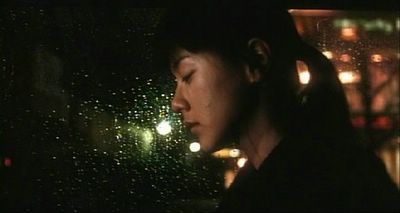
MABOROSI (MABOROSI NO HIKARI), director Hirokazu Kore-eda's first narrative feature, opens with a young girl chasing after her grandmother and pleading for her to return home. The old woman explains that she wishes to die where she was born. She continues on her way, undeterred by her granddaughter. A young woman named Yumiko (Makiko Esumi) awakens. Although she was dreaming, this event happened when Yumiko was a girl. Her husband Ikuo (Tadanobu Asano) tells her that he is not the reincarnation of her grandmother. Ikuo implies that unlike the old woman, he is not going somewhere never to return.
Yumiko and Ikuo are new parents who appear to be deeply in love. Then one night Yumiko is awakened by an ominous knock on the apartment door. She is summoned to a police station to identify a man who was run over by a train. Yumiko doesn’t see the body, or what remains of it, but can confirm that the person killed was her husband. This incident is tragic enough as is, but apparently Ikuo committed suicide, walking the same way as the train and ignoring its horn and squealing brakes.
A few years later Yumiko has been matched with another man for marriage. She and her son move from the city to the country and the seaside home of her new husband and his daughter. She becomes integrated into the community, but her new life is still haunted by questions she has regarding her husband’s death.
MABOROSI, which roughly translates as "strange light", delicately explores the survivor’s mourning and grief. Hirokazu's second film, the brilliant AFTER LIFE (WANDAFURU RAIFU), examines death via the experience of the deceased. Together the two provide an intriguing balance, with MABOROSI naturally being the sadder film.
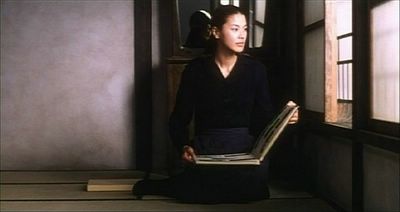
The arresting opening scene efficiently sets up what MABOROSI covers. Yumiko’s experience with her grandmother has given her a very specific fear of death. Without reason or foreknowledge, someone is gone. Despite one’s best efforts, one cannot stop death. Why do people choose to die, to quit living? Her grandmother seems to know her time is near and wishes not to fight the inevitable. Ikuo, on the other hand, would seem to have no reason to commit suicide, yet he does. While the grandmother’s death might be easier to accept, it still elicits feelings of anger and confusion in Yumiko because she chose to stop living. Does the dream indicate that Yumiko intuitively or subconsciously senses similar feelings in Ikuo? Possibly.
Hirokazu quickly establishes a very special, endearing relationship between Yumiko and Ikuo. It is important he does. When Ikuo abruptly dies, the loss she feels can be better understood. The world becomes large and empty. Hirokazu underlines this feeling of smallness and insignificance predominantly through the use of long shots and filling the soundtrack with loud, ambient sounds. The long shots create an overwhelming world to inhabit, one in which everything is distant. The use of natural light often makes scenes dark, as if much of the light on earth has been snuffed out with Ikuo’s death. The constant sound, whether the roar of trains, the sea, the radio, or crickets, becomes deafening to one in search of silence. There is no rest, no escape for the mourning.
Hirokazu's films are notable for their soothing, meditative qualities. To the impatient viewer they may seem slow, but those who succumb to his rhythms can enjoy another world where the constraints of time are washed away. MABOROSI doesn’t have a large arc because the film refuses to advance until Yumiko reaches an acceptance of Ikuo’s death.
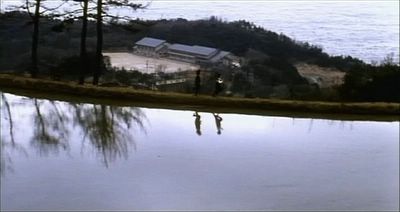
Masao Nakabori’s exquisite cinematography shows new and stunning ways of seeing the world. The careful shot composition reaches its artistic peak when the new brother and sister run and explore the land of the country. A shot in which their running reflections are mirrored in the water is especially spectacular. Ming Chang Chen’s score finds an appropriately beautiful and melancholy tone.
During the past decade Hirokazu has built a small but strong body of work that places him along the best modern directors. He's also one of the most empathetic filmmakers, softly guiding viewers through his meditations on life and death.
(This is a revised version of my DVD review. Follow the link for more information on the quality of and features on the DVD.)

MABOROSI (MABOROSI NO HIKARI), director Hirokazu Kore-eda's first narrative feature, opens with a young girl chasing after her grandmother and pleading for her to return home. The old woman explains that she wishes to die where she was born. She continues on her way, undeterred by her granddaughter. A young woman named Yumiko (Makiko Esumi) awakens. Although she was dreaming, this event happened when Yumiko was a girl. Her husband Ikuo (Tadanobu Asano) tells her that he is not the reincarnation of her grandmother. Ikuo implies that unlike the old woman, he is not going somewhere never to return.
Yumiko and Ikuo are new parents who appear to be deeply in love. Then one night Yumiko is awakened by an ominous knock on the apartment door. She is summoned to a police station to identify a man who was run over by a train. Yumiko doesn’t see the body, or what remains of it, but can confirm that the person killed was her husband. This incident is tragic enough as is, but apparently Ikuo committed suicide, walking the same way as the train and ignoring its horn and squealing brakes.
A few years later Yumiko has been matched with another man for marriage. She and her son move from the city to the country and the seaside home of her new husband and his daughter. She becomes integrated into the community, but her new life is still haunted by questions she has regarding her husband’s death.
MABOROSI, which roughly translates as "strange light", delicately explores the survivor’s mourning and grief. Hirokazu's second film, the brilliant AFTER LIFE (WANDAFURU RAIFU), examines death via the experience of the deceased. Together the two provide an intriguing balance, with MABOROSI naturally being the sadder film.

The arresting opening scene efficiently sets up what MABOROSI covers. Yumiko’s experience with her grandmother has given her a very specific fear of death. Without reason or foreknowledge, someone is gone. Despite one’s best efforts, one cannot stop death. Why do people choose to die, to quit living? Her grandmother seems to know her time is near and wishes not to fight the inevitable. Ikuo, on the other hand, would seem to have no reason to commit suicide, yet he does. While the grandmother’s death might be easier to accept, it still elicits feelings of anger and confusion in Yumiko because she chose to stop living. Does the dream indicate that Yumiko intuitively or subconsciously senses similar feelings in Ikuo? Possibly.
Hirokazu quickly establishes a very special, endearing relationship between Yumiko and Ikuo. It is important he does. When Ikuo abruptly dies, the loss she feels can be better understood. The world becomes large and empty. Hirokazu underlines this feeling of smallness and insignificance predominantly through the use of long shots and filling the soundtrack with loud, ambient sounds. The long shots create an overwhelming world to inhabit, one in which everything is distant. The use of natural light often makes scenes dark, as if much of the light on earth has been snuffed out with Ikuo’s death. The constant sound, whether the roar of trains, the sea, the radio, or crickets, becomes deafening to one in search of silence. There is no rest, no escape for the mourning.
Hirokazu's films are notable for their soothing, meditative qualities. To the impatient viewer they may seem slow, but those who succumb to his rhythms can enjoy another world where the constraints of time are washed away. MABOROSI doesn’t have a large arc because the film refuses to advance until Yumiko reaches an acceptance of Ikuo’s death.

Masao Nakabori’s exquisite cinematography shows new and stunning ways of seeing the world. The careful shot composition reaches its artistic peak when the new brother and sister run and explore the land of the country. A shot in which their running reflections are mirrored in the water is especially spectacular. Ming Chang Chen’s score finds an appropriately beautiful and melancholy tone.
During the past decade Hirokazu has built a small but strong body of work that places him along the best modern directors. He's also one of the most empathetic filmmakers, softly guiding viewers through his meditations on life and death.
(This is a revised version of my DVD review. Follow the link for more information on the quality of and features on the DVD.)
Saturday, July 16, 2005
Harry Potter Day

J.K. Rowling's sixth Harry Potter novel,HARRY POTTER AND THE HALF-BLOOD PRINCE, was released today. I had no part of getting in line to buy the book at midnight--just so that's clear--but I am looking forward to reading it. I walked over to B. Dalton's--a rare stand-alone shop rather than a mall store--to get it while my laundry was was in the washing machines. I was a little surprised that there wasn't a bigger crowd, but apparently there was a line before the store opened at 8 a.m. (A store employee told me that the first person claimed to have arrived at 5:30 a.m.)

Aside from being curious about the phenomenon, I didn't feel compelled to read the series until the release of the first film neared. Typically I don't feel that it is necessary to read the source material before seeing film adaptations--or see the originals before the remakes--but in this case I wanted to know what to expect. I was prepared to write it off as nice but forgettable kid's stuff, but I really enjoyed the first book and tore through the next couple in short time.

It's hard to say if Harry Potter will be a fad or stand literature's test of time, but I'm inclined to favor the latter position. These are rich, well-written books that are likely to enchant children and adults for some time to come. The films haven't matched the novels, but that was, and will continue to be, an impossible task, really.
Thursday, July 14, 2005
Small Change (L'Argent de poche)
SMALL CHANGE (L'ARGENT DE POCHE) (François Truffaut, 1976)
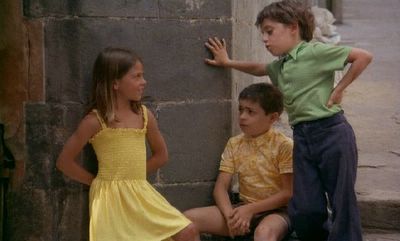
Truffaut knowingly elicits memories of his seminal New Wave film THE 400 BLOWS (LES QUATRE CENTS COUPS) in early classroom scenes. The tone, however, is gentler, and although one boy’s story is tragic, SMALL CHANGE is optimistic.
The stories in SMALL CHANGE mostly take place around the school, an apartment building, and, where else for a Truffaut film, the movie theater. In a masterful sequence, a young boy is left alone in the apartment while his mother searches for her missing wallet. The boy wanders around his environment, picks up the cat, and then leans out the open window when the cat falls onto a lower perch. He is several stories high, and others watch with dread as the child gets precariously closer to the edge. Truffaut milks the scene for all its worth, amplifying the tension to maximum effect before the resolution. There are entire thrillers which generate less anxiety than this one scene.
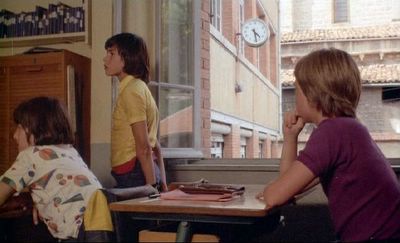
The joy of SMALL CHANGE is seeing the very natural performances of the children. What is remarkable is how this extends from the very young to those bordering on adolescence. Truffaut is so precise with his observations and unintrusive with the camera that we feel as if we are seeing a documentary instead of contrived movie scenarios. He finds the small pleasures of children and captures their fear and excitement, such as one boy’s first crush and kiss.
This delightful classic defies most cinematic representations of childhood. Unlike most films which feature or focus on children, SMALL CHANGE does not make them overly precocious or sentimentalize their experiences. A popular, misguided cinematic postulation states that children are merely miniature adults. Truffaut scoffs at such a notion, presenting the kids as they are in all their triumphs and mistakes. We smile when they’re being good and a little bad. Two brothers decide to let their parents sleep late and make a breakfast of chocolate milk and bread. One boy seriously, but innocently, tells a dirty joke on the playground.
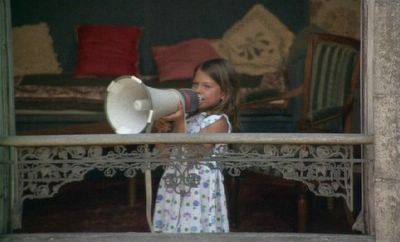
Children can be incredibly kind and selfless, but they can also be mischievous and cruel. They can also try the patience of adults, a frustration echoed by teachers and caretakers. An especially interesting scene takes place between a girl and her parents. They are going to a restaurant, and she wants to take her dirty purse. Her parents try to convince her to take a nicer one, but she is unrelenting. They threaten to leave her in the apartment while they go to eat. The stubborn child refuses to give in, and her parents do indeed leave her behind. She ups them when she uses her father’s bullhorn to broadcast her cries of hunger to the building’s other residents. Predictably the neighbors chasten the absent parents and assemble a rig to deliver food to her. The scene effectively portrays the child’s obstinance, ingenuity, and manipulative skills. It highlights the aggravation children can bring as well as the intelligence they possess.
Most of the stories are warmly amusing, but one unblinkingly looks at a troubled boy. It comes as no surprise at the end of the film to discover that he is abused, but Truffaut uses the prior events to create more poignancy for him and his situation. The boy, who wears the same clothes day after day, is unresponsive and unprepared in class, and the teacher comes down hard on him. Certainly he is crying out for help in the only way he knows how, but recognizing this is easier in hindsight.
SMALL CHANGE silently watches the action most of the time. An exception occurs after the boy’s abuse is revealed and one teacher delivers an impassioned monologue about children’s rights. The speech wouldn’t have sounded out of place during the Clinton administration and makes some good points, but it also strikes me as being very idealized, especially when the educator speaks of what would happen if kids could vote. The importance of community is emphasized throughout SMALL CHANGE and would support those who believe it takes a village to raise a child.
Grade: A
(This is a revised version of my DVD review. Follow the link for more information on the quality of and features on the DVD.)

Husband: It’s terrifying to think of the way kids are in constant danger.Childhood is a recurring subject in François Truffaut’s films, and the French auteur focuses his attention on its joys and tribulations in SMALL CHANGE (L'ARGENT DE POCHE) (or POCKET MONEY, as it's translated in the subtitles). The small French town of Thiers is home to the characters occupying the series of daily vignettes. SMALL CHANGE lacks an overarching structure to push it forward. Rather it simply observes the children and the adults in their lives.
Wife: That’s not exactly true. I mean, whereas an adult would have been laid out for good, kids are as solid as rock. They stumble through life, but they’re not hurt. They’re much tougher than we are.
--from SMALL CHANGE
Truffaut knowingly elicits memories of his seminal New Wave film THE 400 BLOWS (LES QUATRE CENTS COUPS) in early classroom scenes. The tone, however, is gentler, and although one boy’s story is tragic, SMALL CHANGE is optimistic.
The stories in SMALL CHANGE mostly take place around the school, an apartment building, and, where else for a Truffaut film, the movie theater. In a masterful sequence, a young boy is left alone in the apartment while his mother searches for her missing wallet. The boy wanders around his environment, picks up the cat, and then leans out the open window when the cat falls onto a lower perch. He is several stories high, and others watch with dread as the child gets precariously closer to the edge. Truffaut milks the scene for all its worth, amplifying the tension to maximum effect before the resolution. There are entire thrillers which generate less anxiety than this one scene.

The joy of SMALL CHANGE is seeing the very natural performances of the children. What is remarkable is how this extends from the very young to those bordering on adolescence. Truffaut is so precise with his observations and unintrusive with the camera that we feel as if we are seeing a documentary instead of contrived movie scenarios. He finds the small pleasures of children and captures their fear and excitement, such as one boy’s first crush and kiss.
This delightful classic defies most cinematic representations of childhood. Unlike most films which feature or focus on children, SMALL CHANGE does not make them overly precocious or sentimentalize their experiences. A popular, misguided cinematic postulation states that children are merely miniature adults. Truffaut scoffs at such a notion, presenting the kids as they are in all their triumphs and mistakes. We smile when they’re being good and a little bad. Two brothers decide to let their parents sleep late and make a breakfast of chocolate milk and bread. One boy seriously, but innocently, tells a dirty joke on the playground.

Children can be incredibly kind and selfless, but they can also be mischievous and cruel. They can also try the patience of adults, a frustration echoed by teachers and caretakers. An especially interesting scene takes place between a girl and her parents. They are going to a restaurant, and she wants to take her dirty purse. Her parents try to convince her to take a nicer one, but she is unrelenting. They threaten to leave her in the apartment while they go to eat. The stubborn child refuses to give in, and her parents do indeed leave her behind. She ups them when she uses her father’s bullhorn to broadcast her cries of hunger to the building’s other residents. Predictably the neighbors chasten the absent parents and assemble a rig to deliver food to her. The scene effectively portrays the child’s obstinance, ingenuity, and manipulative skills. It highlights the aggravation children can bring as well as the intelligence they possess.
Most of the stories are warmly amusing, but one unblinkingly looks at a troubled boy. It comes as no surprise at the end of the film to discover that he is abused, but Truffaut uses the prior events to create more poignancy for him and his situation. The boy, who wears the same clothes day after day, is unresponsive and unprepared in class, and the teacher comes down hard on him. Certainly he is crying out for help in the only way he knows how, but recognizing this is easier in hindsight.
SMALL CHANGE silently watches the action most of the time. An exception occurs after the boy’s abuse is revealed and one teacher delivers an impassioned monologue about children’s rights. The speech wouldn’t have sounded out of place during the Clinton administration and makes some good points, but it also strikes me as being very idealized, especially when the educator speaks of what would happen if kids could vote. The importance of community is emphasized throughout SMALL CHANGE and would support those who believe it takes a village to raise a child.
Grade: A
(This is a revised version of my DVD review. Follow the link for more information on the quality of and features on the DVD.)
Wednesday, July 13, 2005
On republishing reviews
You may have noticed that recently I've been republishing reviews that have appeared on another site. I'm leaving all of the DVD information with my DVDMon.com reviews and excising it in the transition to here. (I'm providing links to the originals for those who might like that information.) I'm also revising them as I see fit, which may amount to no changes, minor grammar corrections and wording changes, deleted remarks, additional commentary, or some combination of these. The most substantial changes will come in reviews for those films I see again, such as the new content in my UMBRELLAS OF CHERBOURG review.
I'm not severing ties with DVDMon.com--in fact, I'll probably have something for it in the next couple weeks--but with Reel Times: Reflections on Cinema becoming my online home, it makes sense to compile as much in one place as possible. Republishing reviews here will also help keep the blog regularly updated and bring new attention to my older work, the quality of which has pleasantly surprised me, for the most part.
While I'm talking about the site, I might as well point out that one of my regular Google searches about myself--c'mon you know you do it to...I mean about yourself, not me--turned up one of my review quotes on Insights, a web magazine for the New South Wales Synod of the Uniting Church in Australia. They're giving away passes for BECAUSE OF WINN-DIXIE and selected one of my quotes for use on the contest entry page. Pretty wild.
Tuesday, July 12, 2005
That Obscure Object of Desire (Cet obscur objet du désir)
THAT OBSCURE OBJECT OF DESIRE (CET OBSCUR OBJET DU DÉSIR) (Luis Buñuel, 1977)
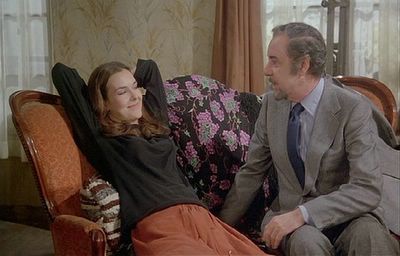
Carole Bouquet and Fernando Rey in That Obscure Object of Desire
For almost fifty years Luis Buñuel made movies that explored humanity’s perverse obsessions. THAT OBSCURE OBJECT OF DESIRE (CET OBSCUR OBJET DU DÉSIR) once again finds him plumbing the deep, dark recesses of sexual desire, and in this, his final film, the great surrealist throws one last curve at the audience, having two actresses play the lead female role.
Mathieu Faber (Fernando Rey) is a middle-aged, well-heeled widower who rapidly becomes fixated on the new, young maid Conchita (Carole Bouquet and Ángela Molina). She rejects his initial advances and abruptly quits the job. Mathieu is dejected, but they will meet again.
He is granted another opportunity to win her, and this time Mathieu and Conchita fall into a happy rhythm. He visits her in the apartment where she lives with her mother (Maria Asquerino). He delights in their time together. Mathieu believes she feels the same way; however, Conchita perplexes him at times. Undoubtedly this is part of the fascination, but his aggravation is slowly building. She sits in his lap and kisses him but resists going any further. Conchita eventually reveals that she is a virgin. Thinking that she wishes for their relationship to be legitimized in some fashion, Mathieu attempts to forge an agreement with her mother. Conchita will move in with him, and he will see to it that money is not a concern for either woman.
Conchita is appalled when she learns that he has attempted to purchase her. She breaks off the relationship. Mathieu is as despondent as ever. He will be afforded more chances to please her, but can he discover what she wants from him?
Through flashbacks Mathieu tells his story about “the worst woman on earth” to his fellow train passengers. They witnessed him dump a bucket of water on Conchita in the station and are very curious what would provoke such an unusual action.

Fernando Rey and Ángela Molina
At face value Buñuel appears to use two actresses to express the duality of Conchita. She is virgin and whore, sadist and masochist, redeemer and punisher. She is all of these things yet none of these things, which adds to her mystery. The actresses do not look alike--the French Bouquet, with her kittenish face and cool demeanor, contrasts sharply with the earthy, Spanish Molina--and no effort is expended to make them resemble each other. Alternating them is an effective means of communicating different aspects of the character’s personality. Plus, in some mystical, cinematic way, the switching of actresses is seamless rather than jarring. It makes perfect sense, perhaps in a Jungian context, whether it is intended to or not. (In the interview reprinted in the Criterion DVD booklet, Buñuel contends that there is no rational explanation.)
THAT OBSCURE OBJECT OF DESIRE focuses on the struggle between the conscious and unconscious mind. Mathieu proclaims love for Conchita, yet from the very start his attraction is immediate and animalistic. His feelings are not intellectually derived, but he states his emotions as if they are verifiable fact. For much of the film he is disconnected from his more primal urges, from his shadow self, and until he is able to integrate these aspects of his personality, he is doomed to repeat the vicious cycle with Conchita. Mathieu’s inability to understand himself is at the core of his failures with her.
Buñuel wittily stages this tempestuous battle of the sexes, but he also leads us into darker corners of the heart and soul. Mathieu’s spurned attempts to have intercourse with Conchita are perhaps more humorous than correlating scenes in teen sex comedies because of the obstacles, or, on one occasion, garment, keeping him from fulfilling his desire. At the same time, these scenes can take on a more insidious tone. Mathieu reaches the point where he is unconcerned with Conchita’s wishes and must satisfy his urges. As he displays in other moments, he views her as an object, an item to be possessed and something to do his bidding. This is when Conchita resists most, determined to be seen for what she is instead of some mental ideal into which she has been constructed.
THAT OBSCURE OBJECT OF DESIRE is an intoxicating descent into one man’s experience of the emotional terrorism intended to shake him from his ways. Buñuel’s final film is a darkly comic piece that aims to do the same to us.
Grade: A-
(This piece was originally published as a review of the Criterion DVD. Follow the link for more information on the DVD.)
Reality TV, new and revisited
THE AMAZING RACE is one of my favorite TV shows, but I came to it a little late, missing the first three seasons. Luckily Game Show Network has started rerunning the seven previous races. Considering that the series ran only in the summer until the 2004-05 season and doesn't return until this fall, the reruns are a welcome substitute.
The first thing that struck me about the first season of THE AMAZING RACE was the leisurely pace, not only in the editing but also in the participants' behavior. The show editors have definitely refined the structure (and improved it), and the contestants have become more intense about every little move. Seeing the first episode demonstrates that the director and editors were still finding their way in how to convey the order and closeness of the teams while the race is in progress. There's too much emphasis on travel details and not enough on the racers, but I expect that the first season will get better. After all, later seasons are edited about as well as anything on television.
The new show from SURVIVOR producer Mark Burnett made its debut tonight. ROCK STAR: INXS is sort of a rock and roll version of AMERICAN IDOL, except the prize isn't an individual recording contract but the chance to front the once-popular Australian band. INXS hasn't been on the scene for some time--rightly so, since lead singer Michael Hutchence was found dead of an apparent suicide in late 1997--but as a brand name and huge 80s act, the time may be right for them to cash in their chips for nostalgia all things 80s. (They certainly have a better chance of selling albums with the INXS name than something else.)
To the show's credit, they don't hide the issue of Hutchence's death, although I certainly don't expect it to be mentioned beyond this first episode. My bet to win is Jessica. Not only is she the hot young thing with the pipes who can add some sex appeal to a band of middle-aged guys, but also, in picking a woman, INXS would gain someone who would face less scrutiny and comparisons as a replacement for Hutchence. (To be honest, though, I don't see any of the other women winning, so this theory's shot if she's packing her bags soon.) If a guy will win, the smart money should be on Brandon, who seems like he's out of the Hutchence mold.
Based on one episode, ROCK STAR: INXS looks to be a fun, zippy show that will give us enough rockin' with the ace house band while still finding time to tell the competitors' stories. If the first show is any indication, it doesn't look like we'll be seeing complete performances by each singer, and I don't think that it's necessary. It was easy to see from a little bit that Dana's style, at least on this song, didn't match the band and that Suzie's botched lyrics were going to put her in the hot seat. The dismissal was surprisingly low-key and about as polite as it gets for this sort of program. The early verdict is that ROCK STAR: INXS will be worthwhile summer viewing, but we'll see how it progresses.
Sunday, July 10, 2005
The Umbrellas of Cherbourg (Les Parapluies de Cherbourg)
THE UMBRELLAS OF CHERBOURG (LES PARAPLUIES DE CHERBOURG) (Jacques Demy, 1964)
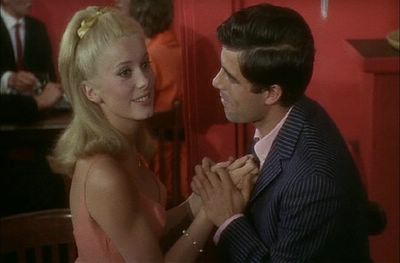
One of the greatest films of all-time, Jacques Demy’s THE UMBRELLAS OF CHERBOURG (LES PARAPLUIES DE CHERBOURG) is a colorful musical which was nearly lost forever. The original negative was damaged to the point where it could not be repaired. Release prints underwent a cheaper process which led to the fast fading of colors. Demy made a high quality tri-color print in 1963, and luckily no color fading had occurred in it when the choice was made to restore the film. The restoration effort resulted in a new negative in 1992 with the sound remixed in Dolby Stereo by Demy’s widow Agnès Varda and UMBRELLAS composer Michel Legrand.
Seventeen year-old Geneviève (Catherine Deneuve) works in her widowed mother’s shop during the day and spends evenings with her new love Guy (Nino Castelnuovo). They fantasize about their future together, and as befits their youth, their options are limited to what they know. Perhaps they’ll sell umbrellas, as she does at the eponymous family business, or work at a gas station, which is Guy’s place of employment.
Geneviève and Guy are seeing each other on the sly. Guy initially avoids telling his sick godmother Aunt Elise (Mireille Perrey) what he will be doing and with whom he will be going one night. Geneviève tells her mother Madame Emery (Anne Vernon) that she and a girlfriend have activities planned. When she learns of the romance, Geneviève’s mother insists that her daughter is too young. These are minor obstacles, though, when two young people are in love, and all is right with the world.
But trouble descends upon the deliriously happy couple. The umbrella shop faces financial difficulties. Madame sells her necklace to help pay the bills. The purchaser, Roland Cassard (Marc Michel), is a young man who may also have eyes for Geneviève. Bad news arrives when Guy finds that he has been drafted for military service in Algeria and must report for a two year tour of duty. Will absence make their hearts grow fonder, or will the separation tear them apart?
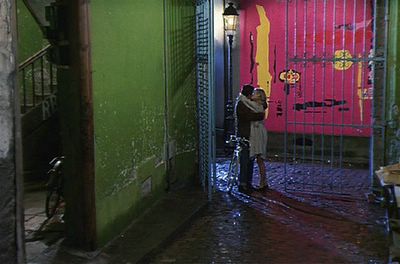
THE UMBRELLAS OF CHERBOURG deviates from other romances, and other films, in that all of the dialogue is sung, from sweeping declarations of amour to everyday pleasantries. (Demy also used the same technique in his 1966 film THE YOUNG GIRLS OF ROCHEFORT [LES DEMOISELLES DE ROCHEFORT].) THE UMBRELLAS OF CHERBOURG differs from other musicals in that it plays almost as if it’s one long song rather than several distinct compositions. There aren’t memorable songs but familiar, beautiful themes, most notably the haunting main melody. Michel Legrand’s music is the film’s heartbeat, and it soars and dips according to the melodrama. The stylistic affectation may require a period of adjustment for some, but the technique works quite well. Life becomes music, with shifts in key and tempo expressing changes in the story and the characters' interiors. It's hard to imagine UMBRELLAS being as emotionally affecting as a more conventional musical.
Deneuve, one of the screen’s great, classic beauties, was twenty when she made this, her first major film. She radiates like few before or after her. Deneuve isn’t the only on screen beauty. Sets and clothes bloom with the colors of springtime flowers.
Sometimes magic gets captured on film. That happened with this simple, tear-stained story of young lovers. Demy drenches the film in color and music, providing an aural and visual palette for the heightened emotions. The vivid feelings even cause Geneviève and Guy to leave the ground, as seen in a tracking shot in which they glide above the street while the camera pulls back. THE UMBRELLAS OF CHERBOURG is mostly bright and boisterous, but the perfect ending lands on a moment of quiet beauty that expresses sadness for what was lost and happiness for what existed. The film breaks your heart, but what a glorious way to have it happen.
Grade: A+
(This is a revised version of my DVDMon review of the Fox Lorber DVD. Koch Lorber has since released a better DVD edition, although I revisited the film at a summer film series. If the opportunity to see it on a big screen presents itself, go.)

One of the greatest films of all-time, Jacques Demy’s THE UMBRELLAS OF CHERBOURG (LES PARAPLUIES DE CHERBOURG) is a colorful musical which was nearly lost forever. The original negative was damaged to the point where it could not be repaired. Release prints underwent a cheaper process which led to the fast fading of colors. Demy made a high quality tri-color print in 1963, and luckily no color fading had occurred in it when the choice was made to restore the film. The restoration effort resulted in a new negative in 1992 with the sound remixed in Dolby Stereo by Demy’s widow Agnès Varda and UMBRELLAS composer Michel Legrand.
Seventeen year-old Geneviève (Catherine Deneuve) works in her widowed mother’s shop during the day and spends evenings with her new love Guy (Nino Castelnuovo). They fantasize about their future together, and as befits their youth, their options are limited to what they know. Perhaps they’ll sell umbrellas, as she does at the eponymous family business, or work at a gas station, which is Guy’s place of employment.
Geneviève and Guy are seeing each other on the sly. Guy initially avoids telling his sick godmother Aunt Elise (Mireille Perrey) what he will be doing and with whom he will be going one night. Geneviève tells her mother Madame Emery (Anne Vernon) that she and a girlfriend have activities planned. When she learns of the romance, Geneviève’s mother insists that her daughter is too young. These are minor obstacles, though, when two young people are in love, and all is right with the world.
But trouble descends upon the deliriously happy couple. The umbrella shop faces financial difficulties. Madame sells her necklace to help pay the bills. The purchaser, Roland Cassard (Marc Michel), is a young man who may also have eyes for Geneviève. Bad news arrives when Guy finds that he has been drafted for military service in Algeria and must report for a two year tour of duty. Will absence make their hearts grow fonder, or will the separation tear them apart?

THE UMBRELLAS OF CHERBOURG deviates from other romances, and other films, in that all of the dialogue is sung, from sweeping declarations of amour to everyday pleasantries. (Demy also used the same technique in his 1966 film THE YOUNG GIRLS OF ROCHEFORT [LES DEMOISELLES DE ROCHEFORT].) THE UMBRELLAS OF CHERBOURG differs from other musicals in that it plays almost as if it’s one long song rather than several distinct compositions. There aren’t memorable songs but familiar, beautiful themes, most notably the haunting main melody. Michel Legrand’s music is the film’s heartbeat, and it soars and dips according to the melodrama. The stylistic affectation may require a period of adjustment for some, but the technique works quite well. Life becomes music, with shifts in key and tempo expressing changes in the story and the characters' interiors. It's hard to imagine UMBRELLAS being as emotionally affecting as a more conventional musical.
Deneuve, one of the screen’s great, classic beauties, was twenty when she made this, her first major film. She radiates like few before or after her. Deneuve isn’t the only on screen beauty. Sets and clothes bloom with the colors of springtime flowers.
Sometimes magic gets captured on film. That happened with this simple, tear-stained story of young lovers. Demy drenches the film in color and music, providing an aural and visual palette for the heightened emotions. The vivid feelings even cause Geneviève and Guy to leave the ground, as seen in a tracking shot in which they glide above the street while the camera pulls back. THE UMBRELLAS OF CHERBOURG is mostly bright and boisterous, but the perfect ending lands on a moment of quiet beauty that expresses sadness for what was lost and happiness for what existed. The film breaks your heart, but what a glorious way to have it happen.
Grade: A+
(This is a revised version of my DVDMon review of the Fox Lorber DVD. Koch Lorber has since released a better DVD edition, although I revisited the film at a summer film series. If the opportunity to see it on a big screen presents itself, go.)
Wednesday, July 06, 2005
Nobody Knows (Dare mo shiranai)
NOBODY KNOWS (DARE MO SHIRANAI) (Hirokazu Kore-eda, 2004)
A mother abandons her four children, leaving twelve-year-old Akira to care for his younger siblings in NOBODY KNOWS. Their mom disappears for long stretches a couple times but returns, so the kids have no reason to think she is not coming back. Since the landlord believes that only Akira and his mother live in the apartment—the two youngest were smuggled into their new home inside suitcases--Kyoko, Shigeru, and Yuki are instructed to stay inside at all times, except for when Kyoko must step onto the porch to do the laundry. Akira is wise enough to understand that mom may have left them for good, but he can only do so much to care for his brother and sisters.
Director Hirokazu Kore-eda tells this harrowing tale with such delicacy and grace that the dark places where NOBODY KNOWS eventually travels don’t feel oppressive. Through a documentary-like approach and reliance on tight close-ups in their apartment, Hirokazu evokes the children’s worldview and their ignorance of how perilous their situation is. The child actors are remarkable in their simple, unaware performances. As Akira, Yûya Yagira won the Best Actor award at the 2004 Cannes Film Festival for his heartbreaking work.
Whether intended or not, NOBODY KNOWS owes much to the films of François Truffaut, specifically THE 400 BLOWS and SMALL CHANGE. Hirokazu’s film is what the first Antoine Doinel film might have been like if it focused exclusively on the time he ran away from home and found a hidden place in Paris to live and play. A tracking shot of Akira running through the city and the film-ending freeze frame are the strongest tip-offs to any 400 BLOWS homage. The children in NOBODY KNOWS turn their parent-free home into a little paradise. Hirokazu dwells on the resiliency of children, a theme that also resonated in SMALL CHANGE and which gives the film a lightness not inherent in the subject matter. It’s one of the year’s best films.
Grade: A
(Review first aired in a shorter version on the July 5, 2005 NOW PLAYING)
My Summer of Love
MY SUMMER OF LOVE (Paul Pavlikovsky, 2004)
As Zeus took the form of a swan to seduce Leda, Paul Pavlikovsky's MY SUMMER OF LOVE promises a scorching romance between two girls to entice the viewer, although it proves to be something else altogether.
Despite their differences teenagers Mona (Nathalie Press) and Tamsin (Emily Blunt) form an intense friendship that leads to love. Red-haired, freckled Mona lives above a pub that her born again brother Phil (Paddy Considine) converts into a spiritual meeting place. She's none too pleased that Phil found God in prison. Along comes Tamsin, a beautiful boarding school student who has returned to her parents' enormous home for the summer. Mona and Tamsin bond over lost family members and those still around who they feel have betrayed them. They're an inseparable duo who bristle at Phil's warnings of the devil's temptations at work in their town.
The devil doesn't have horns, a tail, and a pitchfork but a friendly face and seductive lies. Pavlikovsky keeps MY SUMMER OF LOVE compelling because we're never entirely sure if Mona should doubt Phil's conversion or if he has insight into unseen evils plaguing the town. Out of his conviction Phil erects a large cross at the top of the hill in the hope of saving others. The power of transformation runs deep through the film, not only with that specific religious symbol but also with words, images, and music. The swan plays a key role, whether as the name of the pub before it changes into a place of worship, a knickknack Mona's mother had, or the classical music Tamsin plays on her cello. Water and its importance in key moments of transformation comes into play as well.
Coupled with Ryszard Lenczewski's picturesque cinematography, Press and Blunt's natural performances communicate a palpable sense of the summer's heat and the hazy days of adolescence and ardor.
Grade: B
(Review originally appeared as part of my Deep Focus Film Fest day 3 coverage)
Land of the Dead
LAND OF THE DEAD (George A. Romero, 2005)
Director George A. Romero is credited with creating the zombie movie genre as we know it with 1968’s NIGHT OF THE LIVING DEAD. Recent years have produced many variations on his work, including a remake of DAWN OF THE DEAD, 28 DAYS LATER, and SHAUN OF THE DEAD. Now Romero returns for LAND OF THE DEAD, the fourth film in his zombie cycle. The survivors in the post-apocalyptic world live in a zone where two converging rivers and electrified fences provide buffers from the living dead. The wealthy live in the posh private high rise run by the seedy Kaufman, played by Dennis Hopper. The rest scrounge in the streets, including the hired guns who fight the zombies while searching for supplies in the war zone. While on patrol, the mercenaries notice that the living dead are developing rudimentary abilities to think and communicate.
Among horror aficionados Romero is revered not only for his flair for gore but also his social satire and commentary. LAND OF THE DEAD follows in that tradition. Romero finds creative ways to stage zombies feasting on flesh while tackling subjects such as gated communities, war profiteering, and entertainment as a weapon of mass distraction. While Romero’s more ardent admirers insist that he’s injecting an incisive exegesis of modern life, the commentary’s depth is debatable, but nevertheless the political and social points add a distinct flavor to an otherwise familiar film. LAND OF THE DEAD is more contemplative than many of its cinematic siblings, but it still finds time for the humor and gut-munching that fans demand. Hopper is perfectly cast as the slimy head of the high rise. He delivers what is likely to be the film’s signature line while picking his nose, which is just the sort of oddball touch Hopper brings to all he does. 28 DAYS LATER is the latest, greatest zombie film, but with LAND OF THE DEAD, Romero has made a better film than most of his imitators.
Grade: B-
(Review first aired in a shorter version on the July 5, 2005 NOW PLAYING)
Rebound
REBOUND (Steve Carr, 2005)
Conventional wisdom proclaims that there are no new ideas in Hollywood, and this summer’s slate of movies supports such thinking. Each week brings a sequel, a remake, or a TV show adaptation. Richard Linklater’s BAD NEWS BEARS remake is due later in July, yet the last two months have already produced two films in a similar mold. Will Ferrell coached hapless soccer players in KICKING & SCREAMING, and now comes Martin Lawrence as a disgraced basketball coach working with miserable middle school athletes in REBOUND. Lawrence plays self-centered Ohio Polytech coach Roy McCormick, whose off-court and sideline antics earn him a suspension from the National College Basketball Association. With his career in tailspin, Roy agrees to lead the inept Mount Vernon Junior High Smelters. The team is the usual assortment of uncoordinated outsiders, so they’ll need all the help they can get.
REBOUND retreads and recycles the underdog sports movie template with as little character and inspiration as possible. It’s a laugh-free exercise in moviemaking by numbers. A random middle school game would have more drama and comedy than REBOUND can muster. Eddie Murphy has made a successful transition from raw comedy to family films, even if the pics often leave a lot to be desired. Lawrence can be considered a successor to Murphy, but his first venture into kid flicks--helmed here by Murphy’s DADDY DAY CARE and DOCTOR DOLITTLE 2 director Steve Carr--finds him ill-suited for the task. Lawrence has always come off as smug on screen. In REBOUND that quality makes him seem all the more insincere when he’s not supposed to be. Lawrence also seems uncomfortable in a PG-rated environment that forces him to rein in his style.
Grade: D
(Review first aired on the July 5, 2005 NOW PLAYING)
Monday, July 04, 2005
All Hands on the Hard One
Yesterday's Los Angeles Times had an interesting article about, what the writer dubs, "personal screenwriters". Much of it focuses on the work relationship between Will Ferrell and Adam McKay and Sydney Pollack and David Rayfiel, but the part that jumped out at me was this news about a new project for Robert Altman and Anne Rapp:
On the basis of The Austin Chronicle's rave review I saw the doc at the Dobie Theatre in Austin, TX while on vacation in the summer of 1998. The film's human drama and comedy, not to mention the contestants' endurance, knocked me sideways. so much that I put it in my '98 Top Ten. I haven't watched it in a few years, but my suspicion is that if it had come out a few years later, it might have been a modest arthouse hit. (HANDS ON A HARDBODY anticipates reality television, which didn't make a mark in the US until SURVIVOR'S summer 2000 debut.) It provides the opportunity for a great multi-character story, which is Altman's stock in trade.
Rapp, feeling she and Altman needed to "stretch their wings," parted ways with the director in 2000. Rapp didn't get a movie made during the five-year hiatus, but they have recently reunited and are now reworking the 1997 documentary Hands on a Hardbody, which follows a marathon competition to win a pickup truck, into a drama for Altman to direct.Aside from the fact that there's another Altman film in the works--he already has PAINT and A PRARIE HOME COMPANION in the pipeline--the big news to me is that S.R. Bindler's HANDS ON A HARDBODY is providing the inspiration.
On the basis of The Austin Chronicle's rave review I saw the doc at the Dobie Theatre in Austin, TX while on vacation in the summer of 1998. The film's human drama and comedy, not to mention the contestants' endurance, knocked me sideways. so much that I put it in my '98 Top Ten. I haven't watched it in a few years, but my suspicion is that if it had come out a few years later, it might have been a modest arthouse hit. (HANDS ON A HARDBODY anticipates reality television, which didn't make a mark in the US until SURVIVOR'S summer 2000 debut.) It provides the opportunity for a great multi-character story, which is Altman's stock in trade.
Sunday, July 03, 2005
Radio review
Whether listening live or via the online archive, I hope everyone was able to listen to my appearance on NPR 820 WOSU-AM's Open Line on June 30. The broadcast is still available in the archive, although it looks like you'll need to listen or save it to your computer within a week or two.
I really enjoyed the experience and hope to be invited back. Melissa, Kaizaad, and I had enough differences of opinion to keep things interesting, which always helps. I don't think I got into a groove into after discussing BATMAN BEGINS, the second topic of conversation, but generally I was pleased with how I represented myself. When my parents get around to listening to it, their main observation will probably be that my last name was pronounced incorrectly, something which I meant to point out during the news break but forgot because the first half hour flew by. There was no mention of this blog--I was identified as being with WOCC TV3 and The Film Journal, for which I've written the least--so for the time being there shouldn't be an influx of public radio listeners hogging bandwidth.
I really enjoyed the experience and hope to be invited back. Melissa, Kaizaad, and I had enough differences of opinion to keep things interesting, which always helps. I don't think I got into a groove into after discussing BATMAN BEGINS, the second topic of conversation, but generally I was pleased with how I represented myself. When my parents get around to listening to it, their main observation will probably be that my last name was pronounced incorrectly, something which I meant to point out during the news break but forgot because the first half hour flew by. There was no mention of this blog--I was identified as being with WOCC TV3 and The Film Journal, for which I've written the least--so for the time being there shouldn't be an influx of public radio listeners hogging bandwidth.
Thursday, June 30, 2005
Radio reminder

Today I'll be on NPR 820 WOSU-AM's Open Line from 10 to 11 a.m. Go to the show's page--which looks similar to the composite screen capture I assembled from there--and click on the "listen live" button in the sidebar or the "listen" link in the Thursday segment desription. If you can't catch the show live, it airs again at 6:30 p.m. and should be archived online.
Wednesday, June 29, 2005
Top Films of 2005: The Halfway Point
Since we're almost halfway through the year, it feels like the right time to post what I consider the top films to date. Except for a few stragglers, my mid-year list doesn't seem to mirror my top ten come year's end--most of them drift to the realm of the honorable mentions--although some of these are going to be tough to move down. The usual caveat applies to this in-progress list: films may switch spots for seemingly no reason between now and the end of the year.
1. KINGS AND QUEEN (Arnaud Desplechin, 2004)
A film so maddeningly brilliant that it practically defies description or analysis. Some think it's the art film equivalent of the emperor's new clothes. Perhaps they're right. When I saw it I had such a hard time putting my thoughts into words that I just didn't bother. More than any other new film, I felt my brain's synapses firing like crazy during Desplechin's delirious magnum opus. The Wexner Center is supposedly bringing this back in a few months, so maybe then I can put my enthusiasm into more specific terms.
2. NOBODY KNOWS (DARE MO SHIRANAI) (Hirokazu Kore-eda, 2004)
One of my favorite filmmakers tells a harrowing tale of abandoned children with such delicacy and grace that the dark places it goes don't feel oppressive. NOBODY KNOWS seems to owe much to Truffaut, specifically THE 400 BLOWS and SMALL CHANGE. It's sort of like if the first Antoine Doinel film focused exclusively on the time he ran away from home and found a hidden place in Paris to live and play. The children in NOBODY KNOWS are mostly confined to their parent-free home but don't see the gravity of the situation, turning it into their own little paradise. (A tracking shot of the eldest running through the city and the film-ending freeze frame are the strongest tip-offs to any intended 400 BLOWS homage.) Hirokazu dwells on the resiliency of the children, a theme that also resonated in SMALL CHANGE.
3. WAR OF THE WORLDS (Steven Spielberg, 2005)
Spielberg's visually magnificent and utterly terrifying film proves that there's no one better at making event movies. Although it isn't particularly deep in regard to character or theme, WAR OF THE WORLDS rattled and awed me. The unrelenting intensity becomes uncomfortable while the visualization of terror from above and below is technically impressive and believable.
4. CRASH (Paul Haggis, 2004)
Haggis' eloquent examination of race relations posits more questions than answers, but it offers redemption to those struggling with these issues in contemporary America. Superbly acted and fluidly directed to connect multiple storylines, CRASH brings stereotypes and prejudices to the forefront in hopes of breaking them.
5. FEVER PITCH (Bobby Farrelly and Peter Farrelly, 2005)
Simply put, it'sANNIE HALL for baseball fans and one of the best romantic comedies of the last ten years.
6. MURDERBALL (Henry Alex Rubin and Dana Adam Shapiro, 2005)
This brash, highly entertaining documentary breaks all kinds of preconceptions and misconceptions about quadriplegics. Shot almost exclusively from the vantage point of a wheelchair, MURDERBALL introduces the rough and tumble world of quad rugby and the hardnosed men who play the game. It's uplifting and inspirational without being cloying or sentimental.
7. THE EDUKATORS (DIE FETTEN JAHRE SIND VORBEI) (Hans Weingartner, 2004)
Weingartner taps into youthful feelings of anti-capitalist rebellion a la FIGHT CLUB, without the violent outbursts, and idealistic self-doubt, the kind that plagued Mark Wahlberg’s character in I ♥ HUCKABEES . THE EDUKATORS consist of two young men who break into the vacant homes of the wealthy, rearrange their possessions, and leave notes proclaiming sentiments such as, “Your days of plenty are numbered.” Their motivation is to make the victims uneasy about their accumulated wealth, not to steal or destroy. Scenes of the political pranksters at work are playful and tense. While THE EDUKATORS has affection for the young radicals played by Daniel Brühl, Julia Jentsch, and Stipe Erceg , the final destination isn’t apparent from the outset because their principles get put to the test when a mission takes an unexpected turn. THE EDUKATORS' complex political message is also sprinkled with humor and a romance that interjects some JULES ET JIM tension.
8. DOWNFALL (DER UNTERGANG) (Oliver Hirschbiegel, 2004)
Hirschbiegel dramatizes much of the same material found in the too-dry doc BLIND SPOT: HITLER'S SECRETARY for this riveting inside story of national political madness. Bruno Ganz's performance as Hitler is nothing short of chilling because he plays him not as a monster but as a human, albeit a profoundly disturbed one who perpetuated some of the past century's greatest evil.
9. ME AND YOU AND EVERYONE WE KNOW (Miranda July, 2005)
If Todd Solondz were a humanist, he might make something like performance artist Miranda July's hilarious debut feature film. Dressed in cheerful pastels, ME AND YOU AND EVERYONE WE KNOW is a comic look at how people keep themselves apart, stay confused about sex and love, and desperately want human contact but are afraid or think themselves unworthy of it. July expertly straddles the line of edgy humor without taking it someplace really twisted.
10. MILLIONS (Danny Boyle, 2004)
Two motherless boys find a gym bag full of money in MILLIONS, a children’s film that gets the directorial energy that Danny Boyle brought to TRAINSPOTTING. Damian (Alexander Nathan Etel), a mystical lad who converses with the saints, believes it is a gift from God and is determined to distribute the cash to the needy, much to the chagrin of his older brother Anthony. Frank Cottrell Boyce’s screenplay crafts a wonderful allegory for the value of money. (With the impending conversion to Euros, the English pound will be worthless.) Boyle demonstrates that a family film with a moral message mustn’t be a musty affair. MILLIONS asks hard questions about faith and charity in entertaining and visually inventive ways.
10a. HEAD-ON (GEGEN DIE WAND) (Fatih Akin, 2004)
Here's proof positive that I should take notes more often. I liked this quite a bit but can't remember enough to write about it. Everyone else has called it a punk rock love story, and well, that's going to have to suffice for now.
10b. BATMAN BEGINS (Christopher Nolan, 2005)
A post-9/11 BATMAN film that succeeds as much in exploring trenchant ideas of fear, both personal and civic, as in fulfilling the comic book poses.
Monday, June 27, 2005
No paranoia here

Note attached to War of the Worlds screening pass
(Click photo for a magnified view.)
Nevermind that pens and pencils constitute recording devices.
At least clothes are permissible.
This week's media appearance
In addition to my weekly stint on Youngstown's Real Rock 104, I'll be making an appareance on NPR 820 WOSU AM's Open Line. I'll join Alive's Melissa Starker and Short North Gazette's Kaizaad Kotwal on a panel discussing summer movies and the classic film series in Columbus. (I'm somewhat amused that of all my outlets--including this blog, WOCC TV3, and DVDMon--I'm being identified as a writer for The Film Journal, considering it's the place where I've done the least.) The segment will last from 10 to 11 a.m.
You should be able to listen online to the live broadcast, but if you miss it, it looks like the programs are archived on the WOSU site. The Open Line page has the links for both.
You should be able to listen online to the live broadcast, but if you miss it, it looks like the programs are archived on the WOSU site. The Open Line page has the links for both.
Friday, June 24, 2005
Elizabethtown trailer, take two
Following up on yesterday's entry, ELIZABETHTOWN'S theatrical trailer is now live on the web. Compare and contrast with the internet trailer. Which makes you want to see this movie?
Yeah, me too.
Yeah, me too.
Thursday, June 23, 2005
How to tease a film without giving it all away
The internet trailer for Cameron Crowe's ELIZABETHTOWN is a thing of beauty. You get a sense of the movie's tone and a vague idea of what it's about, but as far as I can tell, nothing is spoiled. The same probably won't hold true for the inevitable theatrical trailer, but one can hope.
This trailer opens with part of a funeral scene. The bulk of it revels in ELIZABETHTOWN images while Elton John's "My Father's Gun" plays before ending with a brief scene between Orlando Bloom and Kirsten Dunst. It's a lovely compilation of image and sound that does what a good teaser or trailer should do: entices you to want to see more without giving it all away in the process.
This trailer opens with part of a funeral scene. The bulk of it revels in ELIZABETHTOWN images while Elton John's "My Father's Gun" plays before ending with a brief scene between Orlando Bloom and Kirsten Dunst. It's a lovely compilation of image and sound that does what a good teaser or trailer should do: entices you to want to see more without giving it all away in the process.
Wednesday, June 22, 2005
Howl's Moving Castle (Hauru no ugoku shiro)
HOWL'S MOVING CASTLE (HAURU NO UGOKU SHIRO) (Hayao Miyazaki, 2004)
HOWL’S MOVING CASTLE is the latest film from Japanese animation master Hayao Miyazaki. The story focuses on Sophie, an eighteen-year-old girl who is transformed into an elderly woman when she confronts the Witch of the Wastes. Her best hope for being changed back to her age is to visit the wizard Howl. While in Howl’s home Sophie meets the fire demon Calcifer and strikes a deal with him that, if successful, will return both to their normal forms.
Miyazaki films are always beautifully and imaginatively animated. HOWL’S MOVING CASTLE is no exception. The mechanical castle, war planes, and their unusual weapons are exceptional creations. It’s almost a given that the storytelling in Miyazaki’s films is dense and somewhat confusing, but in the end it usually comes together. That’s where HOWL’S MOVING CASTLE parts company with its predecessors. Most of the time I had no idea what was happening or why it was happening. The visual power of Miyazaki’s animation is as strong as ever, but it’s all for naught when you can’t make heads or tails of the story on screen. Neither the heroine Sophie nor the mysterious wizard Howl make for engaging characters. Sophie is mostly an observer while Howl is a big question mark. Walt Disney Pictures has taken great care in making English language dubs of previous Miyazaki films, and I presume they’ve again done the same for HOWL’S MOVING CASTLE. (I saw the subtitled version, which is also playing at the Drexel Theatre.) Whether spoken or printed, I can’t envision either version making much sense.
Grade: C+
(Review first aired on the June 21, 2005 NOW PLAYING)
The Adventures of Sharkboy and Lavagirl in 3-D
THE ADVENTURES OF SHARKBOY AND LAVAGIRL IN 3-D (Robert Rodriguez, 2005)
With SIN CITY Robert Rodriguez made a comic book movie for adults. With THE ADVENTURES OF SHARKBOY AND LAVAGIRL IN 3-D he switches to a younger audience. Daydreaming Max believes that the child superheroes Sharkboy and Lavagirl are real, but no one will believe him. His teacher and classmates change their minds when the duo shows up at Max’s school and ask for his help in saving their home Planet Drool.
THE ADVENTURES OF SHARKBOY AND LAVAGIRL is based on a story conceived by Rodriguez’s seven-year-old son Racer. The juvenile inspiration gives the film its creative spark, making it the coolest home movie project imaginable for a father and son. Via Ray Harryhausen-like visual effects, some Salvador Dali landscapes, a dash of George Lucas adventure, and pun-centered humor, SHARKBOY AND LAVAGIRL brings to life what could have been a grade school creative writing assignment. SHARKBOY AND LAVAGIRL is the kind of film I would have loved as a kid. Even though I can see its faults now, I appreciate that Rodriguez has tailored it for children, for better and worse. The positive, youthful spirit and message about working to make one’s dreams real outweigh the slow spots and the dreary 3-D.
Grade: B-
(Review first aired on the June 21, 2005 NOW PLAYING)
Mr. & Mrs. Smith
MR. & MRS. SMITH (Doug Liman, 2005)
Brad Pitt and Angelina Jolie star as Mr. and Mrs. Smith in the film of the same name. John and Jane Smith have been married for five or six years, depending who you ask. Both are bored in the relationship, and no amount of therapy seems capable of repairing the damage. Unbeknownst to one another, John and Jane are professional assassins. Their paths cross on a job that neither completes successfully. With their identities compromised, John and Jane are commanded to eliminate the other or face execution at the hands of their employers.
MR. & MRS. SMITH features some ace action sequences and colors in the rest with an underlying theme about the importance of open communication in marriage. More attention is lavished on the fight and chase scenes than the relatively superficial message, but you don’t go to a big budget summer movie in search of Ingmar Bergman. MR. & MRS. SMITH’S highlights include the battle at home that leads to a different kind of grappling and a superb highway chase scene. Pitt and Jolie have palpable chemistry, and their scenes deliver all the heat that the tabloid gawkers have been anticipating. Jolie owns her role and gives a great movie star performance. MR. & MRS. SMITH gets off to a slow start, but when husband and wife take aim at one another, director Doug Liman finds his groove.
Grade: B
(Review first aired on the June 21, 2005 NOW PLAYING)
Sunday, June 19, 2005
Gosh!
I'm not surprised that NAPOLEON DYNAMITE caught on, especially with high school and college students, but color me shocked to hear that already Preston, Idaho is going to hold the first Napoleon Dynamite Festival on June 24 and 25. (At that link you can also hear NPR's story and interview with Preston's chamber of commerce director.) After all, it took four years after THE BIG LEBOWSKI debuted in theaters for Lebowski Fest to get off the ground.
Those trekking to Preston--reportedly six thousand since January--are the definition of hardcore fans.
Some of the festival events include:
-A tater tot eating contest
-The obligatory impersonation and look-a-like contests
-Happy Hands Club performances
-Tetherball tournament
-Moon Boot Dance
-Rex Kwon Do tour
-A football throwing contest
-Sweet Bike & Roller Blade races
Since NAPOLEON DYNAMITE doesn't exactly portray the people of Preston in the most positive light, it looks like they've made lemonade out of the lemons that the film's exposure brought.
Friday, June 17, 2005
This weekend's Columbus film scene
Here are two noteworthy events happening on the Columbus film scene this weekend:
-The Wexner Center's Film/Video Department presents Luchino Visconti's THE LEOPARD (IL GATTOPARDO) tonight and tomorrow evening. This is the same restored cut featured on Criterion's beautiful DVD set. The film looks fabulous on DVD, but I can't wait to see what this is like on a big screen. It's not to be missed.
-With the Buena Vista juggernaut behind him, Japanese animation master Hayao Miyazaki's PRINCESS MONONOKE and SPIRITED AWAY received wider distribution in the US than any of his previous works. His latest, HOWL'S MOVING CASTLE, opens in Columbus this weekend. As with the other Miyazaki films, the Disney folks have dubbed the voices to make the animated features more accessible. While I have little to no use for dubbed films, I'll give credit where it's due. Much care has gone into the dubbed versions--these aren't cheap rush jobs--and more families are likely to see these wonderful films if they're in English. Both the dubbed and subtitled versions have been included on the DVDs, which should satisfy everyone except for the hardliners.
The good news for purists is that the Drexel Theatre in Bexley requested a subtitled print, which, as I understand it, can be seen at the first and last showings of the day.
Thursday, June 16, 2005
A Different Kind of Desperate Housewife

Catherine Deneuve in Belle de Jour
As an admirer of Buñuel's films and an ardent fan of Catherine Deneuve, it's something of a mystery why I hadn't seen BELLE DE JOUR until tonight. It lived up to its rep as a world cinema classic. Buñuel's surrealist touches, like his ways of showing Séverine’s fantasies and frigidity, make those moments far more cinematically powerful, and humorous at times, than conventional methods could achieve. Jingle all the way, indeed.
These days "desperate housewife" is a de rigueur tag for writers to apply to any number of public figures or for those women to assign to themselves. Anne Bancroft was dubbed one in an obit mentioning her role as Mrs. Robinson. Laura Bush confessed to being one. As I continued to watch DESPERATE HOUSEWIVES in hopes of spotting the creative genius I wasn't seeing, I grew weary of the series' bloated self-importance and the increasingly cartoonish behavior, so Deneuve's Séverine, a Gallic ancestor to the women of Wisteria Lane, provides a satisfying alternative.
While it's not fair to compare one season of the ABC soap with an established film classic, BELLE DE JOUR, with the "pure", suffocating wife, is a more potent statement about the interior lives of women than the vastly overrated television show. To be certain, Séverine doesn't have much in common with the average American woman--as much due to her being French and the film taking place in the 60s--but despite testimonials by the series' creators and cast, the ladies of DESPERATE HOUSEWIVES don't either, except in the most exaggerated ways.
Of course, if the right people make even a tangential connection between DESPERATE HOUSEWIVES and BELLE DE JOUR, maybe the show's astounding popularity can convince someone to put out a DVD that uses a better print. The one out there now isn't terrible by any means, but 16x9 enhancement and a little cleaning up wouldn't hurt.
Wednesday, June 15, 2005
Neko Case in concert


(Photos of Neko Case in concert at Little Brother's taken by Mark Pfeiffer on June 14, 2005)
Neko Case's music is well-suited for late at night during the summer. Her big voice and the dark-tinged music conjure a lonely evening in the middle of nowhere during a heat wave. OK, so Columbus' Short North isn't exactly the empty plains and the current temperatures may be high, although not heat wave equivalent, but nonetheless, a warm mid-June night felt like the right time for Case's blend of country. (Considering the retro tone of her voice, which recalls Patsy Cline, and the music, it's a wonder that Quentin Tarantino hasn't used any of her noir torch songs for one of his films.)
I'd seen Case once before. While she's an impressive singer--her voice is strong and clear--her accompaniment that night was a steel pedal guitar player and a stand-up bass player, who played some percussion with his foot. It was a good show but a little underwhelming. (I also seem to recall the concert being fairly short.) Tonight she played with a full band. They may not have been the ace band--The Sadies--heard on her recent live album THE TIGERS HAVE SPOKEN, but Case's support was a lot better than the first time I saw her live.
Wearing jeans and a black t-shirt inscribed with "This too shall pass" in an engraver's font, Case belted out several songs from her current album, some choice cuts from BLACKLISTED and FURNACE ROOM LULLABY, a Bob Dylan cover, and a few (presumably) new songs. (As you'll see in the setlist, I tagged one of the new songs as "Sparrow". I've found a couple different titles for it online. The three other songs I didn't recognize I'm guessing are new.) Song selection leaned toward the midtempo and slow. While I would have preferred a few more uptempo numbers, the concert was the right thing for a lazy, sticky summer's night.
This was the first club concert I've attended in town since the smoking ban went into effect. It made a world of difference. How nice to go to a concert and not have your eyes sting from the clouds of smoke and get home not reeking of cigarettes.
1. Favorite
2. If You Knew
3. Outro With Bees
4. (new song)
5. Soulful Shade of Blue
6. Ghost Writing
7. Deep Red Bells
8. Buckets of Rain
9. (new song?) (maybe called “Blood Runs Crazy”)
10. Sparrow (new song)
11. Blacklisted
12. Twist the Knife
13. Hex
14. The Tigers Have Spoken
15. I Wish I Was the Moon
16. Furnace Room Lullaby
Encore
17. Set Out Running
18. Wayfaring Stranger
19. (new song?) (maybe called “Holding Out for That Teenage Feeling”)
20. Look For Me (I’ll Be Around)
Saturday, June 11, 2005
One Missed Call (Chakushin Ari)
ONE MISSED CALL (CHAKUSHIN ARI) (Takashi Miike, 2003)
ONE MISSED CALL (CHAKUSHIN ARI) is the most conventional and accessible film I've seen from the prolific Japanese director Takashi Miike. That doesn't mean it's without merit. Who better to exploit an ominous ring-tone, the thunderous crunch of toenail clipping, an inhaler's whoosh, and a peephole phobia for scares than one of the preeminent Asian extreme directors?
In ONE MISSED CALL young people receive cell phone messages from themselves in the future. They soon learn that these missed calls are omens of their impending deaths. Try as she might, Yumi (Kou Shibasaki) cannot avoid getting one of these messages. She and Yamashita (Shin'ichi Tsutsumi), whose sister was one of the first to fall prey to the deadly dialer, race against the clock to solve the mystery before Yumi becomes the latest victim.
Miike reins in his anything goes impulses--there are no random claymation sequences or other giddily insane developments that made THE HAPPINESS OF THE KATAKURIS constantly surprising--but still smuggles in his sense of humor and flair for the grotesque, often at the same time. This includes a severed arm dialing a cell phone, a decapitated head in the foreground and the body stumbling around in the background, and a reanimated corpse with chunks of wet flesh sloughing off of it. For good measure, he throws in a vicious criticism of reality television when one of Yumi's doomed friends is whisked away for a live special counting down her final seconds. (As over the top as the show is, it plays like something the Fox network would do in the blink of an eye.) This is what passes for a straightforward Miike film. No wonder this will be the first of his films Hollywood will try to remake.
In ONE MISSED CALL tension builds within scenes and creeps from scene to scene. Miike prefers for most of the scares to come gradually, with a select blast of unexpected jolts to keep the audience off-guard. The film ends with a flurry of frights--and probably a false ending or two too many--that have been laying in reserve.
As tends to be the case with other J-horror films, I'm not sure that everything in ONE MISSED CALL makes sense. Actually, I'm certain that it doesn't. If anything, the ending confuses matters rather than clarifying them. Rarely has a sunny end credits pop song sounded so incongruous with what preceded it. The overall theme deals with the inability to outrun abuse even through the distance of years, but as the story becomes more muddled, the statement about abuse passed through generations also is less clear. Regardless, Miike's dread-inducing skills and handling of tone trump any mystifying narrative turns.
Grade: B-
(Review originally appeared in a slightly different form as part of my Deep Focus Film Fest day 3 coverage)
Wednesday, June 08, 2005
Fast Film
Recently I reviewed THE ANIMATION SHOW. Tonight I saw something that easily tops anything in that compilation film. Via Movie City Indie I followed a link to UK Channel 4's site to see Virgil Widrich's FAST FILM.
Widrich's experimental short takes photocopied stills from three hundred different films and animates them to make something altogether new. This is pretty amazing stuff. If you have a high-speed connection--you're going to need it--make a point to check it out. His Oscar-nominated COPYSHOP is also worth a look.
Widrich has his own website, which I'm going to explore at a later time. FAST FILM and COPYSHOP are available on a region-free DVD that also contains a Widrich feature film and one more short. The DVD is PAL format, so you'll need a region-free player, like one of those cheap, wonderful CyberHome machines, or a computer that does PAL-to-NTSC conversion, a trick I was surprised to find that mine does. Using the handy, dandy Universal Currency Converter, it looks like the DVD costs around $24US plus international shipping.
Tuesday, June 07, 2005
The Sisterhood of the Traveling Pants
THE SISTERHOOD OF THE TRAVELING PANTS (Ken Kwapis, 2005)
In THE SISTERHOOD OF THE TRAVELING PANTS four friends swap a pair of jeans that magically fit them all. Since the summer brings the first time the girls have been separated from each other, the pants provide a connection during their adventures in Greece, Mexico, South Carolina, and their hometown Bethesda, Maryland. Each girl writes a story of her experiences with the pants and then ships them to the next wearer. Alexis Bledel, America Ferrera, Amber Tamblyn, and Blake Lively star as Lena, Carmen, Tibby, and Bridget.
The bulk of director Ken Kwapis’ experience has come on episodic television, which is appropriate since THE SISTERHOOD OF THE TRAVELING PANTS feels like a supersized TV show. The film shifts efficiently among four familiar coming-of-age stories. The pleasant actresses compensate for the originality and surprises that SISTERHOOD lacks. Bledel gives a nicely understated performance as the demure one. Tamblyn registers some touching moments in a role that amounts to an extension of her JOAN OF ARCADIA character. Ferrera finds the right tone to play the daughter who doesn’t feel she’s a priority in her father’s life, especially when she meets her future stepfamily. Carmen’s storyline could have scaled down the injustices piled on her—dealing with her oblivious WASP stepmom-to-be and siblings, overhearing the casual racial insults her stepmom and a dress shop worker say, and returning home to a seemingly unconcerned father and stepfamily after she had run off—and not have resolved the problems so tidily, though. Only Bridget’s section feels underdeveloped. SISTERHOOD is better than most recent films at depicting regular teenage girls so it can be forgiven when it sometimes takes on an excessive “you go, girl” attitude.
Grade: B-
(Review first aired in a shorter version on the June 7, 2005 NOW PLAYING)
Lords of Dogtown
LORDS OF DOGTOWN (Catherine Hardwicke, 2005)
With his 2001 documentary DOGTOWN AND Z-BOYS Stacy Peralta recounted the days he and his skateboarding friends revolutionized the sport in 1970s Venice, California. Now he’s written LORDS OF DOGTOWN, a fictionalized account of that time brought to the screen by director Catherine Hardwicke. Skateboarding was stodgy until the Zephyr team, including future superstars Peralta and Tony Alva, showed off their surfing-inspired moves. A drought left many pools empty but gave the Z-boys the perfect place to hone their skills and styles.
LORDS OF DOGTOWN is a kinetic film that glides along on the heels of the boys’ boards. Propelled by a pounding classic rock soundtrack, the sharp sounds of wheels on hard surfaces, and camerawork that often grants a subjective perspective, the film captures the visceral experience of skateboarding. Purely as a study in speed and movement, LORDS OF DOGTOWN is a gnarly ride. Character depth suffers, subsisting on distilled adolescent energy and hormones, but Emile Hirsch brings power to his role as a Zephyr team member who resents the success of Peralta and Alva. Heath Ledger plays the surf shop owner who organizes the Zephyr team and initially capitalizes on them. For his performance he seems to be channeling Val Kilmer, a move that’s neither good nor bad but definitely amusing. Hardwicke’s last film, THIRTEEN, was a hysteria-infused depiction of troubled teens and their ineffective or absent parents. (As the elegantly wasted mother of Hirsch’s character Rebecca De Mornay is practically a carbon copy of Holly Hunter in THIRTEEN.) Although she brings the same worldview to LORDS OF DOGTOWN, it’s less problematic since this film is a snapshot of a particular time and place, not a sweeping statement about the nation’s youth. In deifying the skateboarders LORDS OF DOGTOWN tends to gloss over the trouble that some of the Z-boys got themselves into. Peralta’s documentary more completely chronicles the Z-boys’ stories, but LORDS OF DOGTOWN stands as a worthy companion piece.
Grade: B
(Review first aired in a shorter version on the June 7, 2005 NOW PLAYING)
The Longest Yard
THE LONGEST YARD (Peter Segal, 2005)
Robert Aldrich’s 1974 prison football flick with Burt Reynolds is remade as the Adam Sandler movie THE LONGEST YARD. Sandler stars as disgraced quarterback Paul Crewe, who was booted from the pros for shaving points. In an alcohol-fueled fury Crewe leads police on a high-speed chase that ends with a big cop car pile-up and his imprisonment. A Texas warden with political aspirations works the system to get Crewe transferred to his penitentiary. He wants the former QB to help with his prison guard football team. Crewe refuses but eventually is put in charge of assembling a ragtag squad of convicts to scrimmage the guards.
From the adrenalized soundtrack to the hard-hitting football sequences, THE LONGEST YARD brims with testosterone. In keeping with the film’s macho pose, Sandler gives his usual puppy-eyed little boy schtick a much-needed rest, but nevertheless, THE LONGEST YARD is still very much a film in keeping with his juvenile brand of comedy. The cartoonish way in which the characters are played drains the film of any grittiness the setting is supposed to provide. It’s more like a summer camp for rappers, wrestlers, and ex-athletes. Even behind bars a Sandler film works in more than a few front and center product placements, with a fast food restaurant being the main beneficiary. The repetition of prison rape and gay panic jokes plays like the worst sort of audience pandering. In spite of a major screenplay stretch—Crewe commits his crime in California yet ends up in the Texas penal system—THE LONGEST YARD is one of the more competently assembled Sandler films. (PUNCH-DRUNK LOVE is the notable exception to the rule.) It’s likely that this film will hold higher appeal for those more susceptible to Sandler’s routine than I am. While THE LONGEST YARD plays its audience like a piano, it’s a tune that sounds uninteresting to these ears.
Grade: C
(Review first aired in a shorter version on the June 7, 2005 NOW PLAYING)
The Animation Show 2005
THE ANIMATION SHOW 2005 (Various, 2005)
Co-producers Mike Judge and Don Hertzfeldt have again collected their favorite animated shorts and named the compilation THE ANIMATION SHOW. The 2005 version marks the second program of what is anticipated to be an annual touring animation festival. THE ANIMATION SHOW features a variety of styles, including Hertzfeldt’s stick figures in the traditionally animated THE MEANING OF LIFE, the claymation of Peter Cornwell’s WARD 13, and the computer animated ROCK FISH. Bill Plympton may be the best known animator whose work is showcased in THE ANIMATION SHOW. Plympton’s Oscar-nominated short GUARD DOG is about a canine’s paranoid fantasies of the dangers facing his owner as they go a walk.
Animators seeking to get their work seen still face the perceptions that animation is primarily for children and that it begins and ends with the Disney and Pixar styles. Those who make shorts are also marginalized because theatrical exhibition is almost the exclusive domain of features. THE ANIMATION SHOW serves as a corrective to the limited views of what animation is and provides an avenue for worthy short subjects to be seen on a wider scale and where they were intended—on the big screen. Plympton’s GUARD DOG is far and away the funniest of the ten shorts in the program. Cornwell’s sci-fi nightmare WARD 13 is essentially one long action scene, but it’s a superbly edited and conceived piece that also utilizes some well-placed humor. Jennifer Drummond, one of the animators on WAKING LIFE, uses the same painting-over-rotoscoping technique for her distinctive short about food education demo specialists in a Texas grocery store. Georges Schwizgebel’s THE MAN WITH NO SHADOW produces the loveliest images through acrylic paint on cels. Hertzfeldt made my favorite entries in the 2003 ANIMATION SHOW. His THE MEANING OF LIFE is more head-scratching than humorous, but it’s a memorable way to end the 2005 edition.
Grade: B-
(Review first aired on the June 7, 2005 NOW PLAYING)
Wednesday, June 01, 2005
You love me, you really love me
Or maybe not.
I came home from Tuesday night's screening of LORDS OF DOGTOWN, and in between monitoring my fantasy baseball team and going through e-mail, I checked my site traffic report. My eyes nearly popped out of my skull when I saw that the number of visitors and pageloads had passed my previous daily record by a substantial margin. Was I the unknowing beneficiary of a link on a prominent site? Had word made its way around that this blog was worth reading?
Or maybe my list of reviews, which includes Mira Nair's VANITY FAIR and the 70s porn film documentary INSIDE DEEP THROAT, made for a fortuitous combination of words for those using search engines to locate news about a glossy periodical's reveal of a certain Watergate informant.
A hit is a hit is a hit, and I'm glad to have them all. (It's even netted ad clickthroughs amounting to nineteen cents in my Google AdSense account. Ch-ching!) So, if you're new to the Reel Times blog, please feel free to look around. If you're a regular visitor, thanks for stopping by. I'll try to write something more meaningful next time.
Subscribe to:
Posts (Atom)